
ComPAS: Optimizing Data Availability in Ad-hoc Social Networks via Community-Aware Replication
ComPAS: maximizing data availability with replication in ad-hoc social networks
This paper introduces ComPAS, a community-partitioning aware replica allocation method for Ad-hoc Social Networks (ASNETs). It leverages social relationships and node mobility contexts to place data replicas, significantly improving data accessibility while maintaining lower read and relocation costs compared to existing protocols like W-DCG.
TL;DR
Mobile Ad-hoc Social Networks (ASNETs) frequently suffer from data Silos due to node mobility and community partitioning. ComPAS (Community-Partitioning Aware replica allocation method) solves this by intelligently placing data replicas based on social relationships and movement patterns. By placing copies where a user’s neighbors are most likely to be, it achieves superior data accessibility with minimal overhead.
The Motivation: Social Connectivity vs. Physical Partitioning
In the world of ASNETs, users move in groups based on shared interests or physical proximity. When these groups drift apart, the network "partitions," and data stored in one community becomes invisible to another.
Existing replication protocols often stumble here:
- Inefficient Placement: They replicate data blindly, leading to high traffic.
- High Relocation Costs: When communities move, moving the "replicas" often costs more bandwidth than it saves.
- Consistency Issues: Maintaining data integrity across moving nodes is historically difficult.
The authors of ComPAS observed that a user's digital needs are usually linked to their social circle. Therefore, data replication should follow the social graph.
Methodology: Community-Partitioning Awareness
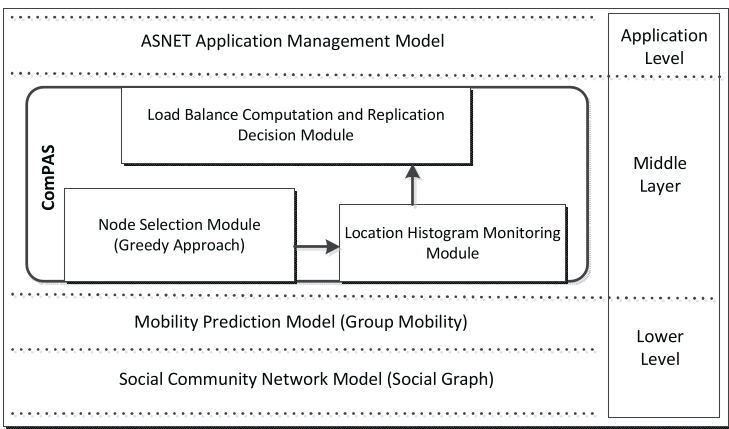
The core of ComPAS is a greedy allocation algorithm that operates within a layered system model.
The System Architecture
The ComPAS platform sits as a middleware layer between the social application and the lower-level network protocols. It monitors node mobility and social interactions to form communities.
The Greedy Selection Logic
Instead of a complex global optimization, ComPAS uses a high-efficiency greedy approach:
- Location Histogram: For a user , ComPAS identifies which communities host the most neighbors of .
- Top-X Placement: It places replicas in the most "neighbor-heavy" communities.
- Load Balancing: If two communities are equally beneficial, the system picks the one with the lowest current storage load to prevent bottlenecks.
The mathematical intuition for Read Cost () is to minimize the distance between a user and the neighbors' data they frequently access, defined by: This formula accounts for whether the neighbor's data () or a replica () is already present in the user's community.
Experiments & SOTA Comparison
The researchers compared ComPAS against W-DCG (Weighted Dynamic Bi-connected Group) and random replication strategies.
Key Performance Metrics:
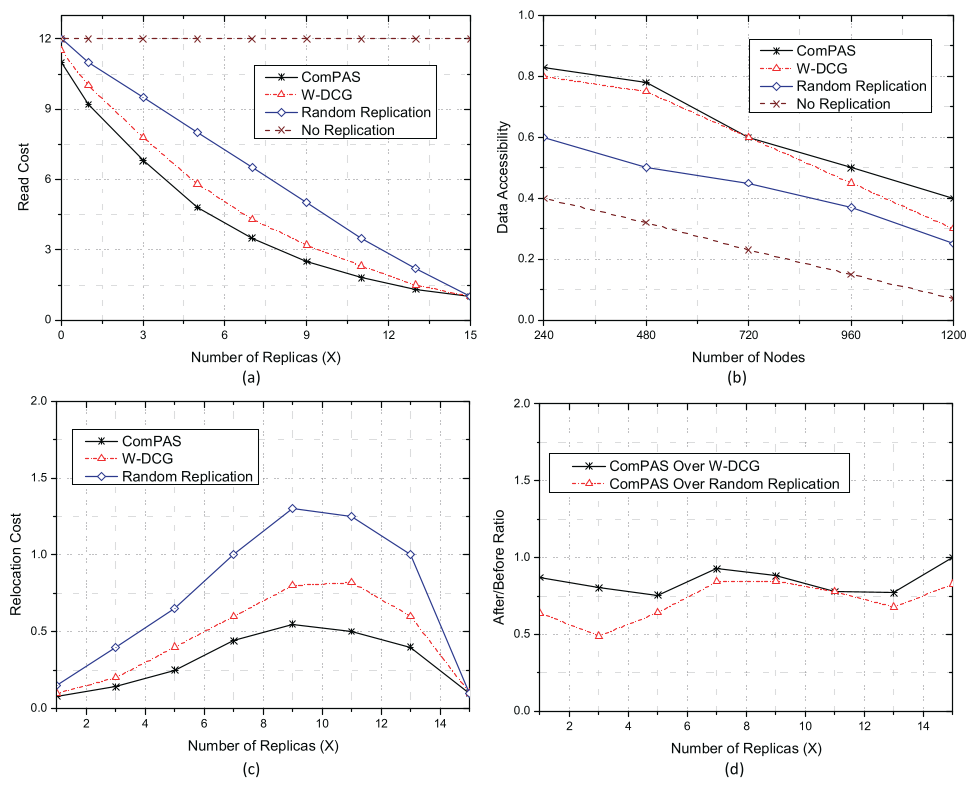
- Read Cost: ComPAS showed a clear downward trend in read costs as the number of replicas increased, significantly outperforming W-DCG.
- Relocation Cost: Unlike other methods that spike in cost when the network changes, ComPAS remains stable by placing replicas in socially stable "hubs."
- Data Accessibility: Even as the network scales to more nodes, ComPAS maintains a high success rate for data requests.
Critical Analysis & Conclusion
Takeaway: ComPAS successfully bridges the gap between social informatics and distributed systems. It proves that "social awareness" is not just a feature but a performance driver in mobile networking.
Limitations:
- Selfish Nodes: The current model assumes nodes are cooperative. In real-world ad-hoc networks, "misbehaving nodes" might refuse to host replicas to save their own battery/storage.
- User-Community Mapping: The assumption that a user belongs to only one community may be too simplistic for complex social dynamics.
Future Work: The authors plan to integrate more robust load balancing and explore cloud deployment, which could help transition ComPAS from academic ad-hoc scenarios to massive-scale Social IoT applications.