
The Strategic Power of Being Bilingual: How Limited Compatibility Shapes Technology Diffusion
The role of compatibility in the diffusion of technologies through social networks
2007-06-11
Summary
Problem
Method
Results
Takeaways
Abstract
This paper investigates the diffusion of competing technologies (e.g., IM systems, OS) in social networks by introducing a game-theoretic model of "bilingualism" or limited compatibility. The authors extend Morris's contagion model to allow nodes to adopt both technologies A and B at an extra cost, characterizing the conditions under which a new technology can achieve an epidemic spread or be blocked by existing network structures.
## TL;DR
Why do technologies like Instant Messengers or Document Formats rarely achieve 100% market dominance, even when one is clearly superior? This paper proves that **limited compatibility** acts as a strategic shield. By making it "just hard enough" to use two systems simultaneously, an incumbent technology can create stable "bilingual" boundaries in a social network that stop a competitor's cascade in its tracks.
## Background: The Limits of Binary Cascades
In classical network theory, information or technology spreads like a virus: if enough of your friends use Tool A, you switch to Tool A. This leads to a winner-take-all outcome. However, the real world is messy. We see "bilingual" regions—people who use both Mac and Windows, or Slack and Discord. Nicole Immorlica and her colleagues at Microsoft and Cornell asked: *What happens to the math of diffusion when users can choose "Both" at a cost?*
## The Innovation: The Bilingual Strategy (AB)
The authors extended the standard coordination game to include three strategies:
1. **A**: Adopt the new technology (Quality $1-q$).
2. **B**: Stay with the incumbent (Quality $q$).
3. **AB**: Maintain both systems, communicate with everyone, but pay a "bilinguality cost" $c$.
The intuition is simple: if the cost $c$ is low, everyone becomes AB; if $c$ is high, it's a winner-take-all battle. The magic happens in the middle.
## The "Aha!" Moment: Survival in the Middle
The most striking finding is the **non-convexity** of the epidemic region. Look at the "cut-out" shapes in the charts below. They demonstrate that for certain qualities of Technology A, it can only take over the world if the cost of being bilingual is either *very low* or *very high*.
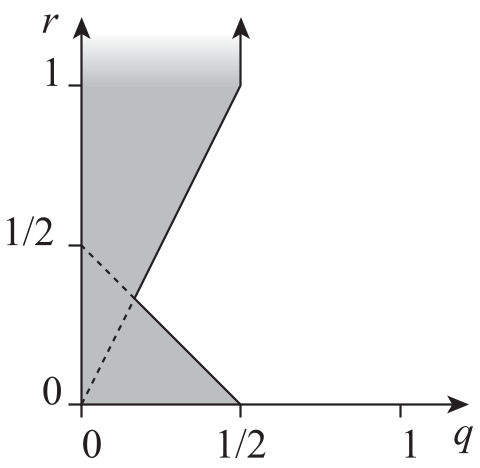
*Figure 1: Notice the triangular cut-out. If the cost 'r' is in that middle gap, the incumbent survives.*
### Why does B survive in the middle?
1. **Low $r$ (Permissive)**: It’s so cheap to have both that the whole network adopts AB. Once everyone has AB, they eventually drop B because A is "better," and they don't want to pay even a tiny cost for a redundant system. A wins.
2. **High $r$ (Inflexible)**: It’s way too expensive to have both. Every person must choose a side. Since A is better, individual rational choice causes a cascade that flips the whole network to A. A wins.
3. **Middle $r$ (The Sweet Spot)**: Users at the "border" of the two groups find it worth the cost to maintain both (AB) to talk to both sides. This AB layer acts as a buffer or "insulator," preventing the A-cascade from ever reaching the B-core. **B survives.**
## Methodology: Blocking Structures and Potential Functions
The authors don't just simulate; they provide a rigorous characterization. They define a **Blocking Structure**: a set of nodes where the internal connectivity is so tight that the incentive to switch to A is completely neutralized by the presence of a "bilingual" interface.
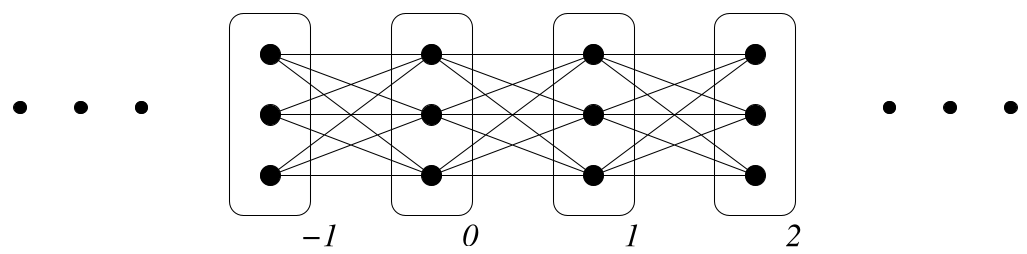
*Figure 2: The 'Thick Line' topology used to prove how cascades stop at group boundaries.*
They also utilize a **Potential Function** ($q X_{A,B} + c n_{AB}$) to prove that if Technology B is truly superior ($q > 1/2$), it is mathematically impossible for Technology A to become an epidemic, regardless of network structure.
## Expanding the Scope: Strategic Alliances
The paper extends this logic to three technologies (A, B, and C). They show that two weaker technologies (B and C) can actually survive a superior newcomer (A) by **forming a limited strategic alliance**—increasing their compatibility with *each other* just enough to form a combined front that A cannot penetrate.
## Critical Analysis & Takeaways
* **Strategic Incompatibility**: For product managers, this suggests that the goal isn't always to be 100% incompatible. Sometimes, making your product "somewhat compatible" is the only thing preventing your users from migrating entirely to a better competitor.
* **Limitations**: The model assumes an infinite $\Delta$-regular graph (every node has the same number of friends). In real-world "Scale-Free" networks (where some people have millions of followers), these boundaries might be much harder to maintain.
* **Future Work**: This framework opens the door to studying "platform wars" not just as a marketing battle, but as a topological defense game.
### Key Table: Payoff Matrix for the Bilingual Game
| | A | B | AB |
| :--- | :--- | :--- | :--- |
| **A** | $1-q$ | $0$ | $1-q$ |
| **B** | $0$ | $q$ | $q$ |
| **AB**| $(1-q)-r$ | $q-r$ | $\max(q, 1-q)-r$ |
*(Note: Payoffs are per-edge; $r$ is the normalized bilinguality cost).*