
Competition Over Timeline: The Game Theory of Social Media Visibility
Competition over timeline in social networks
The paper introduces a queueing-theoretic framework to model the competition for visibility on social network timelines. Using Continuous-Time Markov Chains (CTMC) and non-cooperative game theory, the authors characterize the equilibrium content generation rates for creators aiming to maximize their presence on a user's limited-capacity, reverse-chronological feed.
TL;DR
Social media is a battle for the "Top " slots of a user's feed. This paper treats the user's timeline as a finite queue and uses non-cooperative game theory to find the "Nash Equilibrium" of posting frequency. It reveals that creators aren't always more aggressive when competition increases; there is a critical tipping point where the effort of staying visible outweighs the rewards.
Problem & Motivation: The "Page Fold" Constraint
Despite the infinite scroll of modern apps, user attention is a finite resource. Static studies show that 80% of user time is spent above the page fold. On platforms like Twitter or Facebook's "News Feed," this creates a high-stakes environment where a brand's content is only valuable as long as it isn't pushed down by newer posts.
The authors identify a gap: while we understand how news spreads, we don't fully understand the incentives that drive creators to "spam" or "re-share" content. They ask: What is the optimal rate for a creator to post content given the competition from others?
Methodology: The Timeline as a Markov Chain
The authors define a consumer's timeline as a vector of locations.
- Stochastic Arrivals: Content from various sources arrives as a Poisson process.
- The Shifting Mechanism: Every new arrival pushes existing content down one slot. After shifts, the content vanishes.
- The Utility Function: Each creator chooses a posting rate to maximize their occupancy probability while minimizing "effort cost" .
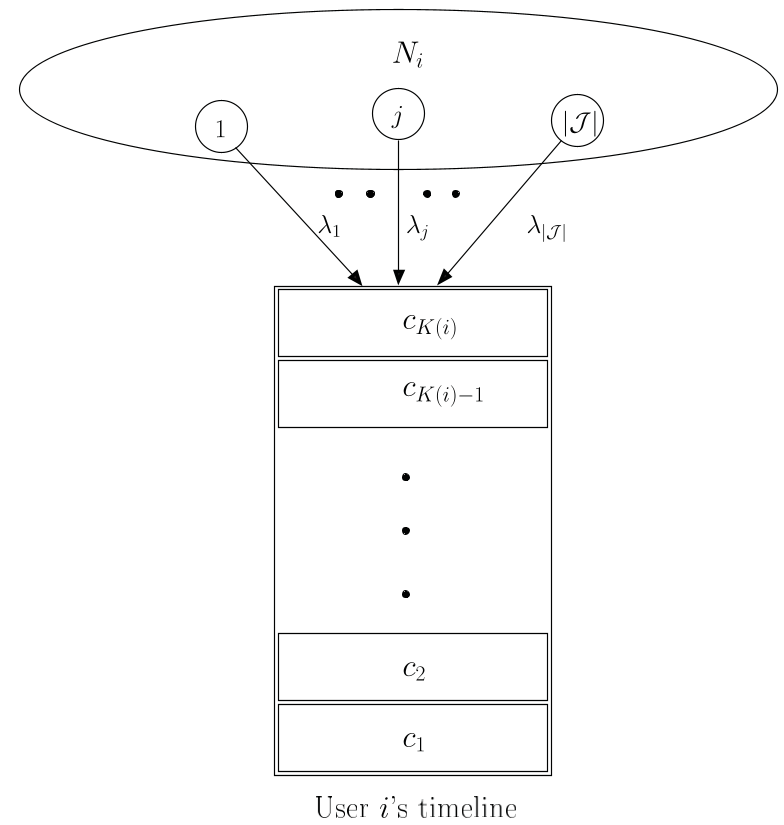 Figure 1: The Bipartite graph representing creators (J) and consumers (I), showing how multiple creators converge on a single user's timeline buffer.
The "ij-busy period"
A key contribution is the derivation of the ij-busy period, denoted as . It represents the duration during which at least one post from creator is visible to user . Using recursion, they find: where represents the ratio of competitor traffic to total traffic.
Experiments: The Tipping Point of Aggression
The paper explores a Symmetric Nash Equilibrium where all players face similar costs.
1. The Competition Paradox (Effect of )
Surprisingly, as the number of competitors () increases, creators don't stay aggressive forever.
- Small : Creators increase their rate as more competition enters to defend their "shelf space."
- Large : Once the timeline becomes too crowded, the probability of staying visible (payoff) drops so low that creators lose the incentive to post frequently, reducing .
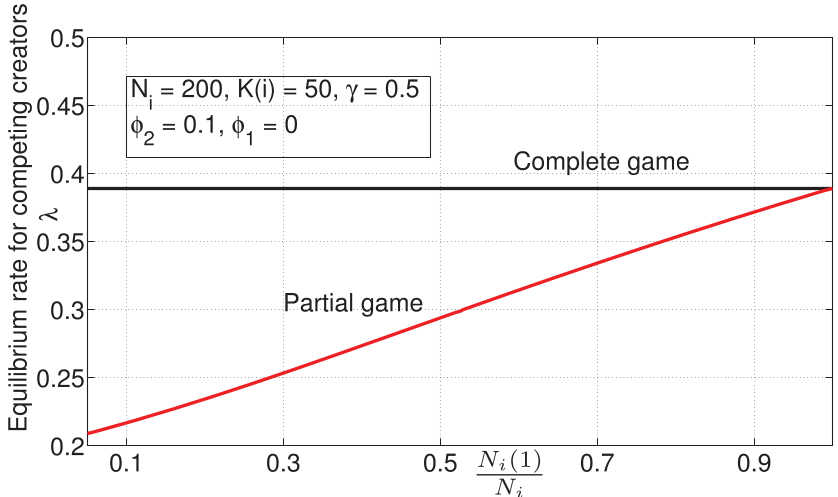 Figure 2: Equilibrium rate against number of competitors. Notice the bell-shaped curve indicating the "Threshhold of Futility."
2. Timeline Size () Effect
Similarly, increasing the timeline size (e.g., showing 50 posts instead of 10) initially encourages more posting because the "survival time" of a post increases. However, if becomes too large, the urgency drops, and the equilibrium rate stabilizes or decreases.
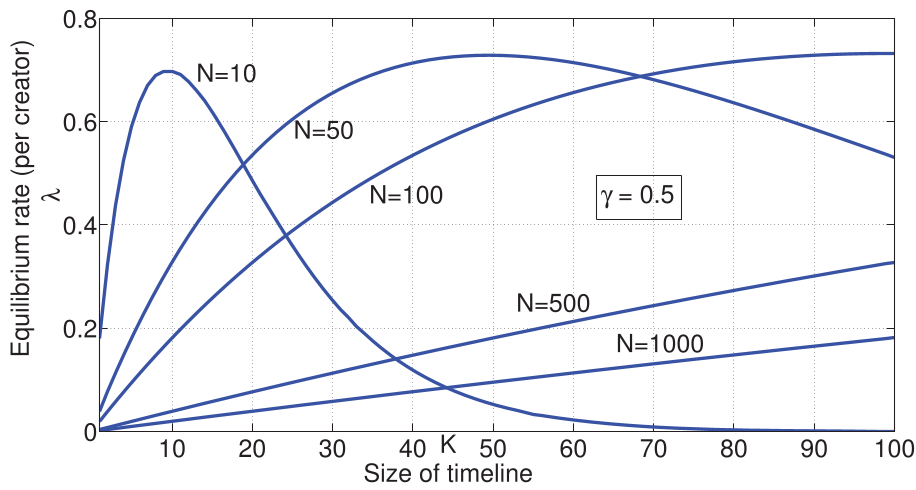 Figure 3: Equilibrium rate against timeline size . Smaller (fewer players) reach peak aggression faster.
Critical Analysis & Conclusion
Takeaways
- Strategic Posting: Brands should recognize that their optimal posting frequency is a function of the "noise" created by others they share followers with.
- Platform Control: Social media providers can manipulate creator activity levels simply by changing the UI (the size of ).
Limitations
The model assumes a reverse-chronological feed, which is increasingly rare in the age of AI-driven "For You" pages (e.g., TikTok/Instagram). In those systems, the "shift" isn't strictly caused by every new arrival, but by a ranking algorithm.
Future Outlook
The framework provides a rigorous mathematical baseline. Subsequent research could integrate User Engagement (e.g., likes/shares extending a post's life) into the Markov model, transforming it from a simple queue into a priority queue based on content quality.