
Seeding vs. Quality: The Strategic Calculus of Competitive Contagion
Competitive Diffusion in Social Networks: Quality or Seeding?
The paper introduces a game-theoretic model of competitive diffusion in social networks where two firms optimize a fixed budget between product quality and initial seeding. Utilizing a myopic best-response dynamics that leads to a linear consumption update rule, the authors characterize a unique Nash equilibrium and determine how budget disparity and network topology dictate optimal marketing strategies.
TL;DR
In a world of limited marketing budgets, should a firm build a better product or buy more "influencers"? This paper provides a mathematical framework to solve this dilemma. It shows that quality is the battlefield of equals, while seeding is the weapon of the underdog (or the dominant leader). By mapping social influence to a centrality-based game, the research identifies why certain network structures, like star graphs, demand different investment strategies than balanced, decentralized networks.
Problem & Motivation: Beyond "Spray and Pray"
Most viral marketing research asks: Which nodes should we seed? but ignores the question: Is the product actually good enough to stay viral?
The authors identify a gap in literature regarding the trade-offs between Product Quality (which provides a long-term "isolation payoff") and Seeding (which jumpstarts the "network effect"). Their intuition is that agents in a network don't just copy others; they perform a "myopic best response," balancing the utility of the product's quality against the coordination benefit of doing what their neighbors are doing.
Methodology: The Coordination Game
The researchers model the consumption dynamics as a local coordination game. If two neighbors consume the same product, they both get a payoff ( or ).
The Centrality Vector
The core of the methodology lies in the derivation of a specific centrality measure. The utility of firm is expressed as: Where is a centrality vector. This formula elegantly decouples the "network position" benefit () from the "product merit" benefit ( term).
(Note: This represents the linear update dynamics where agent consumption at is a function of the weighted adjacency matrix and the quality differential.)
Key Insights: When to Stop Improving Quality
The paper's most striking contribution is the Threshold Strategy.
- The Budget Gap: When firms have similar budgets, they enter a "quality war." Because neither can easily overwhelm the other with seeding, they invest in the product to gain a marginal edge.
- The Marginal Utility of Seeding: A firm should seed an agent only if that agent's centrality exceeds a calculated threshold .
- Diminishing Returns: Quality improvement has diminishing returns. As product quality increases, the threshold for seeding drops, making it more profitable to spend the next dollar on influencers rather than engineering.
Experiments: Star Graphs vs. Balanced Networks
The authors contrast different network topologies to see where seeding is most "profitable."
- Balanced Graphs: These are decentralized. If seeding is profitable here, it’s profitable everywhere.
- Star Graphs: These are centralized. Interestingly, the paper proves that if seeding isn't worth it for the center of a star graph, it’s not worth it for any node in any network.
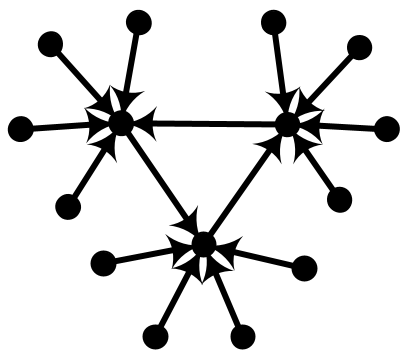 Fig 1. An "l-star" graph configuration that achieves maximum seeding capacity for a given budget.
In their numerical example, they found that in a 15-node network, a 3-star graph (a network with 3 hubs) allows for the highest seeding capacity, whereas a balanced graph (where everyone has equal influence) results in the lowest seeding investment, forcing firms to spend almost everything on quality.
Critical Analysis & Conclusion
Takeaway
The research moves marketing theory from "How to seed" to "How to allocate." It provides a rigorous proof that your social media strategy should change based on how much better your product is than the competition.
Limitations
- Myopic Agents: The model assumes agents only look one step ahead. In the real world, "early adopters" might consider the long-term trajectory of a product (e.g., picking a platform they think will be big).
- Static Quality: The model treats quality as a one-time investment, whereas in software, quality is an iterative lifecycle.
Future Work
This framework opens the door for research into Asymmetric Information—what happens if firms don't know the exact quality of the competitor's product or the exact structure of the network? Applying this to the "Platform Wars" (like TikTok vs. Reels) would be a natural next step.