
Beyond Instant Adoption: Decoding Competitive Influence via DIC and LIC Models
New Competitive Influence Propagation Models in Social Networks
The paper introduces two novel competitive influence propagation models, Deadline Independent Cascade (DIC) and Latency Independent Cascade (LIC), extending the classic Independent Cascade (IC) model to multi-entity competition. These models allow individuals to receive and process multiple influences simultaneously before making a final commitment, providing a more realistic representation of decision-making in social networks.
TL;DR
In the real world, we don't buy a product the second we see an ad; we compare options over a period of time. This paper bridges the gap between academic models and reality by introducing Deadline Independent Cascade (DIC) and Latency Independent Cascade (LIC). While DIC preserves the "nice" mathematical properties (submodularity) that allow for efficient optimization, LIC breaks these rules, revealing why competitive marketing is so unpredictable.
Problem & Motivation: The Flaws of Immediate Activation
Early models like the Independent Cascade (IC) treat influence like a virus: if you are "infected," you immediately become a carrier. In a competitive social network (e.g., iPhone vs. Android), this is unrealistic.
The authors identify two major gaps in prior work:
- The Time Window Ignorance: Most models don't account for the period where a consumer is "active" (interested) but not yet "decided" (loyal).
- Data Asymmetry: Competitive strategies often assume players know the whole network graph, which is rarely true for third-party advertisers.
The authors' insight is to decouple Activation from Decision, allowing a node to "remember" all competing influences received during a transition period.
Methodology: DIC vs. LIC
The core of the paper lies in how the decision window is defined.
1. Deadline Independent Cascade (DIC)
In DIC, every node has a hard deadline .
- Mechanism: A node collects all successful activations from different colors (competitors) until .
- Decision: The probability of choosing color is proportional to the number of neighbors who successfully sent color to it.
- Physical Intuition: Like a scheduled election. You have until election day to hear arguments; on that day, you vote based on the "volume" of influence you received.
2. Latency Independent Cascade (LIC)
In LIC, the clock starts only when you first hear the news.
- Mechanism: Once node is first hit by any influence at time , it waits for a duration (Latency).
- Decision: It makes a choice at .
- Physical Intuition: Like buying a car. You don't care about cars until you see one you like; then you spend two weeks researching competitors before buying.
 The probability formula used to determine the final influence adoption based on proportional neighbor pressure.
The Mathematical Divide: Monotony and Submodularity
The most significant contribution of this work is the proof of combinatorial properties, which determines if we can actually solve these problems effectively.
The "Good" News: DIC is Submodular
The authors prove that in DIC, adding more seeds always increases (or keeps equal) the expected influence (Monotony), and the marginal gain of adding a seed decreases as the seed set grows (Submodularity).
- Impact: This means the classic Greedy Algorithm is near-optimal, providing a approximation. The "last mover" in a competition can use this to optimize their entry strategy.
The "Bad" News: LIC is a Chaos Element
Through clever counterexamples, the paper demonstrates that LIC is neither monotone nor submodular.
- Why? Because in LIC, adding a seed might speed up the "first hit" time for a node, causing its latency window to close before other, more influential nodes can reach it. In essence, trying too hard to influence someone early might backfire by shortening their decision window.
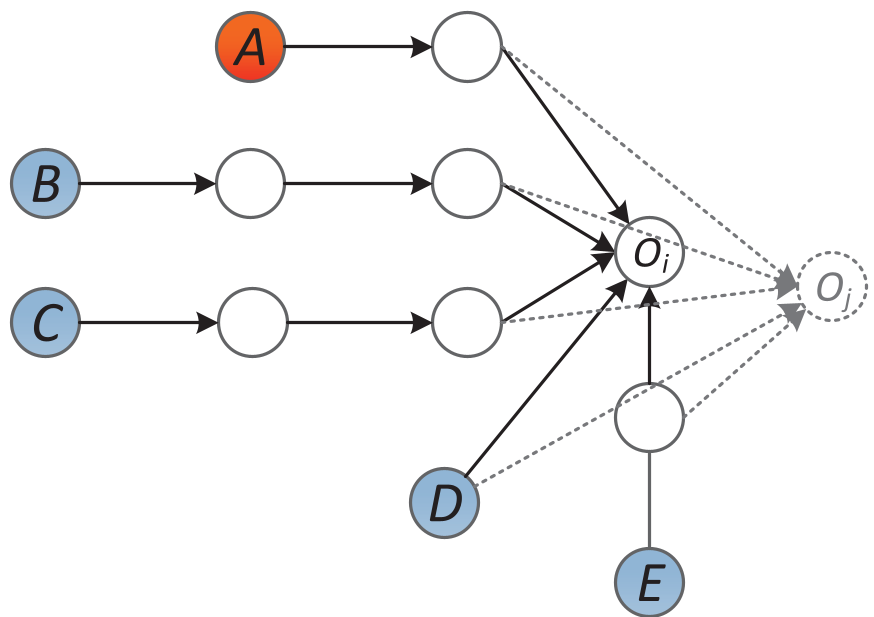 Fig 2: A sample network showing how adding seeds can actually decrease total influence in LIC models.
Critical Analysis & Conclusion
Takeaway
This paper serves as a warning to marketers: Timing is everything. If your target audience behaves according to a "Latency" model (researching only after first contact), being the first to reach them might actually reduce your total influence if it cuts off the path for your other supportive signals.
Limitations & Future Work
- Static Parameters: The deadlines and latencies are fixed integers. Real-world social pressure might suggest these windows should be dynamic or dependent on the intensity of influence.
- Algorithmic Gap: Since LIC is not submodular, the paper leaves the door open for new heuristic or non-submodular optimization techniques (like Sandwich Approximation) to find better strategies in trigger-based environments.
In summary, while DIC offers a safe haven for traditional optimization, LIC highlights the treacherous and non-linear nature of real-world social competition.