
Beyond Check-ins: Leveraging the Power of Tips and Reviews for Smarter Location Discovery
Complementary Usage of Tips and Reviews for Location Recommendation in Yelp
This paper introduces a graph-based location recommendation framework for Yelp that prioritizes "tips" and "reviews" over traditional "check-in" data. By modeling users and locations as a multilayer graph with novel semantic and geographic links, the authors achieve a 15% precision improvement over state-of-the-art baselines like NMF and G-Local.
TL;DR
While most location-based social networks (LBSNs) rely on check-in frequency to guess what you like, this paper argues that what you say matters more than how often you show up. By treating Yelp "tips" and "reviews" as distinct signals in a multilayer graph, the authors achieved a 15% boost in recommendation precision, proving that short-form tips and long-form reviews offer complementary insights into user behavior.
The "Loudness" vs. "Depth" Problem
Existing systems (like those built for Foursquare) are check-in heavy. However, a check-in is a low-effort action. In contrast, writing a review or a tip on Yelp requires cognitive effort.
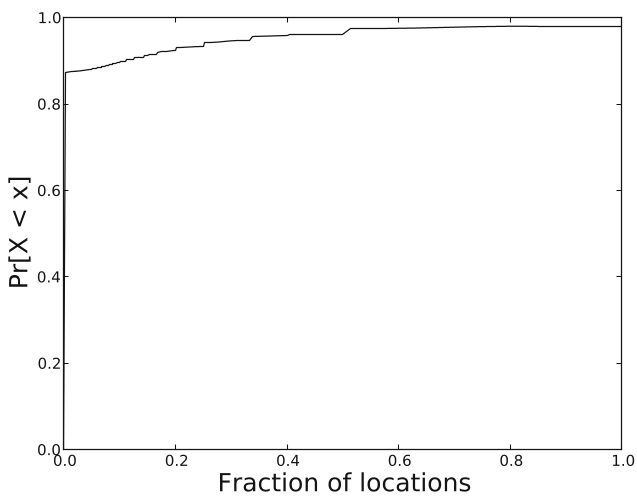
The authors discovered a fascinating behavioral split: 80% of users rarely write both a tip and a review for the same place. Furthermore, venues users "tip" about are geographically closer together than the venues they "review." This suggests that tips and reviews represent different "preference spaces" that must be unified to solve the data sparsity problem common in recommendation tasks.
Methodology: A Multilayer Graph Approach
The core of the paper is a graph where users and locations are nodes, but the magic lies in how the edges are weighted.
1. Entropy-Based User Links (UUT/UUR)
Instead of just saying "User A and B are similar because they both visited the airport," the model uses Tip/Review Entropy.
- If a location has many casual visitors (high entropy, like an airport), a shared visit doesn't mean much.
- If a location has few, dedicated tip-writers (low entropy, like a niche jazz club), a shared visit indicates a strong similarity in taste.
2. Intelligent Distance Modeling (LLD)
Previous works connect a location to its k nearest neighbors. This paper argues that's too noisy. They only create a distance-based edge between two locations if at least one user has visited both. This ensures that the geographic link is grounded in actual human movement patterns.
Experiments & Results: Crushing the Baselines
The framework was tested on the Yelp Phoenix dataset (335,000+ reviews). The performance was compared against NMF (Matrix Factorization) and G-Local.
| Metric | Our Framework | NMF (Best Baseline) | Improvement |
|---|---|---|---|
| Precision@5 | 0.0779 | 0.0687 | ~13.4% |
| Precision@10 | 0.0673 | 0.0584 | ~15.2% |
One of the most striking findings from the ablation study was the unimportance of social circles. Friendship links (UUF) had the lowest impact on recommendation accuracy, suggesting that in location discovery, your physical distance and textual "taste" are far more predictive than who you follow.

Critical Insight: Why This Works
The success of this method lies in its Inductive Bias. By forcing the graph to recognize the difference between a "tip" (identifying standout features) and a "review" (detailed experience), the model captures nuance that simple check-in counters miss.
The Conditional Distance Link is also a masterstroke in noise reduction—it prevents the "Spelling Bee" effect where a system might recommend a nearby gas station just because it's next to your favorite restaurant, focusing instead on semantically linked venues.
Future Outlook
While the current model uses tip/review frequency, it doesn't dive into Natural Language Processing (NLP). The next step for this research is clearly the integration of LLMs or sentiment analysis to understand what the reviews say, rather than just that they exist.
If you are building a recommendation engine for sparse datasets, the takeaway is clear: stop counting visits, and start weighing the effort behind the interaction.