
Beyond Simple Matching: Tackling Task Dependencies in Spatial Crowdsourcing
Complex Task Allocation in Spatial Crowdsourcing: A Task Graph Perspective
This paper introduces the Task Graph Assignment in Spatial Crowdsourcing (TGA-SC) problem, which models complex tasks as Directed Acyclic Graphs (DAGs) to capture subtask dependencies. The authors propose two heuristic algorithms, RwalkS (Random Walk-based) and LayGA (Layered Genetic Algorithm), to minimize total makespan and worker idle time.
TL;DR
Spatial Crowdsourcing (SC) is evolving from simple delivery tasks to complex professional services (like car repair or event setup). This paper introduces TGA-SC, a framework that treats complex tasks as Directed Acyclic Graphs (DAGs). By implementing two novel heuristics—RwalkS and LayGA—the researchers successfully minimized both the total time to finish (Makespan) and the wasted time (Idle Time) by considering both subtask dependencies and the physical location of workers.
Context: Why "Independent Tasks" is a Flawed Assumption
Most existing SC platforms (like Uber or TaskRabbit) treat every task as an island. However, in reality, you can't paint a wall before the plaster is dry. These precedence constraints create a bottleneck: if worker A is slow on subtask 1, worker B (waiting for subtask 2) remains idle. In a spatial context, this is even harder because worker B also has to travel to the specific location.
The authors identify that ignoring these dependencies leads to massive inefficiencies. They bridge the gap between Distributed Computing (which understands DAGs) and Spatial Crowdsourcing (which understands geography).
Methodology: Mapping Graphs to the Real World
The paper formalizes the problem by defining a Complex SC Task as a set of subtasks connected by edges . A worker can only start a task once all its "predecessors" are finished.
1. RwalkS (Random Walk-based Assignment)
Instead of a linear search, RwalkS traverses the graph.
- Forward Walk: Selects the next available subtask based on a probability distribution that favors "critical" nodes (those with many successors).
- Reverse Walk: If the algorithm gets stuck on a non-ready task, it performs a "Reverse Walk" to find other tasks that are ready for execution, ensuring the system doesn't stall.
2. LayGA (Layered Genetic Algorithm)
The solution space for matching interdependent tasks to workers is astronomically large. Global Genetic Algorithms (GloGA) often fail to converge.
- Divide-and-Conquer: LayGA breaks the graph into Layers.
- Layer-wise Optimization: It runs a genetic evolution for tasks within Layer 1, then Layer 2, and so on. This ensures that the search stays focused on immediate dependencies while moving toward the global goal.
 Note: The figure above illustrates the transition from a complex outsourced task to a DAG-based subtask structure assigned to mobile workers.
Experimental Insights
The researchers tested their methods on two distinct scales:
- Campus Scale (StudentLife data): Low travel overhead.
- City Scale (Chengdu Taxi data): High travel overhead.
Key Findings:
- LayGA is the winner: By optimizing layer-by-layer, it avoids the "local optima" trap that standard genetic algorithms fall into.
- The Travel Cost Impact: In city-scale experiments (E3 and E4), the "Makespan" was nearly double that of campus experiments, highlighting that spatial distance is the dominant factor in complex task completion.
- Clustering Failure: Traditional clustering (ClustS), which tries to give many tasks to one worker to save travel time, failed miserably in DAG scenarios because it ignored when the tasks were actually ready to be performed, leading to massive idle times.
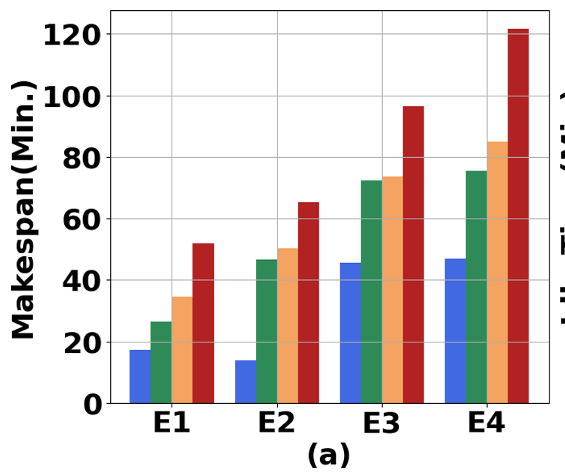 Fig 1: Experimental results showing LayGA and RwalkS significantly outperforming standard DAG scheduling baselines in both makespan and idle time reduction.
Deep Dive: The Skill-Time Tradeoff
The paper uses an interesting exponential function to model execution time based on worker skills back-to-back with travel time. This creates a realistic "Utility Function": This balance () ensures the platform doesn't just pick the closest worker, but the best-qualified worker who can arrive exactly when the task is ready.
Conclusion & Future Outlook
This work marks a shift toward "Professional Spatial Crowdsourcing." By treating tasks as interdependent graphs, we can finally coordinate complex multi-stage projects in the physical world.
Limitations: The current model assumes worker speeds and task requirements are static. Future research should look into stochastic environments where a worker might get stuck in traffic, requiring the DAG to be re-scheduled in real-time.