
Decoding the Cyclophilin Superfamily: A Lean Approach to Protein Classification
A Computational Analysis of Protein Sequences for Cyclophilin Superfamily using Feature Extraction
This paper presents a computational framework for the classification of protein sequences within the Cyclophilin superfamily. It introduces a specific feature extraction method that transforms variable-length biological sequences into fixed-size numeric vectors of 6 dimensions based on local and global similarity measures, followed by evaluation using SVM, K-NN, and Naïve-Bayes classifiers.
TL;DR
Researchers have developed a highly efficient way to classify protein sequences by condensing complex, variable-length amino acid chains into just six key numerical features. Using a combination of global and local similarity metrics and biological "Exchange Groups," the team achieved up to 100% accuracy in classifying plant subfamilies like Fabaceae using standard algorithms like K-NN and SVM.
Background & Motivation: The Biological Needle in the Data Haystack
In the era of genomic sequencing, we are drowning in data. Proteins, the workhorses of the cell, are represented as long strings of 20 different amino acids. However, a major bottleneck in Bioinformatics is Representation Learning: how do you turn a sequence of "letters" (A, G, V, L...) of different lengths into a fixed-size format that a computer can understand?
The authors focus on Cyclophilins (CYPs), a superfamily of proteins vital for protein folding and cellular function. Specifically, they looked at soybean genomes. The goal was to build a system that can accurately identify which subfamily a sequence belongs to, which is a critical step in drug discovery and agricultural trait improvement.
Methodology: High Compression via Biological Intuition
The core innovation lies in the feature extraction pipeline, which moves away from computationally heavy 2-gram or deep learning methods toward a "biologically informed" compression.
1. Global vs. Local Similarity
- Global Similarity: This captures the probability of an amino acid appearing at a specific position across the entire superfamily. It answers: "How common is Alanine at position 10 in all Cyclophilins?"
- Local Similarity: This focuses on the individual sequence, weighting amino acids based on their position-specific occurrence.
2. The Power of Exchange Groups
Instead of treating each of the 20 amino acids as independent variables, the authors grouped them into 6 Exchange Groups (e.g., , ). These groups represent amino acids that can often replace one another during evolution without destroying the protein's function.
The Resulting Vector: By summing the weights of amino acids belonging to each group, every sequence is reduced to a simple 6-dimensional vector.
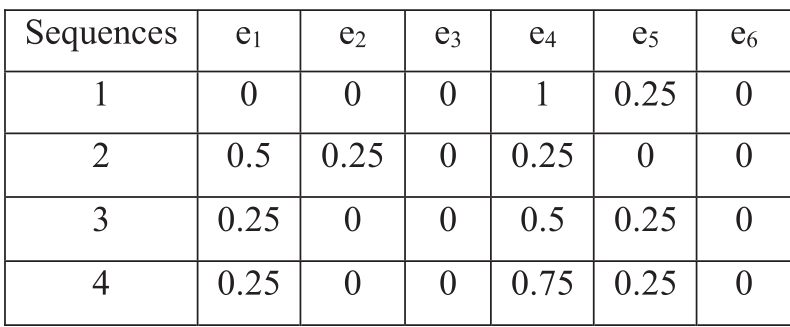 Table: Sample of encoded feature vectors (e1-e6) for protein sequences.
Experiments and Performance
The team tested the approach on two specific subfamilies: Fabaceae and Brassicaceae. They compared three classic classifiers: Support Vector Machines (SVM), K-Nearest Neighbors (K-NN), and Naïve-Bayes (NB).
Key Findings:
- K-NN Dominance: For the Fabaceae subfamily (60-40 split), K-NN achieved a perfect 100% accuracy.
- SVM Reliability: SVM showed consistent performance across both datasets, particularly excelling in the larger Brassicaceae dataset with 99.17% accuracy.
- Efficiency: Because the feature vector is only 6-D, the "Total Computational Time" (TCT) was remarkably low, often under 2 seconds for the entire classification task.
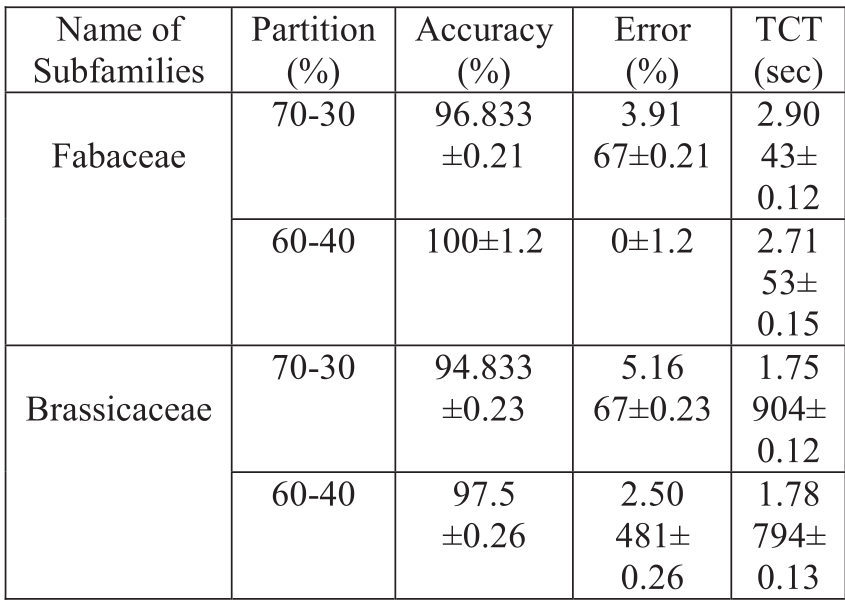 Table: Experimental results showing high accuracy and low error rates for the K-NN classifier.
Critical Analysis: Why This Matters
The most impressive takeaway is that dimensionality reduction doesn't have to mean information loss. While recent trends in AI favor "End-to-End" deep learning where the model learns the features itself, this paper proves that expert-driven feature engineering (using biological exchange groups) can produce a model that is:
- Interpretable: We know exactly why a protein was classified based on its exchange group weight.
- Lightweight: It can run on basic hardware without needing GPUs.
- Accurate: Outperforming many complex methods on specialized datasets.
Limitations: The study is currently focused on the Cyclophilin superfamily. While the "Exchange Group" logic is universal, the position-specific weightings might need significant recalibration for more diverse or highly mutated protein families.
Conclusion
This work demonstrates that simple, elegant mathematical representations of biological properties can solve complex classification problems. As we look toward the future of "Precision Agriculture" and "Personalized Medicine," these efficient computational tools will be essential for real-time genomic analysis.