
Decoding the Infant Brain: Dissociating Growth from Individuality
A Computational Framework for Dissociating Development-Related from Individually Variable Flexibility in Regional Modularity Assignment in Early Infancy
This paper presents a novel across-subject across-age multilayer network framework to study infant brain functional development. Using rs-fMRI data from 207 infants (0-2 years), the study introduces an automated community detection method to dissociate age-dependent "mode flexibility" from individual-specific "unlikability" in regional brain modularity.
TL;DR
Researchers have developed a new computational framework that finally separates how the brain matures with age from how it differs between individuals during the critical first two years of life. By analyzing 435 rs-fMRI scans using a sophisticated "multilayer network" approach, the team identified which brain regions are hard-wired by biology and which are uniquely shaped by an infant's personal journey.
Background: The "Averaging" Trap
In the world of developmental neuroscience, we often ask: "What does a typical 6-month-old's brain look like?" To answer this, researchers usually average data across dozens of babies. While this reveals general growth trends, it ignores the "individual fingerprint." This paper argues that age is a simplistic lens; factors like nutrition, environment, and genetics create a high degree of individual variability that group averages simply erase.
The Problem: Merging Two Different Signals
Existing methods struggle to distinguish between:
- Development-Related Change: Systematic rewiring that happens as every human brain matures.
- Individual Specificity: The unique topological variations that distinguish one baby from another at the very same age.
Why is this hard? Because modularity (how the brain organizes into functional "communities") is dynamic. If you use fixed parameters, you might miss the hierarchical nature of the brain. If you don't link subjects together in your analysis, you lose the ability to compare them consistently.
Methodology: Automated Multilayer Networks
The authors propose a framework using Multilayer Network-Based Modularity Detection.
1. The Multi-layer Supra-adjacency Matrix
Instead of analyzing each baby in isolation, they build a massive network where each "layer" is an individual's Functional Connectivity (FC) matrix. These layers are connected to one another, allowing the algorithm to find communities that are consistent across the group while still allowing for individual deviations.
2. Automated Optimization
A major innovation here is the Automated Heuristic Parameter Optimization. The Gen-Louvain algorithm depends on two sensitivity parameters: (resolution) and (coupling). Rather than picking these manually (which introduces bias), the authors calculated heatmaps of community numbers () and similarity () to find the most "robust" islands of stability.
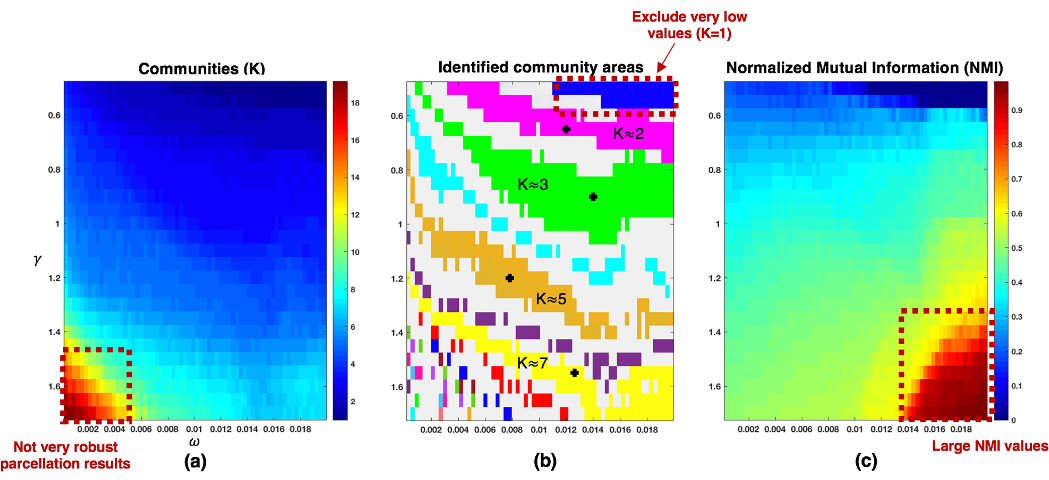 Fig 1: Heatmaps used to optimize and for robust community detection.
3. Mode Flexibility vs. Unlikability
- Mode Flexibility (): Does the "standard" modular assignment of a region change as the infant grows older? This measures Age Dependency.
- Unlikability (): How different are individuals from the "mode" within a narrow age window? This measures Individual Variability.
Key Results: Five Types of Brain Regions
The study mapped every brain region into a 2D space of "Age Effect" vs. "Individual Effect." This led to a fascinating five-category taxonomy:
- The Stabilizers (Low Age Effect, Low Individuality): Primary visual areas and the limbic system (e.g., Amygdala). These are the fundamental kernels of the brain—consistent across everyone and stable throughout early growth.
- The Transformers (High Age Effect, High Individuality): The lateral parietal cortices and parts of the "Task Executive Network." These regions are the most "plastic," changing significantly with age and varying wildly between individuals.
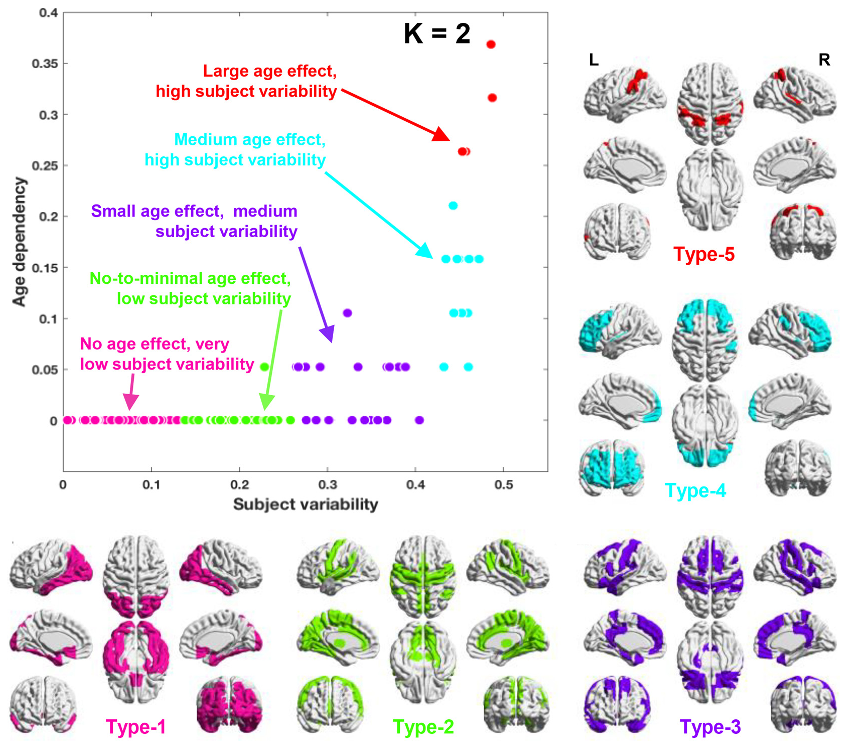 Fig 2: Classification of brain regions based on variability sources for K=2.
One of the most striking findings is that High-Order Cognition areas (like the superior parietal lobule) exhibit the highest unlikability. This suggests that the parts of our brain responsible for complex reasoning and attention are exactly where our unique individual "personalities" start to manifest first.
Critical Insights & Future Outlook
This work shifts the focus from "group averages" to "individual trajectories."
Why it matters
- Early Detection: If we know how much a region should vary among healthy infants, we can more easily spot outliers that might indicate neurodevelopmental disorders like Autism or ADHD.
- Hierarchical Understanding: By testing multiple scales ( to ), the authors proved that individual variability increases as we look at finer modular structures.
Limitations
While the sample size (435 scans) is impressive for infant research, the study acknowledges that some "individual variability" might still include subtle age effects. Furthermore, the link between these functional "categories" and actual behavioral outcomes (like IQ or temperament) is the logical next step for this research line.
Conclusion
The infant brain is not just a growing machine; it is a diversifying one. By dissociating age from individuality, this framework provides a powerful lens to observe how the human "functional fingerprint" emerges from the universal blueprint of development.