
Computational Linguistics Education: Bridging the Divide Between Human Language and Machine Logic
An exploration on computational linguistics in teaching practice
This paper explores the pedagogical methodologies of "Computational Linguistics" in a university setting, focusing on the curriculum at Shanxi University. It details a balanced approach between theoretical "Elementary Knowledge" (segmentation, POS tagging) and practical "Scientific Research Ability" (QA system development) to address the needs of the emerging information age.
TL;DR
This paper provides a historical and pedagogical deep dive into the "Computational Linguistics" curriculum at Shanxi University. It advocates for a teaching model that balances rigorous linguistic norms with hands-on computational implementation. By moving beyond passive learning to active research (e.g., building QA systems), the authors aim to produce "amphibious" experts capable of navigating the intersection of computer science, linguistics, and mathematics.
The Motivation: Why Teaching CL is a Unique Challenge
Computational Linguistics (CL) is not just "coding for words." It is the product of ancient linguistics meeting emerging computer science.
As noted by the authors, CL resides at a complex intersection:
- For Computer Scientists: Language is a non-numerical computation problem, requiring new formalization models.
- For Linguists: It demands a shift from studying language for humans to studying language for machines.
The core pain point is the Silo Effect: Mathematicians need linguists for data, linguists need computer scientists for tools, and computer scientists need mathematicians for theory. The curriculum's goal is to synthesize these roles into a single "amphibious" scholar.
Methodology: The Shanxi University Framework
The authors break down their teaching practice into two pillars: Elementary Knowledge and Research Ability.
1. The Anatomy of Lemmatization
Before diving into complex AI, students must master the "atomic" level of CL: Segmentation and Part-of-Speech (POS) Tagging.
- Norm Sensitivity: Students analyze different standards (e.g., Beijing University vs. National Language Committee norms) to understand that "truth" in language processing is often relative to the chosen framework.
- The "Human-in-the-Loop" Experience: Students are required to manually annotate texts before coding, forcing them to confront ambiguities (person names, location names, unknown words) that machines struggle with.
2. Theoretical to Applied: The QA System Project
To elevate students from "learners" to "researchers," the course utilizes a milestone project: Developing a Question-Answer (QA) system based on Case Grammar.
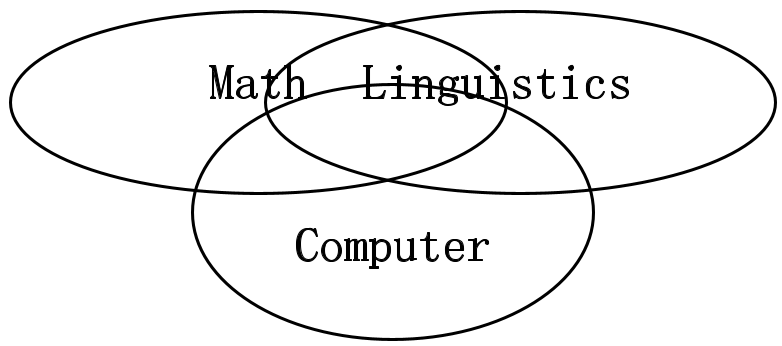 Figure 1: The interdisciplinary nature of CL, showing the convergence of linguistics, mathematics, and CS.
By building this system from scratch—from literature review to experimental evaluation—students build the "solid foundation" needed for SOTA research.
Results & Evidence: From Classroom to Global Competition
The efficacy of this curriculum isn't just theoretical. The tools developed by the teaching group and their students (using the software and corpora described in the paper) provided the evaluation data for Bakeoff 2007, an international competition for Chinese language processing. This demonstrates that the "Shanxi University Model" successfully translates classroom teaching into high-impact research output.
Note: The paper highlights the success of their independent segmentation software in international evaluations.
Critical Analysis: The Bottleneck and the Future
The authors offer a strikingly prescient insight (considering this was written in 2008): The Bottleneck of Logic and Statistics.
They argue that relying solely on grammar, logic, and pure statistics (the "Big Three" of 2000s NLP) may eventually hit a plateau. To break through, they suggest:
- Exploring Semantics and Cognitive Science: Moving beyond surface-level patterns to deep understanding.
- Training "Amphibious" Talent: The industry needs people who don't just use libraries but understand the underlying linguistic philosophy and mathematical constraints.
Limitations
While the paper provides a robust pedagogical framework, it is naturally limited by its era (2008). It focuses heavily on rule-based and early statistical methods. Modern readers might find the lack of "Deep Learning" or "Transformer" architectures dated, yet the core logic—that one must understand linguistic norms to build better models—remains more relevant than ever in the age of Hallucination-prone LLMs.
Conclusion: Takeaway for the Modern AI Era
The "Shanxi University Exploration" reminds us that the essence of Computational Linguistics is "studying language by the computer and for the computer." Whether we are training Llama-3 or a 2008 segmentation model, the requirement for logic, formalization, and interdisciplinary mastery remains the same.
To stay at the "forefront of the discipline," we must continue to produce researchers who can speak both the language of humans and the logic of machines.