
Unified Emotion Modeling: Breaking the Interdisciplinary Silo between Psychology and AI
Computational Modeling of Emotion: Toward Improving the Inter- and Intradisciplinary Exchange
This seminal paper proposes a unified framework for the computational modeling of emotion, bridging the gap between psychology and computer science. It advocates for the modularization of emotion theories, their formalization in implementation-independent languages (Set Theory and Agent Logics), and their integration into general cognitive architectures like Soar, ACT-R, and BDI.
TL;DR
Computational emotion modeling is often a "reinventing the wheel" exercise. This paper argues that for AI to truly "have" or simulate emotions, we must stop building one-off models and start using formal languages and unified cognitive architectures. By deconstructing emotions into Beliefs, Desires, and Intentions (BDI), researchers can create modular, reusable components that translate vague psychological theories into rigorous code.
The "Emotion Paradox" in Modern AI
Despite the explosion of Interest in Affective Computing, psychology and computer science remain two ships passing in the night. Psychologists possess over 150 theories of emotion—most of which are too linguistically fuzzy to program. Meanwhile, AI researchers build "emotional" agents that are essentially reactive black boxes, disconnected from the cumulative wisdom of cognitive science.
The authors point out a glaring issue: Theoretical Fragmentation. For instance, the popular OCC theory of emotion has been implemented dozens of times, yet no two implementations are identical because the original theory doesn't specify the underlying computational "gears."
Methodology: The Vertical and Horizontal Deconstruction
To fix this, the paper proposes a systematic "reverse-engineering" of the human emotion system. This involves a two-axis approach:
- Horizontal Division: Mapping the flow of information from perception appraisal emotion generation behavioral effect.
- Vertical Division: Distinguishing between the Intentional Level (the "What": beliefs about fear or joy) and the Design Level (the "How": the symbolic representations and data structures).
1. Formalization via Agent Logics
The authors champion the use of BDI Logics (Belief-Desire-Intention). In this view, emotion isn't some mystical "extra" but a functional state triggered by the interaction of an agent's knowledge and its goals.
- Joy: Believing a desired goal has been reached.
- Distress: Believing an undesired state has occurred.
By using formal logic (like KARO or Set Theory), we can define these states with mathematical precision.
 Figure 1: Deconstructing emotion generation into linked computational functions.
Architecture: Where the Rubber Meets the Road
The paper evaluates how emotions can be "plugged into" existing cognitive architectures:
- Soar & EMA: The EMA (Emotion and Adaptation) model uses Soar’s production rules to simulate appraisal. It treats appraisals as "elaboration" productions that fire in parallel, mimicking the speed of human intuition.
- ACT-R: This architecture focuses on memory and procedural knowledge. Here, emotions like "worry" are modeled by introducing task-irrelevant productions that compete for working memory resources—a highly plausible model of how anxiety inhibits performance.
- MAMID: A specialized "affective" architecture that uses linear combinations of factors to compute the intensity and valence of emotions, allowing for complex social modeling.
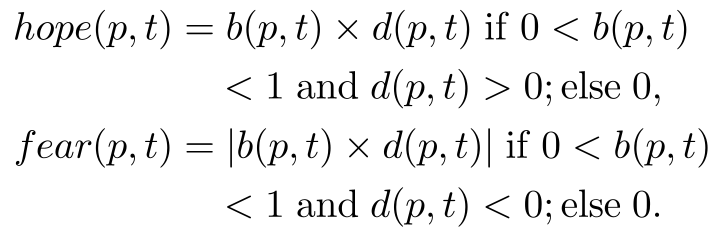 Example: A set-theoretic formalization of Hope and Fear based on probability and desirability.
Key Insights and Results
The experiments cited show that when agents are "emotion-enhanced":
- Resource Allocation is better: Emotions act as a "heuristic" to tell the agent which goals to prioritize in a dynamic environment.
- Predictability improves: Formalizing the OCC model revealed hidden ambiguities—for instance, whether "disappointment" requires a metacognition (a belief about a previous belief). Formalization forces us to answer these "hard" questions.
Conclusion: A Modular Future
The ultimate takeaway is a call for Unification. Rather than every researcher claiming they have the "best" emotion theory, the community should build a "theoretical toolbox" of basic elements.
Limitations: The paper primarily focuses on symbolic AI. As we move into the era of Large Language Models (LLMs) and Deep Learning, the challenge remains: how do we map these rigorous symbolic BDI structures onto the "black-box" weights of a neural network?
For the field to advance, we need to treat emotion not as a feeling in the machine, but as a critical computational mechanism for survival.