
CMEs: Why Emotional AI Needs a Software Engineering Revolution
Development of computational models of emotions: A software engineering perspective
This paper provides a critical review of Computational Models of Emotions (CMEs) through the lens of Software Engineering (SE). It analyzes how existing models (like WASABI, ALMA, and EMA) are developed and proposes a shift from informal research-driven procedures to formal, standardized SE methodologies to improve reusability and scalability.
TL;DR
Computational Models of Emotions (CMEs) are the "brains" behind affective AI, but their development is currently a "Wild West." This paper argues that the secret to better emotional agents isn't more psychology—it's better Software Engineering (SE). By applying rigorous SE phases (Requirements to Testing), we can move from experimental "one-offs" to reusable, scalable emotional modules.
Background: The Gap Between Theory and Code
Currently, building a CME is an informal process. A researcher picks a theory (like Appraisal or Dimensional theory), interprets it, and hard-codes it into an agent. The result? A model that works in one specific simulation but is impossible to transplant into another. The authors position this work as a "reality check," moving the field from purely academic modeling toward Software Engineering maturity.
The Problem: The "Informality" Trap
The paper identifies a recurring pain point: Requirements Infidelity.
- Prior Work Problem: Researchers often act as both the "client" and the "developer," leading to biased requirements that ignore non-functional needs like latency or memory efficiency.
- The Struggle: Since emotion theories (like OCC or PAD) are written for humans, translating them into discrete algorithms leads to "gaps" that are often filled with ad-hoc code rather than robust architecture.
Methodology: Mapping Emotions to Engineering
The authors propose analyzing CMEs through five standard SE phases. The core insight is that an emotion model is, at its heart, a data-processing pipeline.
1. Requirements Analysis
They categorize requirements into:
- Domain-Specific: Needs of the application (e.g., a "waiter robot" needs social etiquette).
- Theory-Driven: Constraints from psychology (e.g., "emotions must decay over time").
2. Architectural Design
The paper emphasizes the need for Component-Level Design. Instead of a monolithic block of code, a CME should have clear interfaces.
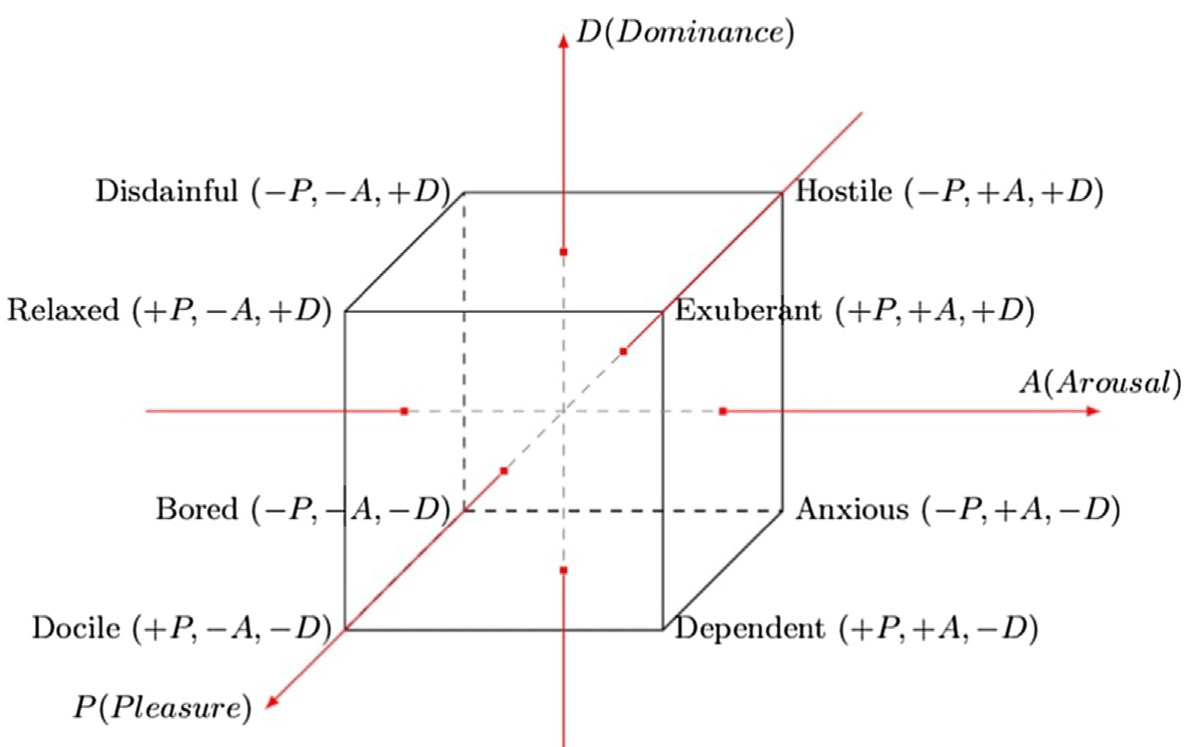 Figure: The Evolution of Architectural Design in CMEs (DeepEmotion Example)
The INFRA (Integrative Framework) is highlighted as a success story because it uses "Provides" and "Requires" interfaces, allowing the "Emotion Filter" to communicate with the "Internal Memory" without being hard-coupled.
Experiments & Results: The "Testing" Reality
Most CMEs are validated via "Scenarios" (e.g., Pacman-like simulations).
- SOTA Comparison: While traditional software uses Unit Tests and Integration Tests, CMEs use Qualitative Simulations.
- The Missing Link: The authors find a severe lack of open-source code and standardized validation frameworks. To improve, we need "Standard Criteria" that allow different models to be compared on the same benchmark.
 Figure: Standardized Mapping of Emotions to PAD (Pleasure, Arousal, Dominance) Values - A step toward homogenization.
Critical Insight: The 6 Challenges
The authors conclude with a roadmap for the future. The most critical takeaway is the need for Homogenization. Until we agree on what a "Mood" component looks like at the interface level, we will keep reinventing the wheel.
Summary & Conclusion
This paper is a call to arms for AI researchers: Stop just building models; start engineering software. By adopting modularity, formal UML documentation, and standardized test cases, we can create affective agents that are not only "believable" but also maintainable and interoperable.
Limitations: The paper notes that "Maintenance" is almost non-existent in CME literature—models are published and abandoned. Future Work: The creation of a "Formal Software Engineering Methodology for CMEs" is the next logical step for the industry.