
Beyond the Token: Redefining Scaling Laws with Compute-Optimal Tokenization
Compute Optimal Tokenization
This paper introduces "Compute Optimal Tokenization" by training nearly 1,000 models (50M to 7B parameters) using Byte Latent Transformers (BLT) and subword tokenizers. It establishes that the optimal ratio of data to parameters should be measured in bytes (not tokens) and identifies that an optimal compression rate exists (around 4 bytes/token for English) which slowly decreases as compute scales.
TL;DR
The "Chinchilla" rule of 20 tokens per parameter is incomplete because it ignores how much information a token actually carries. This FAIR (Meta) study proves that the true scaling constant is ~60 bytes per parameter for English. By training 1,300+ models, the authors reveal that there is a "Goldilocks" compression rate for tokenizers—and as we spend more on compute, we should actually move toward less compressed tokenizers.
The "Token" Mirage in Scaling Laws
Since the seminal works of Kaplan et al. and Hoffmann et al., the AI community has treated the "Token" as the fundamental atom of scaling. However, a token in a byte-level model is fundamentally different from a token in a 200k-vocabulary BPE model.
The authors argue that existing scaling laws are "tokenizer-dependent." If you change your tokenizer, your scaling law breaks. The missing variable is Compression Rate (), defined as the average bytes per token.
Methodology: The Latent Lever
To study this, the researchers used Byte Latent Transformers (BLT). Unlike standard Transformers that use fixed subword vocabularies, BLT segments byte streams into latent representations. This allowed the team to artificially set (bytes per token) anywhere from 1 to 12.
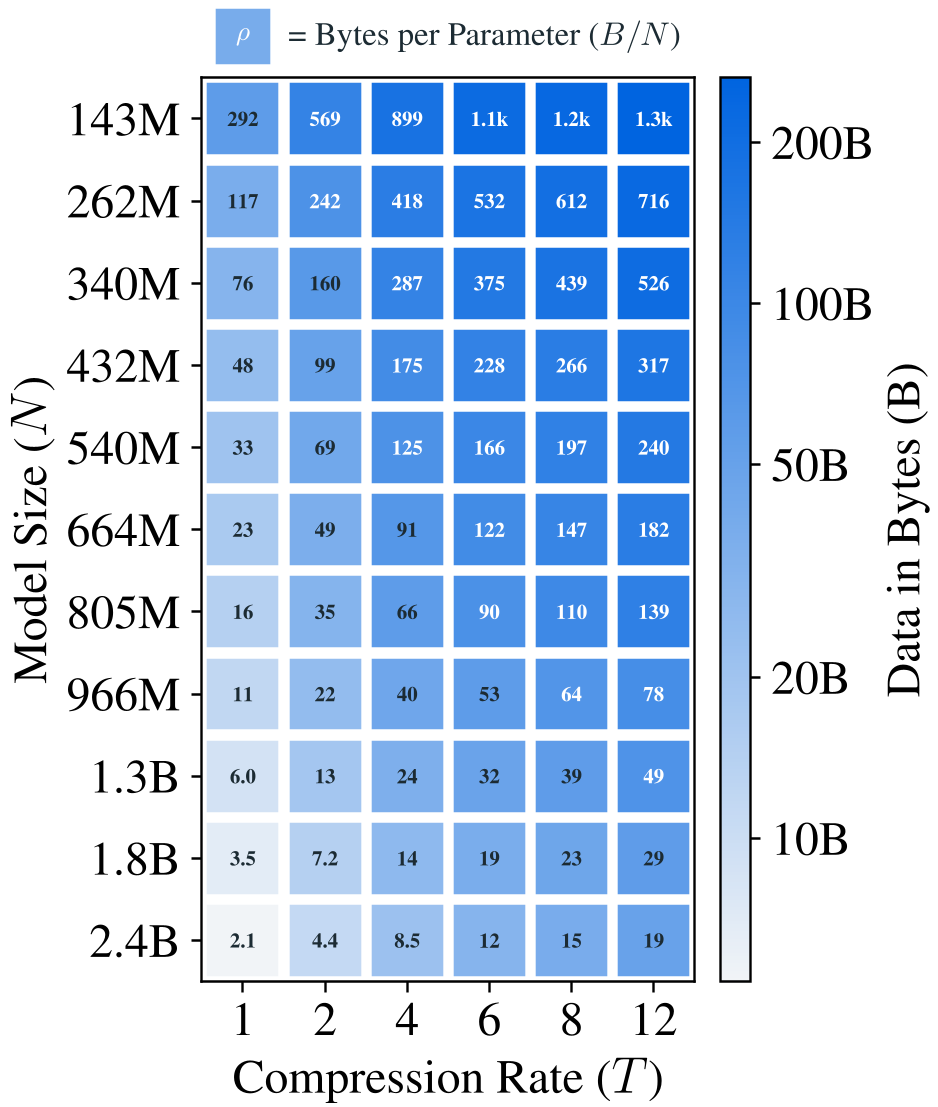 Figure: The experimental grid across compute budgets, model sizes, and compression rates.
Finding 1: The Byte-to-Parameter Constant
The most significant takeaway is that while the optimal tokens-per-parameter ratio changes with the tokenizer, the bytes-per-parameter ratio () remains remarkably stable.
- The Law: For English text, .
- The Intuition: Whether you use characters, BPE, or SuperBPE, you should aim for ~60 bytes of raw text for every model parameter to stay compute-optimal.
Finding 2: The Optimal Compression Rate
Is higher compression always better because it's "faster"? No. The study discovers a U-shaped loss curve.
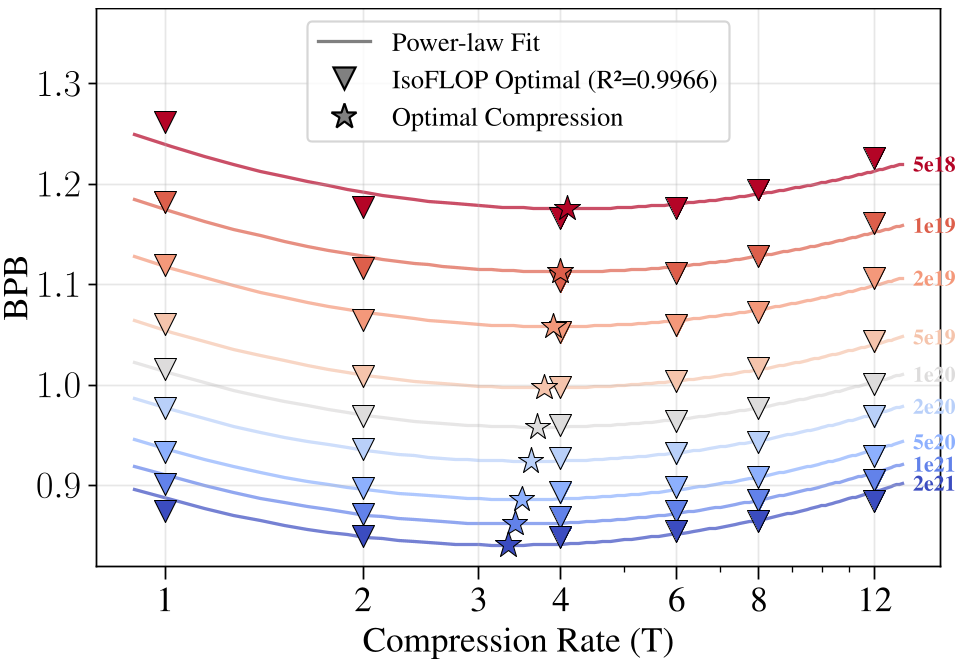 Figure: Optimal loss () shows a clear minimum. Diverging from the ideal compression rate (around 4 bytes/token) leads to higher loss.
Remarkably, as the compute budget () increases, the optimal compression rate decreases. This implies that for massive models, we might actually want smaller vocabularies and longer sequences to allow the model to spend more "compute-per-byte" during inference.
Multilingual Implications: The Parity Factor
When moving beyond English, the "optimal" settings shift based on Parity—the ratio of bytes required to express the same info in Language X vs. English.
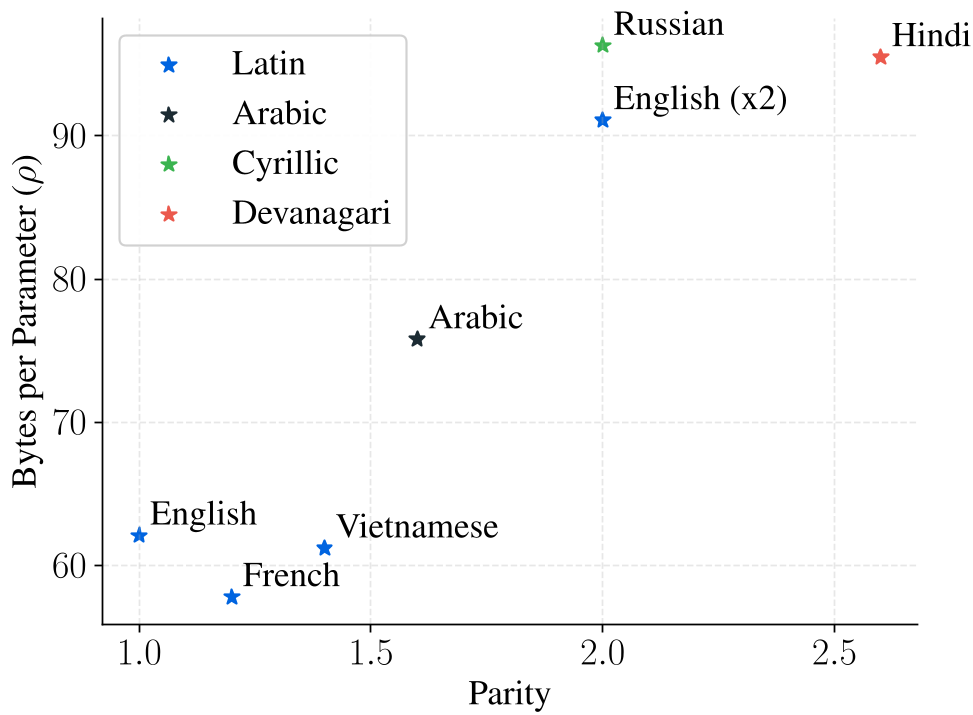 Figure: Languages with higher parity (like Hindi or Russian) benefit from higher compression rates.
For example, Russian requires ~2x the bytes of English for the same meaning. Consequently, a Russian-optimal tokenizer should have a higher compression rate and a higher byte-per-parameter ratio compared to an English one.
Critical Analysis & Conclusion
This paper provides a much-needed "Metric System" for tokenization.
Hard Truths for LLM Developers:
- Stop counting tokens: When planning your next cluster run, count the bytes of your raw dataset.
- Vocabulary Masking: The finding that masking 90% of a BPE vocabulary can improve performance at scale is a frontal assault on the "bigger is better" vocabulary trend.
- Inference Trade-offs: While lower compression yields lower loss per byte, it increases inference costs. The paper suggests that BPE's current popularity is a happy accident—it happens to be near the compute-optimal point for current English-centric budgets.
Future Work: The next frontier is applying this "Compute Optimal Tokenization" to multi-modal data (Vision/Audio), where the definition of a "byte of information" is even more elusive.