
FLANDM: Democratizing Data Mining via Model-Driven DSLs
Computer Languages, Systems & Structures
The paper introduces FLANDM, a model-driven development framework designed to rapidly create Domain-Specific Languages (DSLs) for data mining. By providing a reusable infrastructure and clear separation of concerns, it enables non-experts to execute complex data mining tasks using high-level, domain-specific terminology.
TL;DR
The FLANDM (Framework for Development of LANguages for Data Mining) ecosystem is a strategic breakthrough in Data Mining Democratisation. It allows for the creation of high-level query languages tailored to specific industries (e.g., medicine or education) by reusing a robust technical core. This methodology slashes development costs by 50%, enabling non-experts to extract insights without writing a single line of Java or Python code.
The "Data Divide": Why Tools are Still for Experts
Modern enterprises are drowning in data but starving for insights. The current state-of-the-art involves either complex workflow tools (RapidMiner, KNIME) that still require statistical expertise, or ad-hoc scripts that are impossible to maintain. The author's previous work suggested Domain-Specific Languages (DSLs) as a solution, but a new problem emerged: the cost of building a custom language for every new domain was simply too high.
FLANDM tackles this by identifying that while the vocabulary of a doctor and a teacher differs, the underlying data mining patterns (Classification, Clustering, Association Rules) remain largely the same.
Methodology: The Power of Dual Metamodels
The core innovation of FLANDM lies in its architectural modularity. Instead of a monolithic "Query-to-Code" engine, it splits the process into two logical layers:
- Entities Metamodel (Domain Expert Layer): Captures the "what"—the names of entities like
studentsorpatientsand their attributes. - Data Procedure Metamodel (Technical Specialist Layer): Captures the "how"—abstracting data mining algorithms into platform-independent tasks.
The Architecture Shift
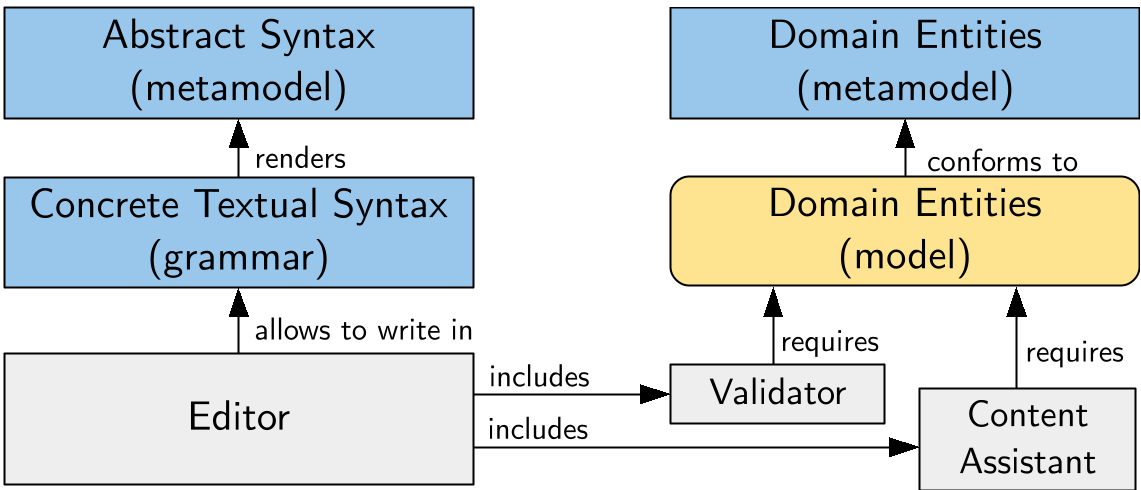
As shown in the framework overview, the Query Validator and Content Assistant (auto-complete) are decoupled from the domain itself. They dynamically read the "Entities Model," meaning they don't need to be recoded when moving from a Diabetes dataset to a Visa application dataset.
From High-Level Queries to Executable Evidence
Consider a medical expert checking diabetes risk. They write a simple query:
find_reasons_for test_result = positive of Diabetes_Results
FLANDM transforms this through Three Stages:
- Parsing: Validating against a base EBNF grammar.
- M2M Transformation: Mapping
find_reasons_forto aJ48Rulesclassification procedure. - M2T Generation: Producing Weka-compatible Java code that executes the J48 algorithm.
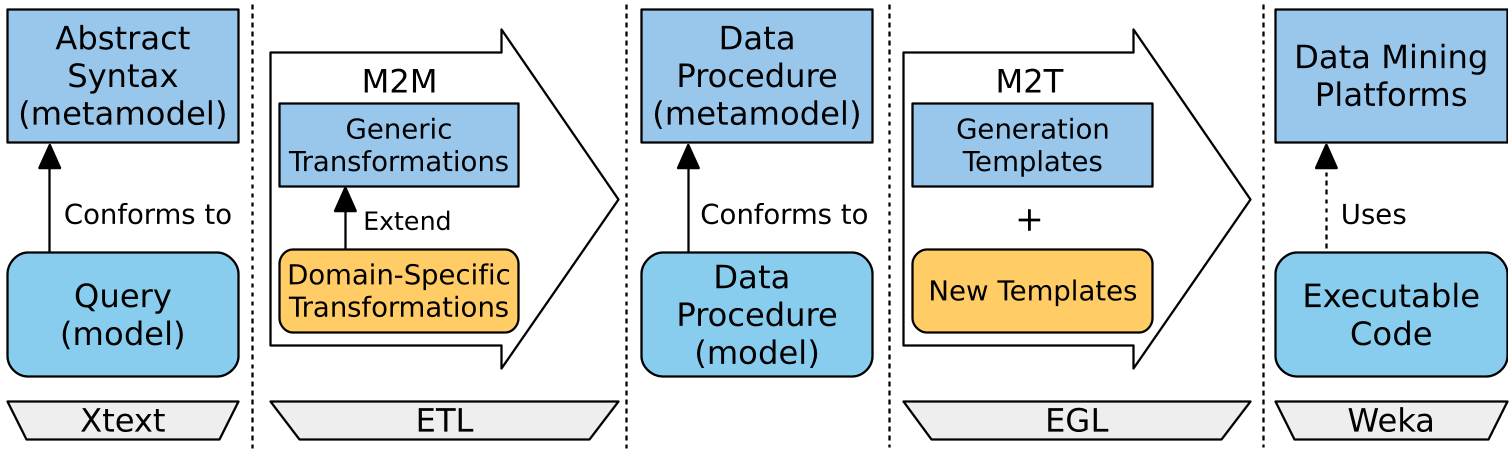 Figure: The transformation from a Query Specification to a concrete Data Procedure.
Evaluation: Efficiency Proven
The researchers tested FLANDM across four distinct domains. Using the Gaffney and Durek reusability model, they measured the "Relative Integration Cost" (denoted as b).
- Key Finding: The integration cost averaged just 8.2%. This means that 90% of the work required to build a language’s technical backbone was saved by reusing FLANDM’s components.
- Macro Result: The total cost (C) to develop a new DSL plummeted to 49.5% of the cost of building it from scratch.
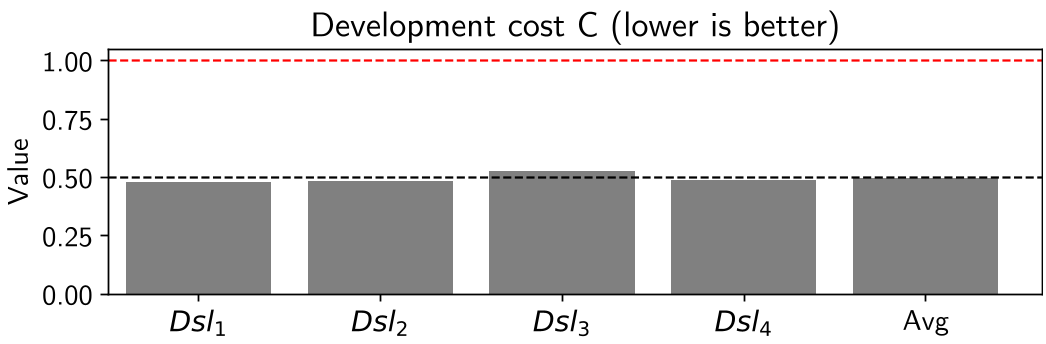 Figure: Consistent cost reduction across four different industry case studies.
Critical Insight & Future Outlook
FLANDM successfully shifts the burden of DSL development from "coding" to "configuration." However, the authors honestly note a limitation: Data Acquisition (S1.1) remains highly manual. Cleaning and formatting raw data into the necessary ARFF/Tabular formats still requires a data scientist.
The next frontier for this work is the development of Lavoisier, a specialized language for automated data acquisition, and the integration of Meta-learning to automatically select the best algorithm parameters based on the dataset's characteristics.
Takeaway: If you are building tools for non-technical users, stop building "one-off" solutions. Use a model-driven approach to abstract your logic into reusable procedures—the ROI is over 50%.