
Precise Diagnosis: How Self-Attention RCNNs are Outperforming Doctors in Disease Prediction
Computer Methods and Programs in Biomedicine
The paper introduces a Self-attention based Recurrent Convolutional Neural Network (RCNN) designed specifically for disease prediction, focusing on cerebral infarction. By integrating intra-layer recurrent connections within a convolutional framework and adding a self-attention mechanism, the model achieves a state-of-the-art accuracy of 95.71% on real-world clinical text datasets.
Executive Summary
TL;DR: This paper presents a novel neural architecture that combines the strengths of Convolutional Neural Networks (CNN), Recurrent Neural Networks (RNN), and Self-Attention to predict diseases from unstructured clinical text. By focusing on cerebral infarction, the model demonstrates a remarkable 95.71% accuracy, significantly surpassing traditional rule-based symptoms and general deep learning baselines.
In the landscape of Medical AI, this work sits at the intersection of NLP and Predictive Healthcare, moving beyond simple data classification into high-level semantic "understanding" of patient notes.
The Pain Point: The "Messy" Nature of Clinical Notes
Clinical text is notoriously difficult for machines to parse. Unlike structured data (like age or blood pressure), doctor notes are:
- Unstructured: Varying styles across different departments and doctors.
- Context-Dependent: A word's meaning changes based on the surrounding medical history.
- Unequally Weighted: In a 500-word note, only 5 words might be critical for diagnosing a stroke.
Previous methods used either static rules (which fail on edge cases) or basic CNNs (which miss the sequence context). The authors identified that a single approach cannot handle these challenges simultaneously.
Methodology: The Fusion of Recurrence and Attention
The core of the paper is the Self-attention based Recurrent Convolutional Neural Network (RCNN).
1. Recurrent Convolution (The "How")
Unlike standard CNNs, the "Recurrent" part uses intra-layer connections. Each neuron in the convolution layer behaves like a bidirectional RNN. This allows the model to capture context from both the left and right of a word simultaneously, effectively creating a "sliding window" that understands the sequence of medical symptoms.
2. Self-Attention (The "Why it Works")
The model doesn't treat all convolved features equally. It uses a Softmax-based self-attention mechanism to assign a probability to each feature. If a patient note mentions "numbness in limbs," the attention mechanism assigns a higher weight to these features than to "patient reports usual diet."
 Figure 1: The proposed architecture illustrating the flow from Word Embedding to Self-Attention based Recurrent Convolution.
Experimental Performance
The researchers tested their model on a massive real-life hospital dataset. They focused on Filter Size and Epochs as primary hyperparameters.
- Optimal Filter Size: A filter size of 5 was found to be the "sweet spot," providing the best balance between local keyword capture and broader context.
- Performance vs. Baselines:
- Proposed Model: 95.71% Accuracy / 91.43% Recall.
- Multimodel CNN: 94.8% Accuracy.
- Panel Regression: ~60% Accuracy.
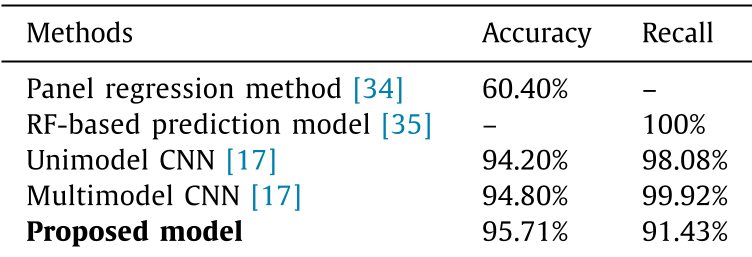 Table 1: Comparative analysis showing the proposed model's superiority over traditional and existing deep learning methods.
Critical Insight & Future Outlook
The primary contribution of this work isn't just the high accuracy—it’s the Inductive Bias built into the architecture. By forcing the model to use both recurrence (for sequence) and attention (for importance), the authors mirrored how a human doctor reads a chart: scanning for context while pinpointing critical symptoms.
Limitations: The model adds significant computational overhead due to the nested recurrence and attention weights. In a real-time hospital triage system, the training time and latency would need further optimization.
The Takeaway: This research proves that "Deep Learning" in medicine is moving away from "black box" CNNs toward Context-Aware architectures. The future of AI diagnosis lies in models that can read between the lines of unstructured human language.
Keywords: Deep Learning, Self-attention, Healthcare Data, Biomedicine, Disease Prediction.