
Beyond Density: Predicting Hip Fractures with Biomechanical Digital Twins and Machine Learning
Computer Methods and Programs in Biomedicine
This study proposes a hybrid approach for predicting osteoporotic hip fractures in postmenopausal women by combining patient-specific 2D Finite Element (FE) analysis with Machine Learning (ML). Utilizing Support Vector Machines (SVM), the method integrates mechanical bone response data with clinical attributes, achieving a classification accuracy that significantly outperforms the current clinical gold standard (BMD).
TL;DR
Osteoporosis diagnosis is stuck in a "density-only" paradigm that misses nearly 35% of high-risk patients. This paper introduces a novel methodology that transforms standard 2D DXA scans into patient-specific mechanical simulations, which, when paired with Support Vector Machines (SVM), improves fracture prediction accuracy by 14% over the current clinical gold standard.
Background: Why Density Isn't Everything
For decades, clinicians have relied on Bone Mineral Density (BMD) to screen for osteoporosis. However, bone strength is not just about "how much" mineral is there, but "how it is distributed" and "how it reacts to impact." Current screening misses many patients because it ignores bone geometry and the physics of a fall. While 3D Quantitative Computed Tomography (QCT) offers a better look, its cost and radiation levels prevent it from being a universal screening tool.
The Insight: The "Virtual Stress Test"
The authors suggest a mid-way solution: Use the cheap, low-radiation 2D DXA scan but treat it as a blueprint for a Finite Element (FE) model. By simulating a sideways fall—the most common cause of hip fractures—the researchers can generate "mechanical fingerprints" (attributes) for every patient.
Methodology: From Pixels to Physics
The workflow follows a rigorous pipeline:
- Segmentation: Semi-automatic identification of the proximal femur from DXA.
- FE Modeling: Mapping grey-scale pixel values to bone material properties (Young’s Modulus, Yield Stress).
- Simulation: Applying subject-specific impact forces calculated based on the patient’s height, weight, and soft tissue thickness.
- Feature Extraction: Generating 19 predictors including Load-to-Strength Ratio (LSR) and Strain Energy Density (SED).
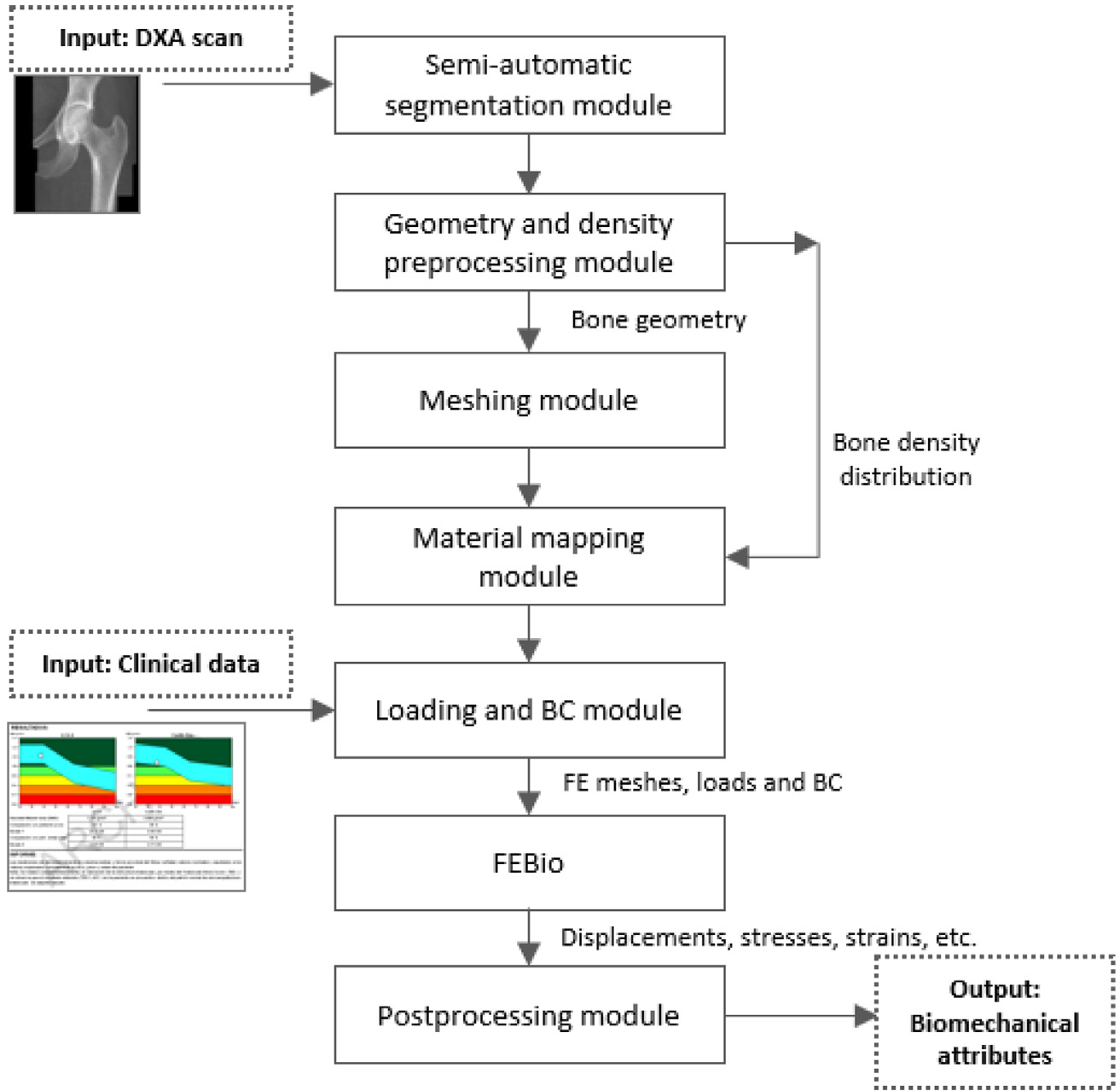 The image shows the transition from a clinical DXA scan to a heterogeneous finite element mesh capable of simulating stress distribution.
The study compared multiple ML algorithms: Logistic Regression, Shallow Neural Networks, Random Forest, and SVM.
Experimental Results: The Power of Non-Linearity
The researchers found that Linear models underestimated risk. The bone's response to damage is complex and non-linear, which is why the SVM with a Radial Basis Function (RBF) outperformed all other methods.
| Method | Accuracy (Test) | Improvement vs. BMD |
|---|---|---|
| BMD (Gold Standard) | 64.8% | - |
| SVM (Clinical + FEA) | 78.35% | +13.55% |
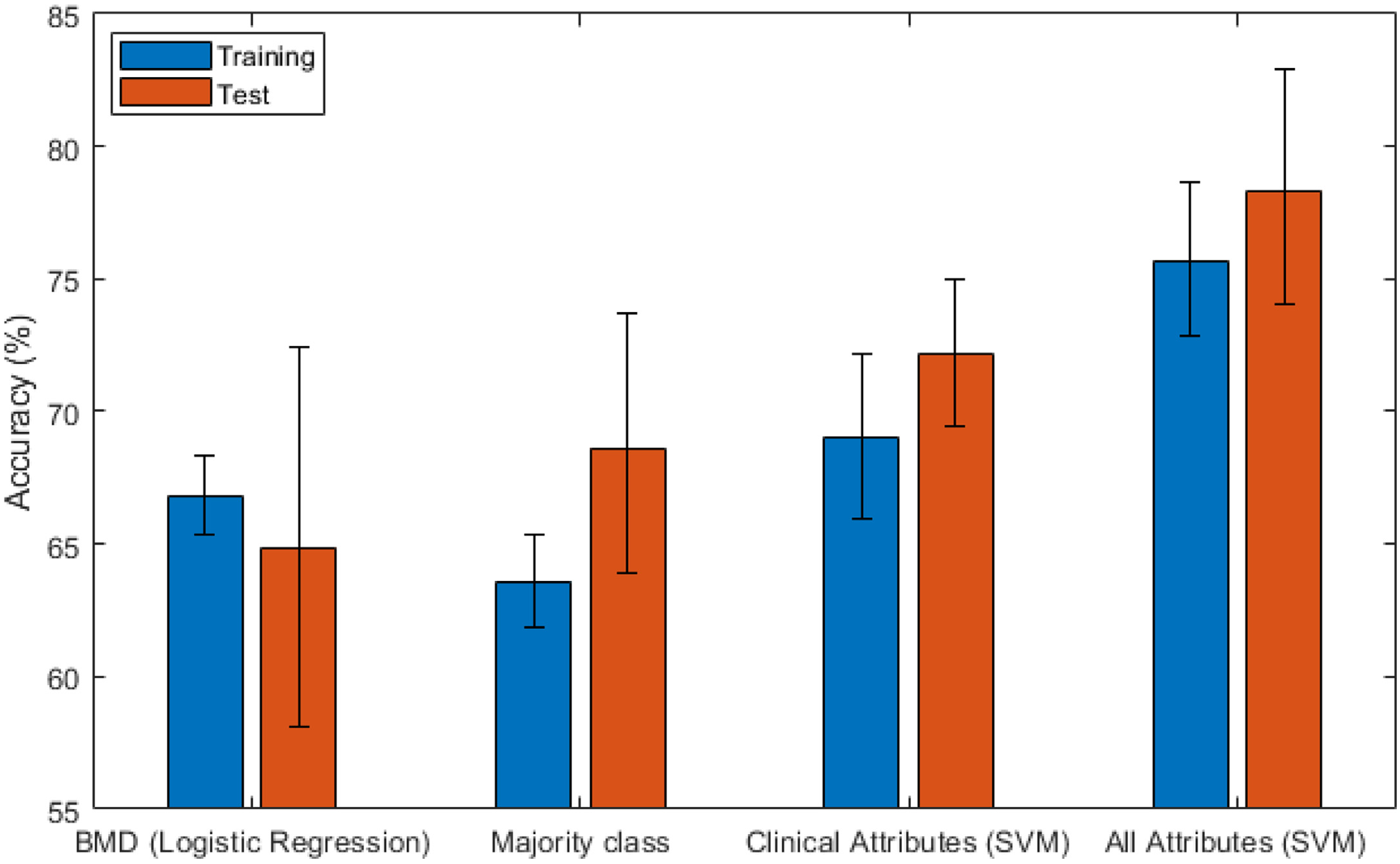 Results show a clear performance leap when biomechanical attributes are added to the ML model (blue bars vs. orange/brown baselines).
Critical Insight: Inductive Bias in Biomechanics
What makes this paper significant is the "Inductive Bias" provided by the FE model. Instead of asking the Machine Learning model to learn physics from scratch (which would require millions of samples), the authors used Finite Element Analysis to provide the physics, allowing the ML model to focus on the statistical classification from a relatively small dataset (n=137).
Limitations & Future Work
- 2D vs 3D: The 2D model suffers from "overlapping" tissues (cortical and trabecular bone are flattened). Future work aims to use 3D-DXA reconstruction.
- Demographics: The study focused solely on postmenopausal women; applying this to male populations remains an open research question.
Conclusion
This research moves us closer to "Preventive Biomechanics." By integrating fast (2-second) simulations into the clinical loop, doctors could soon provide patients with a risk score based not just on how "dense" their bones are, but on how those bones would actually survive a fall.