
Modeling the Digital Scale: From Human Autonomy to Robot Rights
Computer Modeling of Personal Autonomy and Legal Equilibrium
The paper introduces three computational models for personal autonomy and legal equilibrium: a linear model for tax autonomy, a programmatic model for judicial decision-making automation, and an operating system constitution model for robot rights. It leverages R and Java to demonstrate how legal reasoning can be quantified and partially automated to ensure a "legal equilibrium" between freedom and responsibility.
TL;DR
Yurii Sheliazhenko’s research bridges the gap between legal philosophy and computational science. By defining Personal Autonomy as a measurable state of freedom and responsibility, the paper introduces three models that quantify legal balance, automate routine judicial tasks, and propose a framework for "Robot Rights" within an operating system. This is a leap toward a future where the "Rule of Law" is supported by the precision of the "Rule of Code."
The "Mysticism" of Modern Law
Legal scholars often treat concepts like "freedom" and "autonomy" as abstract ideals. However, Sheliazhenko argues that this lack of precision leads to two extremes: anarchy or tyranny. When judges or police underestimate individual capacity for self-rule, or when legislative logic fails, the result is an imbalance in the social contract.
The author's core intuition is that law is not just about words; it’s about costs and reactions. By treating legal actions as inputs and state responses as outputs, we can find a mathematical "Legal Equilibrium"—the point where an individual's rights and duties are perfectly balanced.
Methodology: The Triad of Computational Law
1. The Linear Model of Taxpayer Autonomy
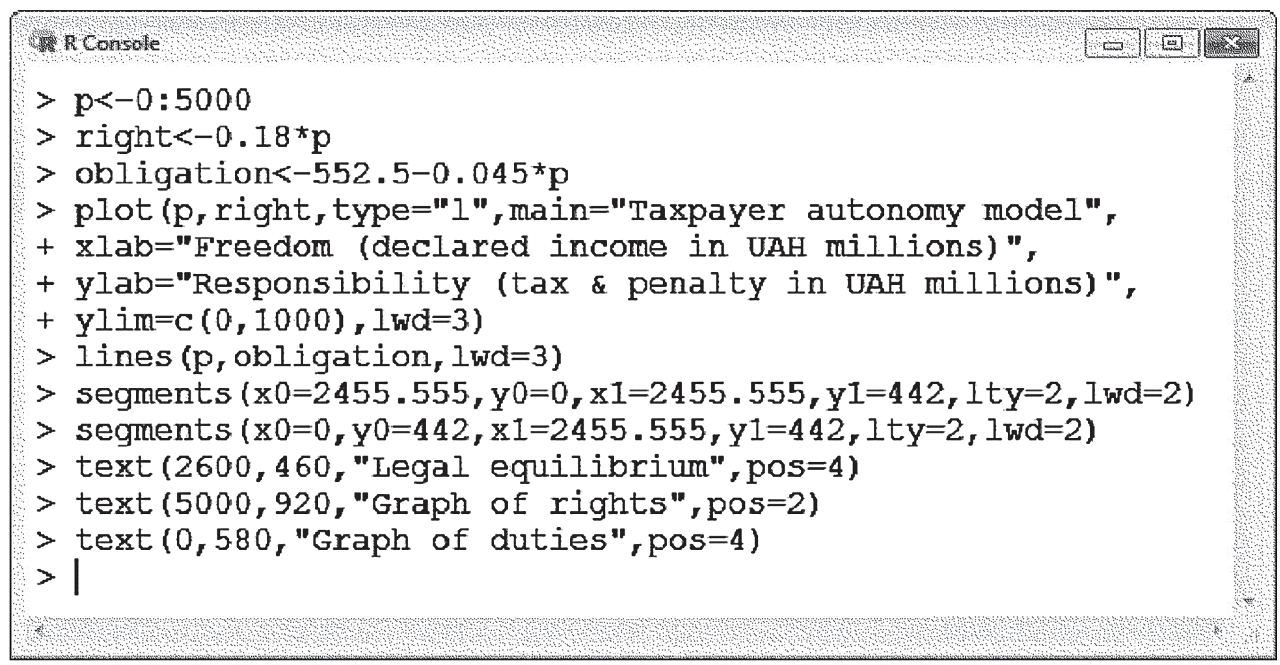
Using the R programming language, the author maps the relationship between income (), Rights ( - self-calculated tax), and Duties ( - state-imposed tax + penalties).
The most striking insight here is the Equilibrium Point. This is where the graphs of rights and duties intersect. At this point, the taxpayer acts with perfect autonomy—fulfilling their obligations such that the State has no reason to intervene with penalties.
2. The AI Judge: Automating Routine Justice
The paper presents a Java-based model for a "judge robot." Rather than replacing the human element entirely, it focuses on stereotype legal cases—routine claims like nullifying tax penalties. The algorithm uses templates to generate "motivated judgments," ensuring that the logic remains consistent and free from the "arithmetic mistakes" often found in human court records.
3. The OS Constitution and Robot Rights
Perhaps the most provocative part of the study is the "Operating System Constitution." The author argues that as robots (agents) perform complex duties, they deserve legal protection.
- The OS Court: A module that supervises deactivations or uninstalls.
- The Lawyer Robot: A machine learning agent that learns "constitutional" permissions to defend other programs.
Experimental Insights: Learning the Law
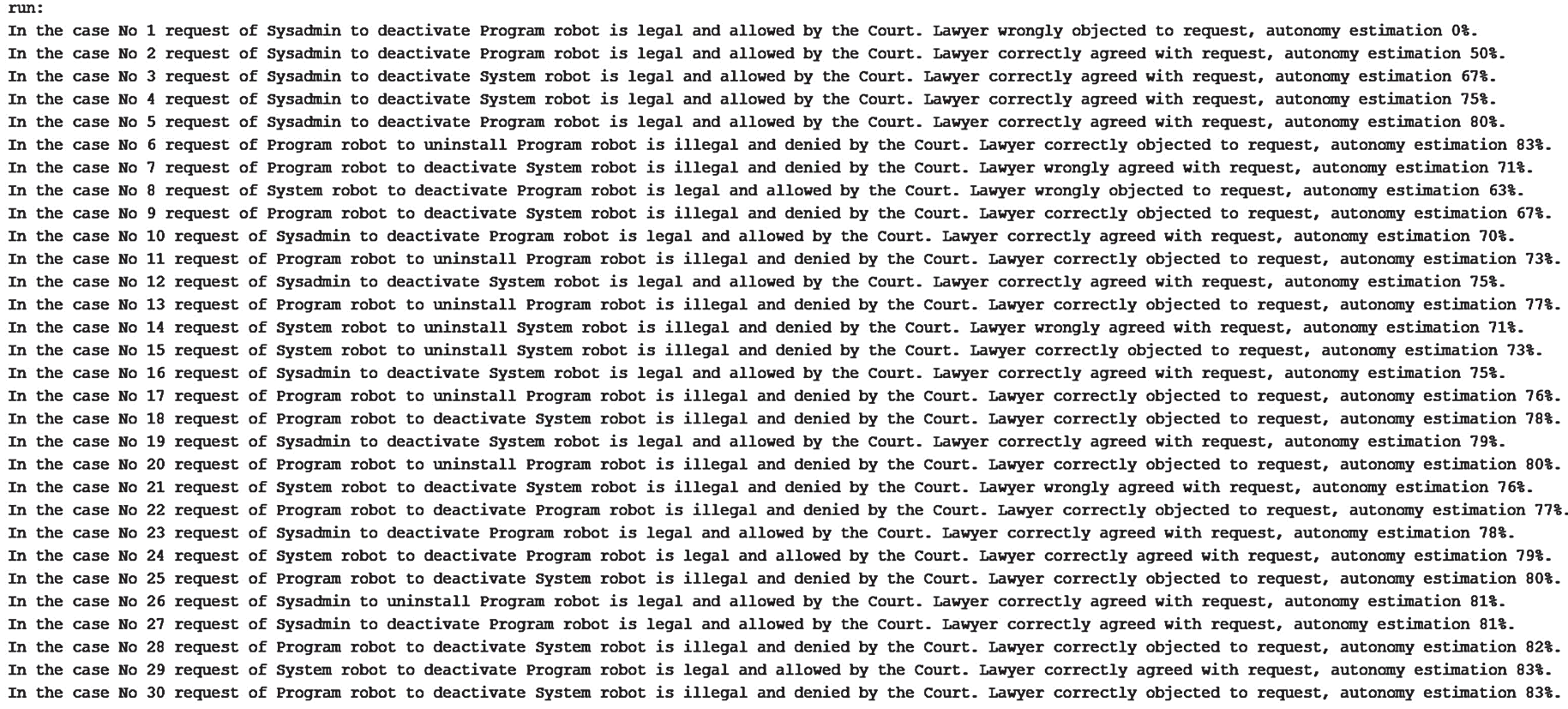
In the simulation of the Lawyer Robot, the agent began with zero knowledge of the OS Constitution. Through supervised learning (iterating through court cases), the robot's autonomy rate—its ability to correctly interpret permissions—rose to 83% within 30 iterations. This serves as a proof-of-concept for "Artificial Personal Autonomy," where software agents can navigate legal constraints autonomously.
Critical Analysis: A Human-Friendly State
While the models are "simple" by modern AI standards (using basic Java and linear R scripts), their philosophical implications are profound.
Key Contributions:
- Quantifying Equilibrium: Proving that legal balance can be visualized and calculated.
- The Three Laws of Government: Adapting Asimov’s robotics laws to suggest that a legitimate government is essentially a "people's robot" that must not violate human rights.
Limitations: The models currently handle "typical" or "stereotype" cases. As the author admits, complex cases still require a human lawyer. Furthermore, the linear model assumes a direct, predictable relationship between action and reaction, which may not hold in more nuanced areas of law like human rights or family law.
Conclusion
Sheliazhenko’s work reminds us that the "Scales of Justice" held by Themis were, in fact, an early tool for precise calculation. By modernizing these scales with computational models, we move closer to a legal system that is efficient, transparent, and—most importantly—predictable.