
Digital-Class: Revolutionizing School Safety and Attendance with Computer Vision
Computer Vision for Attendance and Emotion Analysis in School Settings
This paper introduces "Digital-Class," an open-source computer vision tool developed for school settings to automate attendance and perform real-time emotion analysis. By utilizing OpenCV and the Microsoft Azure Face API, the system achieves efficient facial recognition and provides early warnings for student mental health shifts.
TL;DR
Researchers have developed an accessible, Python-based software tool that automates classroom attendance and monitors student emotional well-being. By combining OpenCV for facial recognition and Microsoft Azure for emotion scoring, the project aims to save teachers over 5,000 minutes a year while providing a "safety net" for identifying students in psychological distress.
Background & Motivation: Beyond the Time-Sink
Manual attendance is an archaic administrative burden. The authors estimate that the average teacher spends nearly 95 hours per year simply calling out names. However, the motivation for this study goes deeper than efficiency. In the wake of rising school safety concerns in the US, there is a critical need for systems that don't just record video, but understand it.
The core insight of this project is that mental health tracking can be a byproduct of automated attendance. Since many school shooters exhibited prior signs of depression, a system that flags "prolonged sadness or anger" to a guidance counselor could serve as a vital early warning system.
Methodology: Accessible yet Robust
The researchers prioritized a software architecture that is "friendly" to high school students and teachers, using Python and OpenCV.
The Technical Pipeline:
- Detection: Utilizing Haar Cascades to identify facial structures within a video frame.
- Recognition: Implementing Local Binary Pattern Histograms (LBPH). Unlike EigenFaces, LBPH focuses on local textures, making it less sensitive to the inconsistent lighting found in typical classrooms.
- Emotion Scoring: The system queries the Microsoft Azure Face API to analyze eight emotional states, specifically tracking happiness, neutral, anger, and sadness for student profiles.
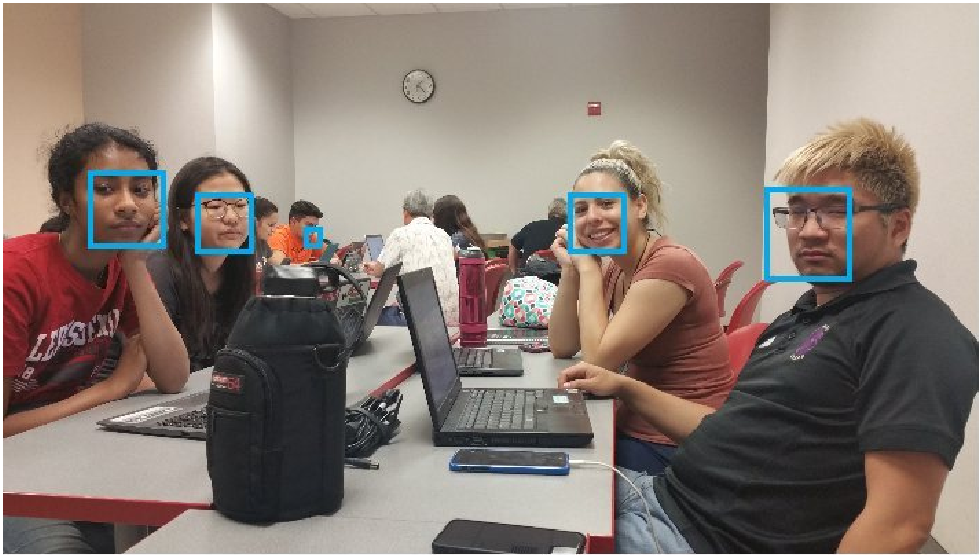 Fig 1: Facial detection is the first step toward collecting longitudinal emotional data.
Experiments: Distance and Data Volume
The researchers conducted rigorous testing to determine how physical environment and data quantity affect the OpenCV Confidence Score (where a lower score indicates higher certainty).
- The Power of Data: Increasing the training set from 20 to 180 images per student nearly doubled the recognition accuracy.
- The Distance Factor: As expected, increased distance from the camera raises the error score. However, with a large enough training set (180 images), the system remains consistent enough for hallway or large classroom use.
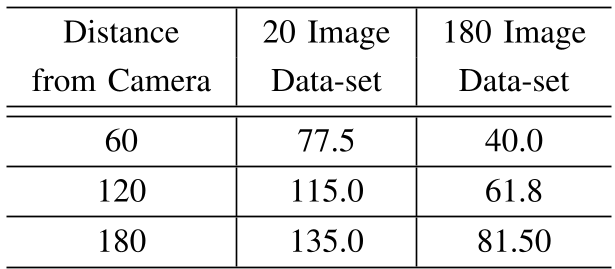 Table 1: The relationship between distance, training set size, and recognition error.
Critical Analysis: Privacy and Limitations
A significant portion of the paper is dedicated to FERPA compliance. The authors address privacy concerns by clarifying that the system creates a local database of numerical data (CSV) rather than saving raw video footage.
Limitations identified include:
- Visual Variability: Changes in appearance (glasses, makeup, hairstyles) can spike error scores.
- Occlusions: Obstacles like facial hair (as seen in the Yale Database tests) can confuse emotion classifiers—specifically mistaking sadness for a neutral state.
Conclusion: A Tool for Empowerment
The "Digital-Class" project is more than a utility; it is a pedagogical bridge. By making the code open-source on GitHub, the authors encourage students to move from being passive users of technology to active developers of AI. It demonstrates that Computer Vision can be local, accessible, and potentially life-saving.
The software is available for evaluation and modification at: https://github.com/ferrabacus/Digital-Class