
Decoding the Terroir: Machine Learning the Chemical Fingerprints of Grape Skins
Computers and Electronics in Agriculture
This study presents a machine learning-based framework for the geographical authentication of grapes from Mendoza, Argentina, using the multi-elemental composition of grape skins. By analyzing 29 trace elements via ICP-MS and comparing four algorithms, the researchers achieved a peak prediction accuracy of 88.9% using Random Forest (RF).
TL;DR
Researchers in Argentina have successfully developed a "digital sommelier" capable of tracing grapes back to their specific origin in Mendoza with nearly 90% accuracy. By analyzing the mineral content of grape skins using ICP-MS and Random Forest algorithms, this study provides a robust method for protecting the "Denomination of Controlled Origin" and ensuring wine authenticity.
Context: The Geochemistry of Taste
In the world of fine wine, geography is everything. The concept of terroir suggests that the character of wine is an expression of the soil's chemistry. However, proving exactly where a grape comes from is a complex analytical challenge. Traditional methods often look at the finished wine or the seeds, but this study shifts focus to a winemaking by-product that is often discarded: the grape skin.
The Problem: The Challenge of Chemical Similarity
Mendoza is a vast region with various micro-climates and soil types. For industry-standard certification, distinguishing between neighboring estates (like Maipú vs. Guaymallén) is difficult because the elemental profiles are extremely similar. Linear statistical models often fail to capture the subtle, non-linear relationships between trace elements and their geological origins.
Methodology: From Plasma to Predictions
The researchers collected 413 samples across 28 estates in Mendoza. The workflow involved:
- Chemical Digestion: Lyophilized grape skins were acid-digested.
- ICP-MS Analysis: 29 elements, ranging from common metals like Iron (Fe) to ultra-trace Rare Earth Elements (REE) like Cerium (Ce) and Lanthanum (La), were quantified.
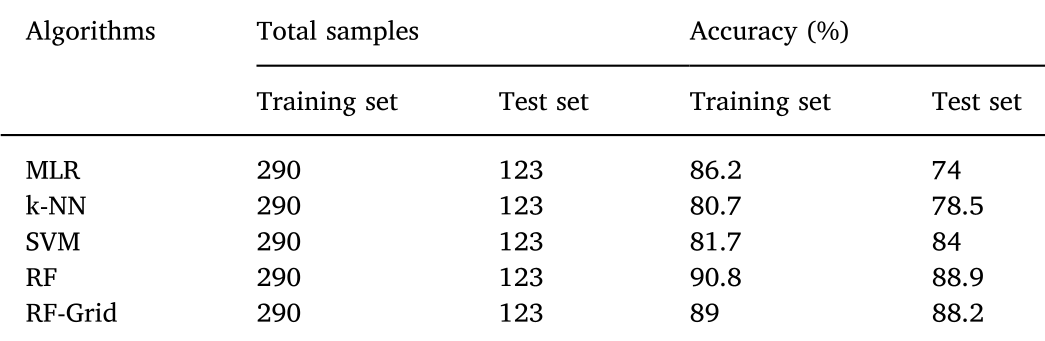
- Data Mining: Four models—Multinomial Logistic Regression (MLR), k-NN, SVM, and RF—were trained to classify samples into five regions.
 Note: The study compared multiple supervised learning architectures to find the optimal boundary for geographical classification.
Why Random Forest?
The study found that Random Forest (RF) was superior. Unlike linear models, RF builds an ensemble of decision trees, allowing it to handle the complex, high-dimensional chemical data inherent in soil-to-fruit transfer. Through "mtry" and "nt" parameter grid optimization, RF achieved stable, repeatable results with a lower computational cost than SVM.
Evaluation & Results
The experiments demonstrated a clear hierarchy in algorithmic performance:
- Random Forest: 88.9% Accuracy
- SVM: 84.0% Accuracy
- MLR (Linear): 74.0% Accuracy
A critical discovery was identifying which elements actually matter. Rubidium (Rb) emerged as the "MVP" of indicators, with 100% relative importance in the RF model, followed by Manganese (Mn) and Zinc (Zn).
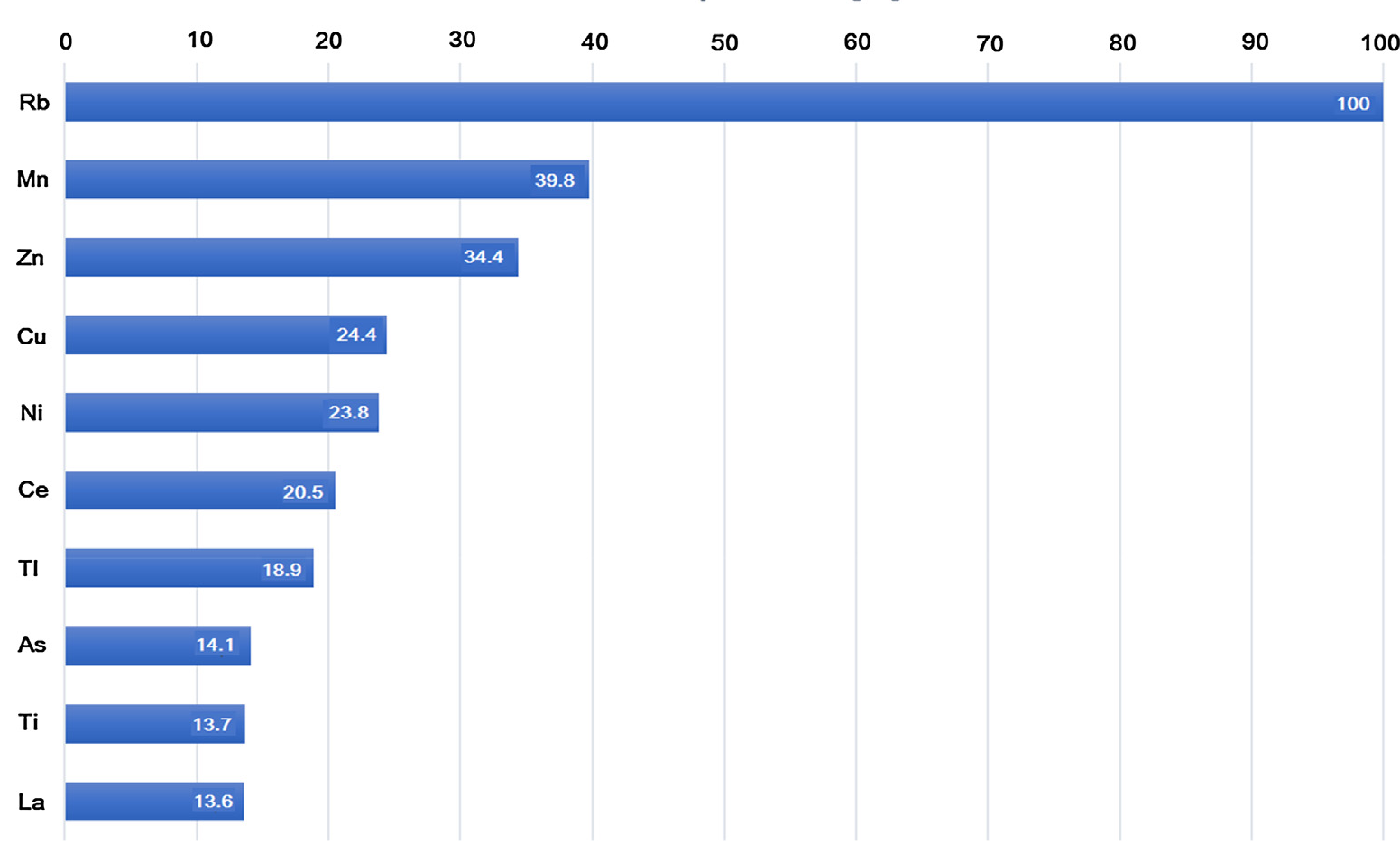 The Ranking of Predictors: Rb, Mn, and Zn provide the most reliable geographic signal.
Critical Insight: The Future of Traceability
This research proves that the chemical composition of grape skins is not just noise; it is a high-resolution map of the land.
- SOTA Achievement: By utilizing by-products (skins), the industry can verify origin before, during, and after the fermentation process.
- The "Why": Rubidium and REEs are particularly effective because they reflect the geochemistry of the Andes' alluvial deposits, which vary based on altitude and mountain transport patterns in Mendoza.
- Limitations: While 89% is impressive, the overlap in PCA (Principal Component Analysis) suggests that some sub-regions are so chemically similar that even advanced AI reaches a ceiling. Future work might need to combine elemental data with isotopic analysis for 100% certainty.
Conclusion
As global food fraud becomes more sophisticated, machine learning offers the wine industry a powerful shield. This study demonstrates that by listening to the "trace element whispers" in grape skins, we can protect the heritage and commercial value of prestigious wine regions like Mendoza.