
Statistical Machine Learning: The Precision Engine of Modern Agricultural Vision
Computers and Electronics in Agriculture
This review comprehensively surveys the application of statistical machine learning (ML) algorithms within agricultural machine vision systems, focusing on both supervised (Naive Bayes, DA, kNN, SVM) and unsupervised (K-means, Fuzzy Clustering, GMM) techniques. It establishes a roadmap for selecting specific algorithms based on agricultural tasks such as weed detection, disease diagnosis, and fruit grading, highlighting the field's transition toward precision automation.
TL;DR
As global food demand surges, the shift from "farming by intuition" to "farming by data" is being driven by statistical machine learning (ML). This comprehensive review deciphers how classic algorithms like SVM, kNN, and GMM are being deployed in machine vision systems to automate weed detection, fruit grading, and disease diagnosis with SOTA accuracies often exceeding 95%.
The "Biological Noise" Problem
Agriculture is perhaps the most challenging "office" for computer vision. Unlike industrial inspection lines with controlled lighting, agricultural systems must deal with:
- Unconstrained Illumination: Moving clouds and sun angles change color signatures.
- Morphological Variance: No two leaves or fruits are identical in shape.
- Overlapping Classes: Weeds often look nearly identical to young crops in their early growth stages.
The authors argue that the key to success isn't just "more data," but matching the statistical assumptions of an algorithm to the biological reality of the crop.
Methodology: Choosing the Right "Brain" for the Machine
The paper provides a masterclass in matching methodology to task:
1. Supervised Learning: The Specialists
- Support Vector Machines (SVM): Shown to be highly effective for disease detection. By using kernels (like RBF), SVMs can project complex, non-linear leaf textures into high-dimensional spaces where healthy and infected tissues are clearly separable.
- k-Nearest Neighbor (kNN): A non-parametric "lazy learner." It excels in grain variety identification because it makes no assumptions about data distribution, allowing it to handle the subtle, non-Gaussian variances in seed morphology.
2. Unsupervised Learning: The Delineators
- Gaussian Mixture Models (GMM): Unlike hard clustering, GMM provides "soft" assignments. This is critical for plant phenotyping and water stress estimation, where the transition from "healthy" to "stressed" is a gradient rather than a hard line.
- Fuzzy Clustering: Used primarily for site-specific management zones. It acknowledges that soil properties (like clay content) overlap across a field, allowing for more nuanced variable-rate irrigation.
 Note: The taxonomy of statistical ML applications in agriculture.
Critical Results & Evidence
The review highlights several landmark achievements in the field:
- Rice Disease Identification: Using a combination of shape and texture features via SVM achieved a staggering 97.2% accuracy.
- Yield Estimation: GMM models applied to 3D reconstructions of grapevines yielded 98% accuracy prior to ripening, effectively predicting harvests months in advance.
- Weed Control: In wheat fields, Naive Bayes and kNN algorithms demonstrated that even simple statistical models could reach 98.9% accuracy in identifying invasive species among crops.
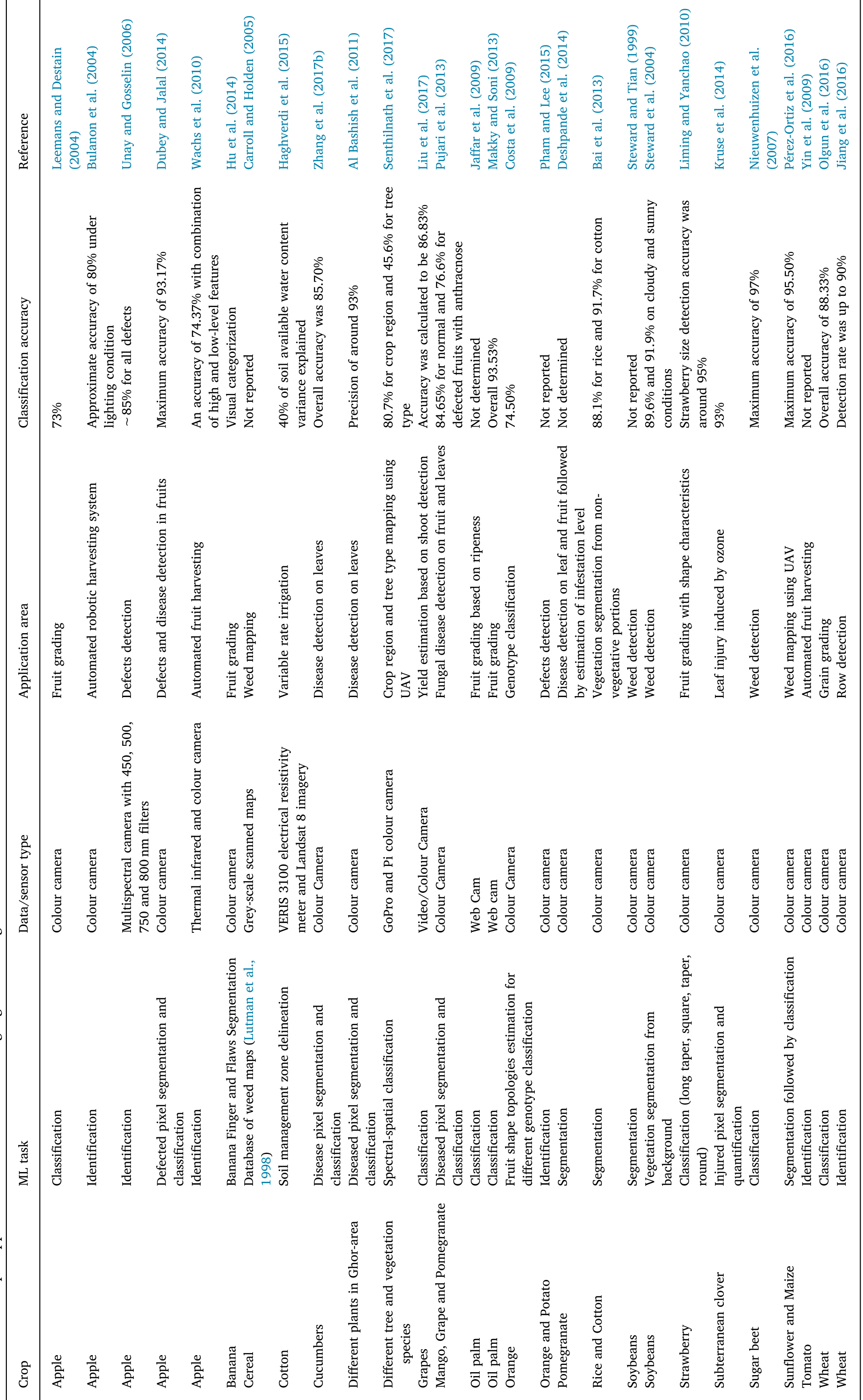 Table: Effectiveness of various unsupervised algorithms across different crops.
Insight: Beyond the "Deep Learning" Hype
While the current AI landscape is dominated by Deep Learning, this paper makes a compelling case for Statistical ML. These algorithms are:
- Computationally Efficient: Essential for "Edge AI" sensors on tractors and drones with limited power.
- Interpretable: Unlike black-box neural networks, researchers can see which features (e.g., "redness" or "circularity") the model is prioritizing.
- Data-Efficient: They require significantly smaller training sets than deep learning models to reach convergence.
Conclusion & Future Outlook
The "future of features" lies in fusion. The most robust systems reviewed were those that did not rely on color alone but fused Spectral, Textural, and Structural data.
Limitations: The primary bottleneck remains the "hard assignment" in classic K-means and the computational cost of kNN in real-time high-resolution video streams.
Takeaway for Engineers: Don't default to a CNN. If your data is limited and your deployment environment is a low-power drone, a well-tuned SVM or GMM might provide the SOTA performance you need with a fraction of the overhead.