
What Computers Can Tell Us About Emotions: Automating Affective Analysis in Negotiations
What Computers Can Tell Us About Emotions – Classification of Affective Communication in Electronic Negotiations by Supervised Machine Learning
This paper explores the application of supervised machine learning to classify emotions in text-based electronic negotiations. By utilizing the Circumplex Model of Affect (Valence and Activation), the authors achieve a 55% overall accuracy and over 62% precision in identifying critical "activating negative" emotions using Naïve Bayes and SVM.
Executive Summary
TL;DR: Researchers at TU Wien have developed a framework to automatically detect human emotions during electronic negotiations. By leveraging supervised machine learning (specifically SVM and Naïve Bayes), they successfully categorized messages into "affective quadrants," achieving high precision in identifying negative, high-energy emotions that often lead to negotiation failure.
Context: While most negotiation research focuses on "the deal," this work shifts the spotlight to "the feel." It bridges the gap between psychological emotion models and practical Machine Learning, positioning itself as a foundational step toward real-time Affective Negotiation Support Systems (ANSS).
The Motivation: Why Coding "Feelings" is Hard
Negotiations are more than just numbers; they are social interactions layered with mistrust, strategy, and tension. Previous research has shown that emotions like anger or disappointment significantly impact concessions and trust building.
However, there is a bottleneck:
- The Human Factor: Historically, analyzing emotion in text required human coders—an "after-the-fact" process useless for real-time support.
- Implicit Signaling: Unlike face-to-face talks, text-based negotiations lack non-verbal cues. Negotiators use "lexical surrogates" (e.g., "hmmm") or punctuation (e.g., "???") to signal state, which standard sentiment analysis often ignores.
Methodology: From MDS to Machine Learning
The authors move beyond simple "positive vs. negative" sentiment. They adopt the Circumplex Model of Affect, which maps emotions onto two axes: Valence (Pleasure/Displeasure) and Activation (High/Low energy).
1. The Data Pipeline
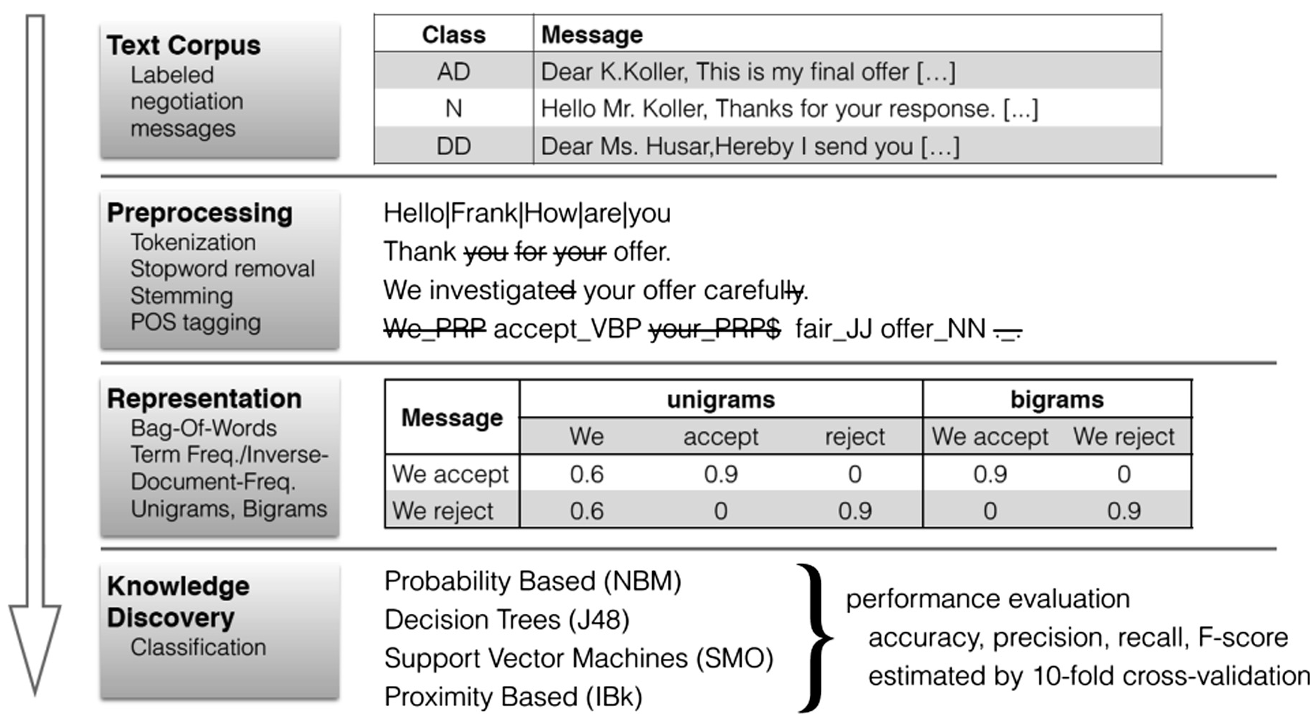
The team used 730 messages from 57 bilateral negotiations conducted on the Negoisst platform. They employed Multi-Dimensional Scaling (MDS) to group messages based on human-perceived similarity, creating five labels: Neutral (N), Activated Pleasure (AP), Deactivated Pleasure (DP), Activated Displeasure (AD), and Deactivated Displeasure (DD).
2. Feature Engineering and Architecture
The study tested 16 different preprocessing settings. Key findings included:
- N-grams: Combining unigrams and bi-grams (e.g., "very disappointed") captured more context than single words.
- Stemming: Reducing words to their roots (e.g., "negotiating" to "negotiate") was essential for handling the small dataset size.
Experimental Results: Catching the "Danger Zone"
The most significant finding was the performance of Naïve Bayes (NBM) and Support Vector Machines (SMO).
- Overall Accuracy: ~55%, doubling the random baseline.
- The "Activating Displeasure" (AD) Success: This category (anger, frustration) is the most critical for negotiators to catch. The models achieved 62.4% precision for AD, meaning when the computer flags a message as "angry," it is correct nearly two-thirds of the time.
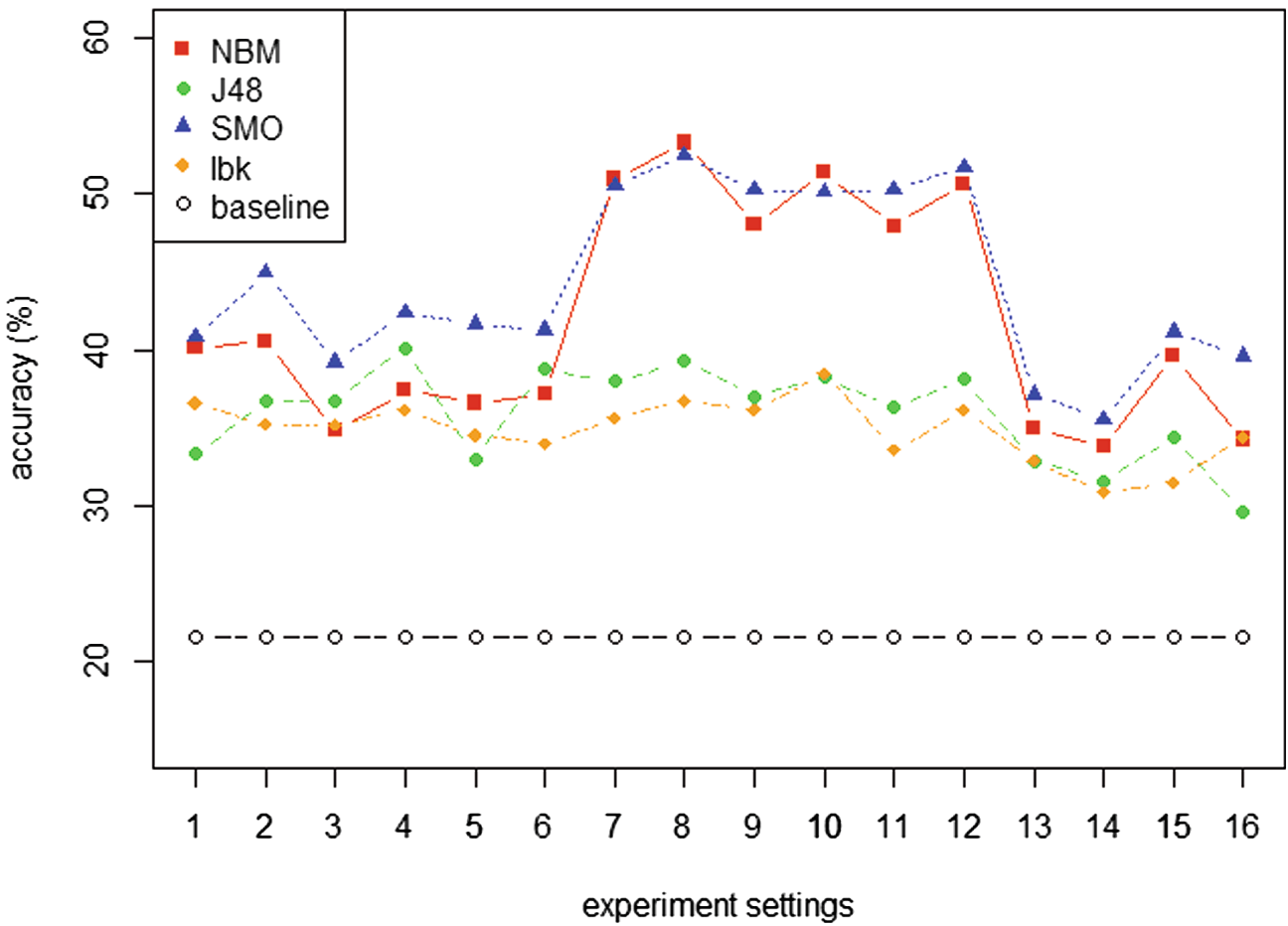
Surprisingly, Stopword Removal and POS Tagging (identifying nouns/verbs) actually hurt performance. This suggests that in negotiations, even "noise" words and specific grammatical structures carry the weight of emotional intent.
Critical Analysis & Conclusion
Takeaway: This research proves that computers can detect the "emotional temperature" of a negotiation transcript without human intervention. This paves the way for software that warns a user: "Your last draft sounds aggressive; it might cause the opponent to walk away."
Limitations:
- Data Scarcity: 730 messages is a small sample for modern ML. The model might struggle with diverse cultural expressions of emotion.
- Context Dependency: Negotiation strategy often involves "faking" anger or happiness; the model currently cannot distinguish between genuine and instrumental affect.
Future Outlook: With the rise of LLMs (like GPT-4), we can expect these accuracies to skyrocket. The future of negotiation support lies in "Emotional Intelligence as a Service," where AI acts as a mediator, cooling tempers and facilitating mutual agreements by reading between the lines.