
Weaving Social Intelligence: How "Social Fabric" Scales Cultural Algorithms
12484_Computing with the social fabric The evolution of social intelligence within a cultural framework.
This paper introduces an enhanced Cultural Algorithm (CA) framework that integrates a "Social Fabric" component to facilitate knowledge distribution among agents. By leveraging five universal knowledge sources and a social network topology, the Cultural Algorithms Toolkit (CAT) achieves superior optimization performance in engineering design tasks compared to standard CA.
TL;DR
Optimization isn't just about individual success; it's about how a culture transmits intelligence. This paper presents an enhanced Cultural Algorithm (CA) that uses a Social Fabric—a networked communication layer—to distribute five key types of knowledge. Tested on the classic "Pressure Vessel" engineering problem, the networked approach proved more stable and accurate than traditional methods, especially when the network was given time to "digest" new information.
Problem & Motivation: The Complexity of Cultural Exchange
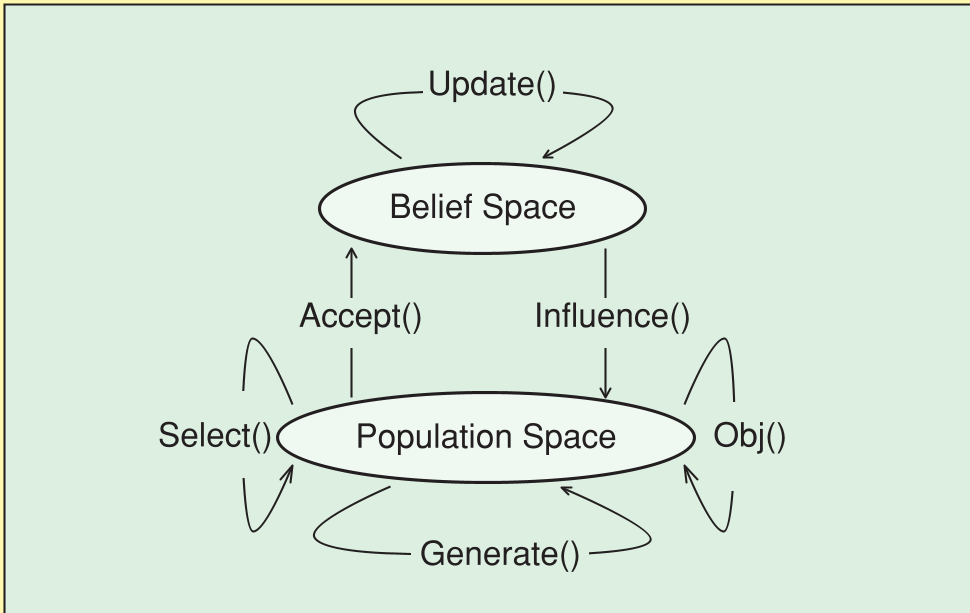
While Cultural Algorithms have long been successful in mimicking macro-evolution (the belief space) and micro-evolution (the population space), a fundamental question remained: How does the structure of social interaction actually influence the search trajectory?
Earlier iterations of the Cultural Algorithms Toolkit (CAT) focused on the Marginal Value Theorem (MVT) from population biology to balance exploration and exploitation. However, they lacked a formal mechanism to model the "Social Fabric"—the intricate web of relationships (kinship, economic, etc.) that defines how real-world cultures solve problems. The authors hypothesized that by "weaving" these social networks back into the algorithm, they could regulate the "knowledge swarming" process more effectively.
Methodology: The Core Architecture
The system is built upon three pillars: the Five Knowledge Sources, the MVT Influence Function, and the new Social Fabric.
1. The Five Knowledge Sources
The belief space is comprised of universal knowledge types:
- Topographic: Maps the landscape.
- Normative: Defines "good" ranges for variables.
- Domain: Specific problem-solving heuristics.
- Situational: Exemplary cases (the "Best-of" list).
- History: Tracks search dynamics over time.
2. Knowledge Swarming via MVT
The system treats knowledge sources as "predators" foraging in a "patch" (a bounding box of the search space). Using the Marginal Value Theorem, knowledge sources stay in a patch until the "yield" (improvement in fitness) drops below the environmental average.
3. The Social Fabric Extension
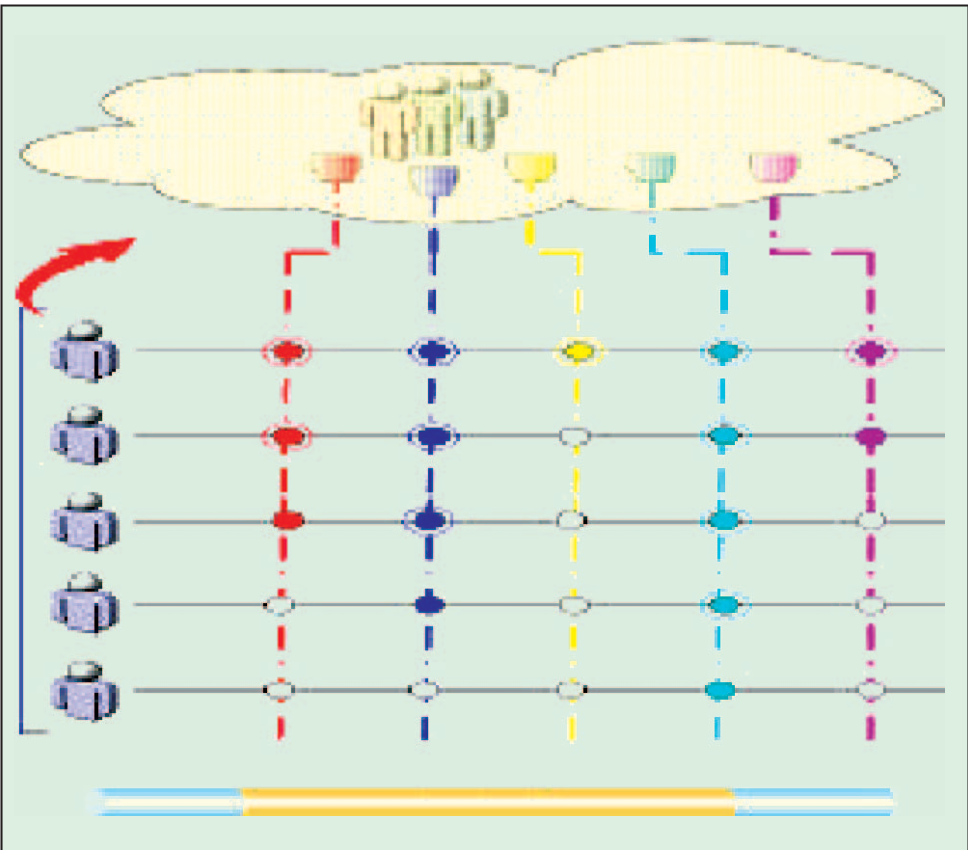
The breakthrough in this paper is the Social Fabric. Instead of knowledge sources directly dictating agent behavior, they "seed" influencers in a network.
- Network Topologies: The authors tested Ring (lbest) and Square topologies.
- Voting Mechanism: Agents receive bids from multiple knowledge sources via their neighbors and "vote" on which one to follow for the next step.
Experiments & Results: The Pressure Vessel Challenge
The authors put their "woven" algorithm to the test against the Pressure Vessel Design problem—a non-linear constraint optimization task with four design variables (thickness of shell, thickness of cap, radius, and length).
Key Findings:
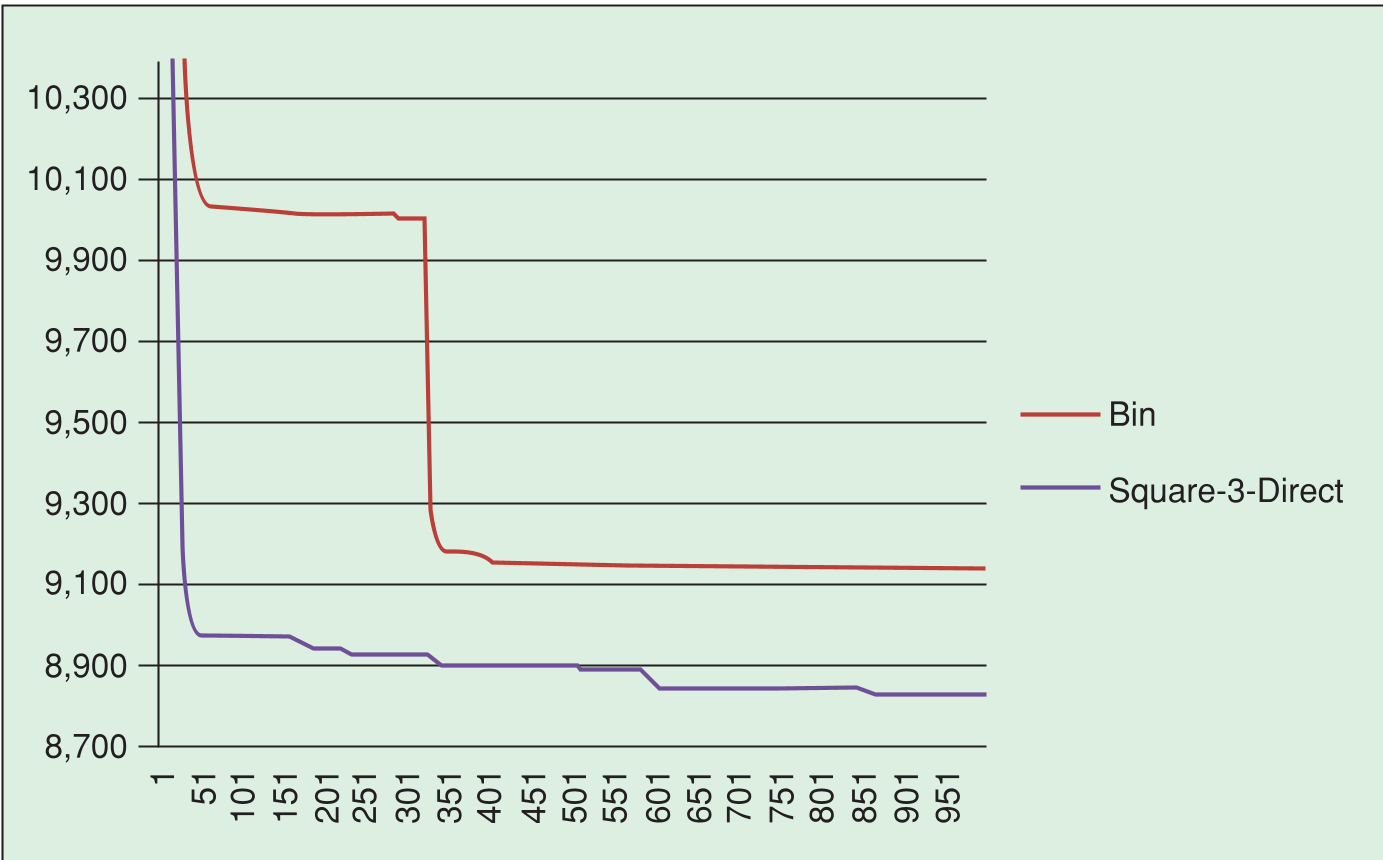
- Network Power: The Social Fabric (Square topology) consistently outperformed the MVT-only baseline in terms of finding the global minimum.
- The "Digestive" Effect: Interestingly, accessing the network every 3 generations (Experiment #2) yielded much more stable results than accessing it every year (Experiment #1). This suggests that the population needs interval steps to "digest" the impact of the social influence before the next broadcast.
| Metric | CAT (MVT Only) | CAT (MVT + Social Fabric - 3yr) |
|---|---|---|
| Best Value | 8814.131 | 8798.165 |
| Mean | 9132.489 | 8830.251 |
| Std. Dev. | 285.955 | 67.455 |
Critical Analysis & Conclusion
This work demonstrates that the topology of social connection is just as important as the quality of information. By allowing agents to filter knowledge through a social network, the algorithm avoids premature convergence and explores the landscape with greater collective intelligence.
Takeaway: Optimization isn't just a math problem; it's a social one. For developers and researchers using evolutionary algorithms, incorporating a "social layer" that limits the frequency of global updates can lead to much more robust and consistent convergence in high-dimensional spaces.
Future Outlook: The authors suggest that every optimization problem may have a "signature network"—a specific social topology best suited for its unique landscape. Finding these signatures could be the next frontier in automated algorithm design.