
AG-S3: Rethinking Scalable Privacy in the Age of Social Networks
Computing in social networks
The paper defines the S³ problem (Scalable Secure computing in Social networks) and introduces AG-S3, a decentralized protocol for computing symmetric aggregation functions. It allows nodes to compute functions like polling or counting without a central authority, achieving competitive scalability and security under a rational-adversary model.
TL;DR
Is it possible to conduct a global poll on Facebook without Facebook actually knowing how you voted? This paper introduces the S³ Problem (Scalable Secure Social computing). The authors propose AG-S3, a protocol that achieves efficiency and accuracy by replacing heavy cryptography with a "social reputation" mechanism. It proves that decentralized, private, and scalable computation is possible if we assume users value their digital reputation.
Context & Motivation: The Centralization Paradox
Modern social networks are gold mines of data, but they are controlled by central authorities that often prioritize profit over privacy. While we want to perform large-scale computations (like crowdsourcing or political polling), we shouldn't have to trust a central server.
Prior attempts to solve this via Secure Multi-Party Computation (SMPC) are theoretically sound but practically broken for social scales—they are simply too slow and message-intensive. The AG-S3 protocol seeks a different trade-off: it sacrifices absolute cryptographic perfection for a system that is fast, scalable, and "secure enough" because misbehaving users risk being publicly "tagged" as untrustworthy.
The Core Mechanism: Groups, Proxies, and Secret Shares
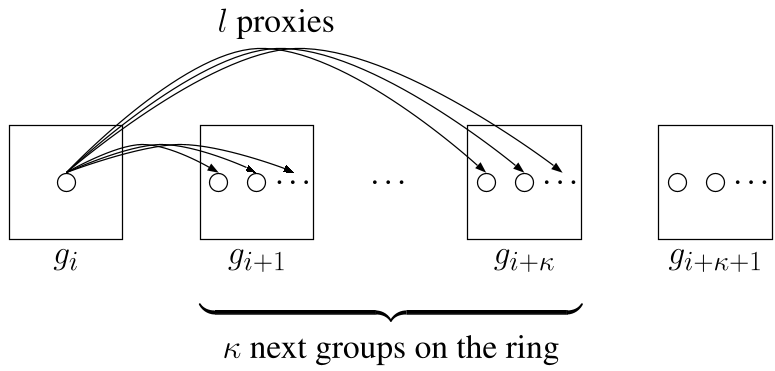
The beauty of AG-S3 lies in its structured overlay. Nodes are not just a chaotic swarm; they are organized into groups on a virtual ring.
1. The Overlay Structure
Nodes are clustered into groups of size . A node communicates with its "officemates" and a small number of "proxies" in subsequent groups. This structure ensures that no single node needs to know everyone else, keeping the spatial complexity at .
2. Secret Sharing with a Social Twist
To ensure privacy, a node doesn't send its input directly. Instead, it breaks its input into multiple shares.
- Many shares are random noise.
- One share contains the actual input.
- The sum of these shares equals the input.
These shares are scattered among proxies. Because proxies only see an "individual aggregate" of many shares from different clients, they cannot pinpoint the original input of any specific person.
3. Verification & Reputation
The protocol assumes "Rational" rather than purely "Byzantine" actors. Users care about their public profile. If a node tries to bias the output by sending an impossible value, its neighbors can detect the anomaly using distance-based checks (Lipschitz continuity) and "tag" the offender's profile.
Methodology: The Reduction Theorem
A major technical contribution is the Reduction Theorem. The authors prove that if you can solve the S³ problem for component-wise vector addition, you've essentially solved it for any regular symmetric function. By representing multisets of inputs as vectors, complex social analytics are reduced to simple, verifiable addition.
Experiments & Results: Performance at Scale
The paper provides a rigorous theoretical proof of correctness and accuracy:
- Scalability: Computational and message load per node is only , a massive improvement over SMPC protocols.
- Accuracy: The error remains negligible relative to the total population, specifically .
- Anonymity: The probability of an adversary successfully deanonymizing a user vanishes as the network grows.

Critical Insight: Why Does This Work?
The intuition here is the Trade-off between Privacy and Accuracy. In many systems, to verify a node isn't cheating, you have to see its data (breaking privacy). AG-S3 bypasses this by using groups. You don't verify the individual, you verify the group aggregate. As long as there is at least one non-compromised group in a chain (which is statistically likely in large networks), the privacy chain remains intact.
Future Outlook
While AG-S3 sets a high bar for decentralized social computing, it opens new questions:
- Can we increase the tolerance of faulty nodes beyond ?
- How would this perform in a "Sybil" environment where one person can create thousands of fake accounts?
This work serves as a foundational step toward a world where "Social Computing" doesn't mean "Giving your data to a Tech Giant," but rather "Computing together as a community."