
Concatenated Network Codes: Bridging the Complexity-Performance Gap in GBNC
A family of concatenated network codes for improved performance with generations
This paper introduces a novel family of concatenated network codes designed to enhance the erasure performance of Generation-Based Network Coding (GBNC). By serially combining an outer convolutional code for "generation mixing" and an inner block code, the method achieves significant reliability gains without the high complexity of large-scale block coding.
TL;DR
To solve the efficiency bottleneck of Random Network Coding (NC), researchers have long used "generations" (small blocks), but this sacrifices error correction power. This paper proposes a Concatenated Network Code that introduces "generation mixing". By using a convolutional outer layer to create packets spanning multiple generations, it achieves a "trickle-down" decoding effect that reduces failure rates by nearly 10x while keeping the low computational footprint of small-block coding.
Problem & Motivation: The Block Size Dilemma
In the world of Network Coding, size matters. If you code across all source packets simultaneously, you get optimal erasure protection but your CPU melts under the or complexity of Gaussian elimination. To stay practical, systems like the one proposed by Chou et al. use Generations—partitioning data into small, manageable chunks.
The catch? Standard generations are silos. If a generation loses too many packets, it’s gone forever, even if the next generation arrives perfectly. The authors identified this fragmentation of redundancy as a major weakness. Their insight: what if we could "mix" a few packets between generations to let a successful future generation help rescue a failed past one?
Methodology: The Architecture of Mixing
The proposed framework consists of a serial concatenation of two codes:
- Outer Convolutional Code (): It takes the current generation and previous generations to produce "mixed-generation" packets.
- Inner Block Code: It performs standard random linear network coding within the current generation.
Encoder Architecture
The source packets are first processed by a systematic convolutional encoder. Because it's systematic, the original packets are preserved (Rate 1), but mixed packets are added. These mixed packets are linear combinations of the current and past window of generations.
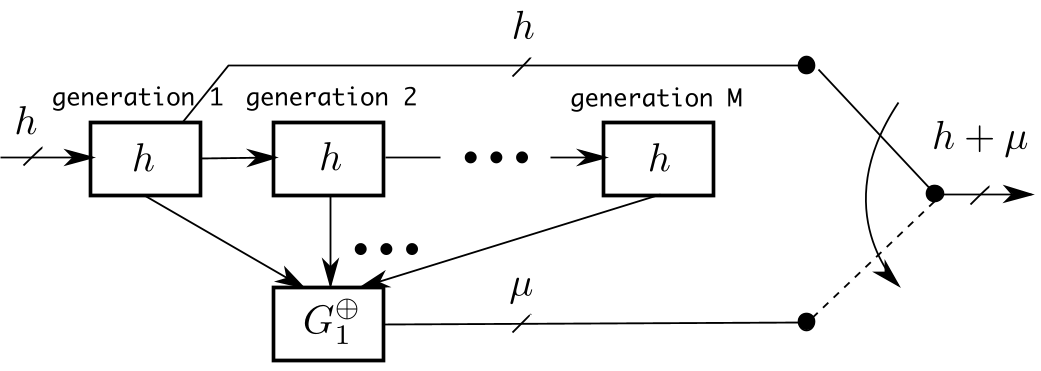 Fig 1: General block diagram of the concatenated encoding phase per generation.
The "Trickle-Down" Decoding Logic
The brilliance lies in the decoder states. When a generation arrives, the decoder attempts standard recovery. If it fails (rank deficiency), it doesn't give up. It waits for the next generation. If the next generation is successfully decoded, its packets can be subtracted from the "mixed packets" received earlier, potentially providing the missing rank to solve the previous failed generation.
This creates a chain reaction. A single successful generation at the end of a transmission could theoretically trigger the decoding of a long sequence of previously "lost" blocks.
Experiments & Results: Quantifying the Gain
The authors tested the code on simple 2-node lines and complex ISP topologies (Rocketfuel).
Performance on Lossy Channels
The results confirm that even a small amount of mixing () dramatically shifts the performance curve. As seen in the probability of decoding failure (PDF) graphs, the concatenated schemes (C-M,L) consistently outperform the block coding baseline.
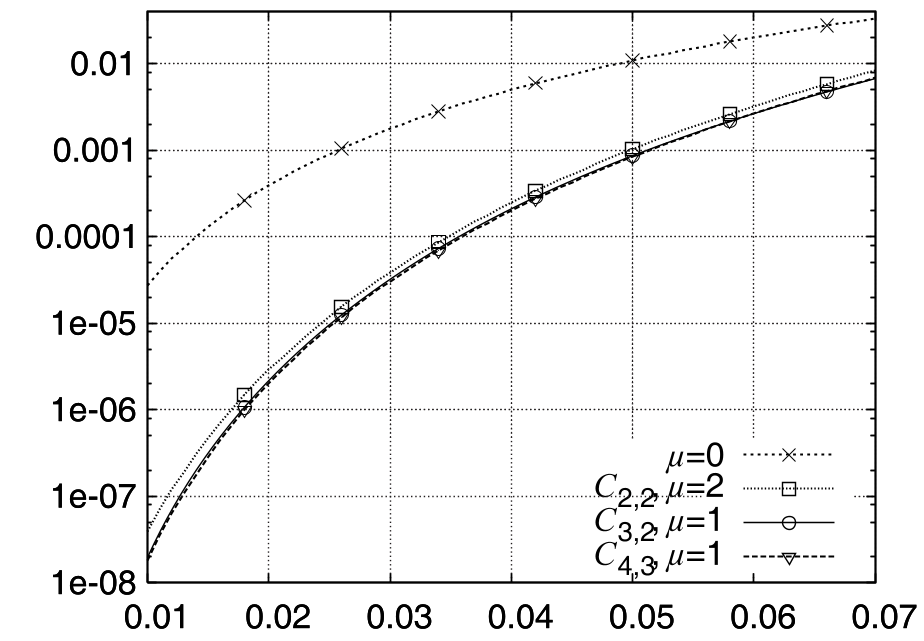 Fig 2: Decoding failure probability (PDF) comparison. Note how the concatenated codes (M=2, 3, 4) achieve much lower failure rates than the M=1 baseline.
Handling Bursty Erasures
The code shines even brighter in bursty channels (Gilbert-Elliott model). In scenarios where erasures come in waves, the flexibility of the "mixed" packets allows the system to bridge the gaps caused by bad channel states better than rigid block codes.
Critical Analysis & Conclusion
Why it Works
The fundamental advantage is the increase in effective block size without the quadratic cost in complexity. By spreading packets across a memory length , the code creates a virtual larger block. The authors correctly point out that beyond , the gains provide diminishing returns because the probability of "unlocking" mixed packets decreases as the window grows.
Limitations
- Latency: The "trickle-down" effect implies that a generation might not be decoded until several generations later, which may not suit real-time voice applications.
- Buffer Management: Transport nodes need to buffer generations, though this is a minor cost in modern hardware.
Final Takeaway
For large-scale multicast or broadcast where feedback (ACK/NACK) is impossible or too expensive, this concatenated approach is a superior "drop-in" replacement for standard GBNC. It offers a 10x reliability boost with negligible overhead, proving that a little bit of mixing goes a long way.