
CKMN: Bridging the Semantic Gap with Explainable Concept Knowledge Mining
Towards More Explainability: Concept Knowledge Mining Network for Event Recognition
The Concept Knowledge Mining Network (CKMN) is a novel explainable event recognition framework that leverages multi-domain concept representations (scene, object, action). By utilizing intra-domain temporal mining and inter-domain co-attention, it achieves State-of-the-Art (SOTA) results, specifically reaching 81.7% mAP on FCVID and 85.6% mAP on ActivityNet.
TL;DR
Researchers from the Chinese Academy of Sciences and Huawei have unveiled CKMN (Concept Knowledge Mining Network), a framework that makes video event recognition both more accurate and more "human-readable." By shifting focus from raw pixels to high-level concepts (like "candles" or "kitchen") and modeling how these concepts interact over time, CKMN outperforms traditional black-box models on major benchmarks while explaining why a video was classified as a "Birthday Party" or "Making Coffee."
The "Black Box" vs. Concept Mining
Most current SOTA video recognition models rely on 3D-CNNs or Transformers. While powerful, they are essentially black boxes—they provide a label but no reasoning. Concept-based methods were proposed as an alternative, but they historically struggled because they didn't understand the temporal dynamics of concepts:
- Scene concepts (e.g., "Parlor") usually last the whole video.
- Action concepts (e.g., "Blowing") appear only for seconds.
- Interactions (e.g., "Cake" + "Candle" + "Fire") are what truly define the event.
CKMN addresses this by treating concepts not as static features, but as dynamic knowledge to be mined.
Methodology: The Two Pillars of CKMN
The architecture revolves around two core subnetworks that process initial concept detections (from pre-trained Scene, Object, and Action detectors).
1. IaCKM: Mining Intra-domain Evolution
The Intra-domain Concept Knowledge Mining (IaCKM) subnetwork is designed to recognize that some concepts are "marathons" and others are "sprints."
- Short-term Existence Mining (StEM): Uses Dilated Temporal Pyramid Convolutions. By varying the dilation rate, the model can "see" concepts at different temporal scales without increasing the parameter count.
- Long-term Existence Mining (LtEM): Employs Temporal Self-Attention to identify concepts that provide a consistent "semantic anchor" throughout the entire video.
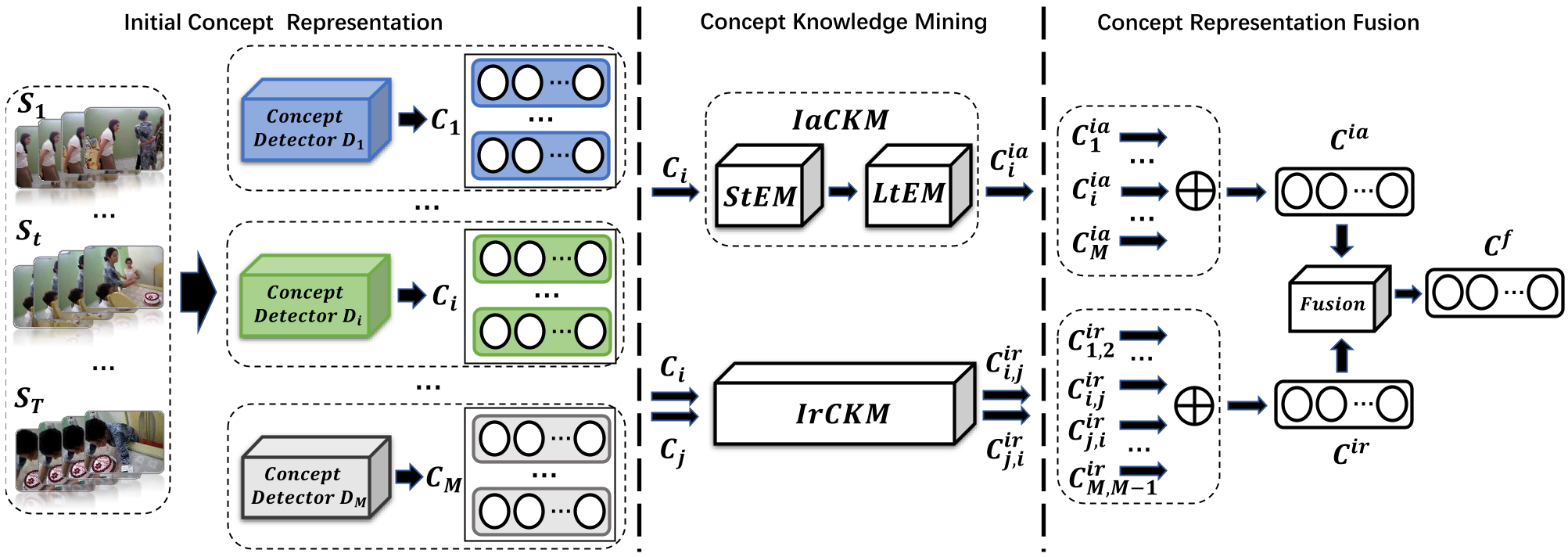 Caption: The CKMN pipeline, showing the flow from segment-level concept detection to Intra- and Inter-domain mining.
2. IrCKM: Cross-Domain Synergy
The Inter-domain Concept Knowledge Mining (IrCKM) subnetwork is where the model explores "Co-occurrence." For instance, seeing a "Mug" (Object) becomes much more relevant to "Making Coffee" (Event) if a "Kitchen" (Scene) is also detected. CKMN uses a co-attention style learning to let representations from one domain (e.g., Objects) emphasize or suppress features in another (e.g., Actions).
Experimental Performance: Knowledge over Volume
One of the most striking results is CKMN's efficiency. While previous works like OSF used over 20,000 distinct concepts, CKMN uses only 1,765 general-sense concepts but achieves higher accuracy.
| Dataset | Method | mAP |
|---|---|---|
| FCVID | OSF (Prior Concept SOTA) | 76.5% |
| FCVID | CKMN (Ours) | 81.7% |
| ActivityNet | P3D (Appearance-based) | 78.9% |
| ActivityNet | CKMN (Ours) | 85.6% |
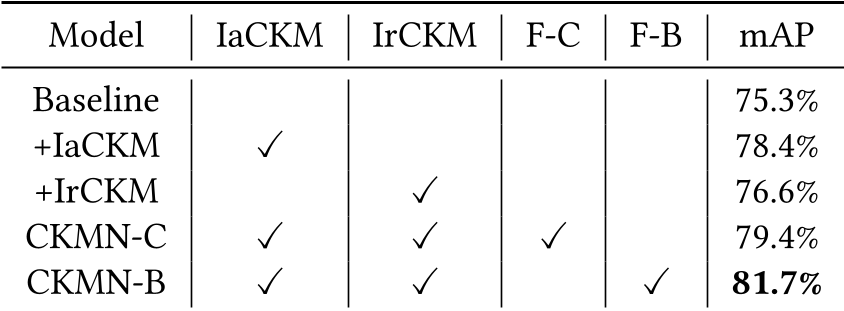 Caption: Ablation study showing the significant gain (+6.4% mAP) when combining IaCKM and IrCKM with Bilinear Fusion.
Why It Matters: Real-World Interpretability
Beyond the numbers, CKMN provides a "recounting" of the video. If the model identifies a video as "Soccer," it can explicitly highlight the "Soccer field" (Scene), "Soccer ball" (Object), and "Shooting goal" (Action). This level of transparency is critical for applications in automated surveillance, content moderation, and accessible AI.
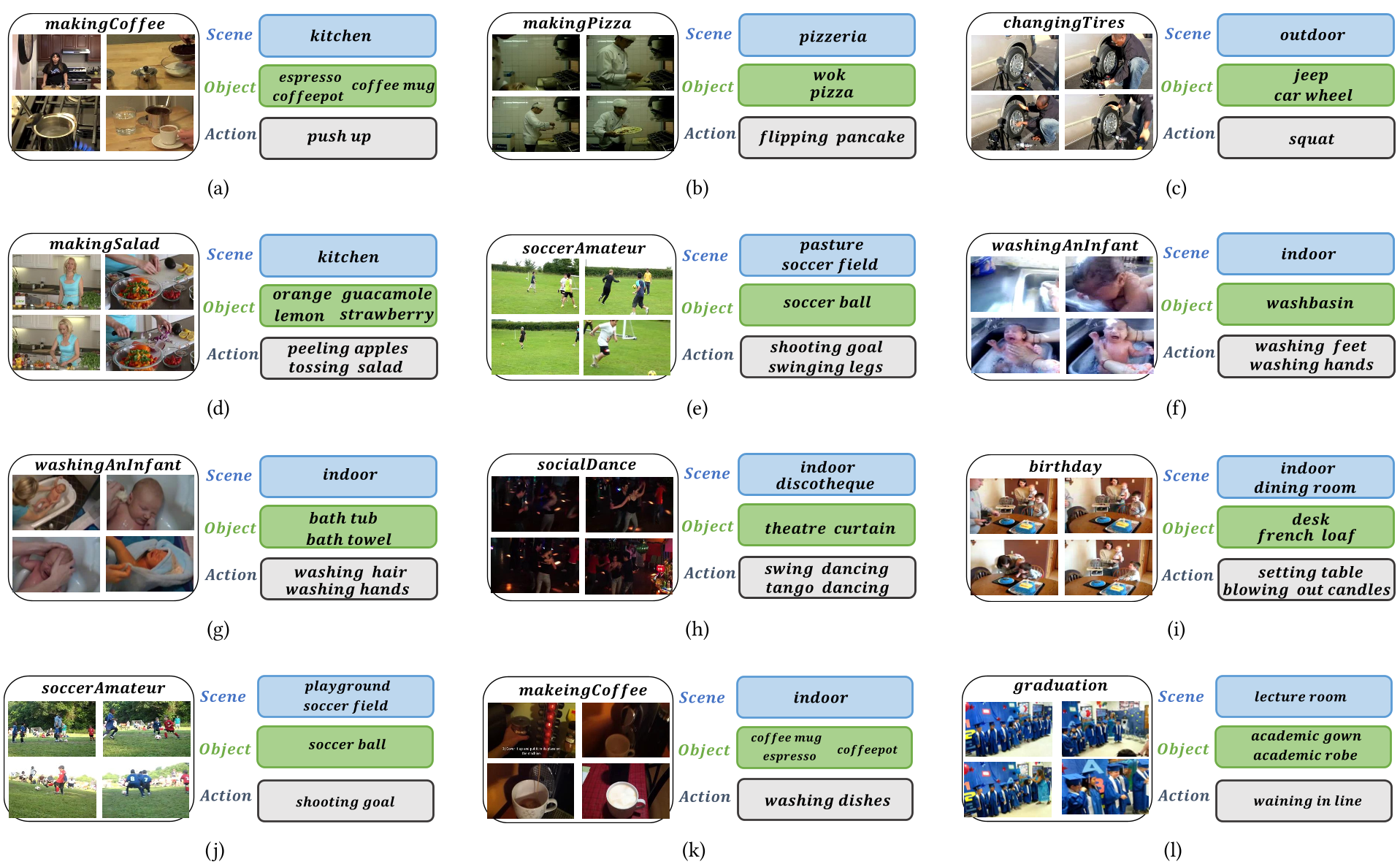 Caption: Visualizing how CKMN links specific concepts to event categories, providing a semantic trace for its decisions.
Conclusion
CKMN proves that structured knowledge mining is a viable, and perhaps superior, path for complex video understanding compared to pure feature engineering. By modeling how long concepts last and how they correlate across domains, the framework moves us one step closer to AI that understands videos the way humans do: through the lens of semantic concepts.