
Social BPM: Bridging the Gap Between Rigid Processes and Human Collaboration
A Conceptual Framework for Social Business Process Management
This paper proposes a conceptual framework for Social Business Process Management (Social BPM) that integrates social dimensions into traditional BPM. It introduces a multi-perspective meta-model (Behavioral, Organizational, Social) and an operational OWL ontology with SWRL rules to automate knowledge inference and improve process flexibility.
TL;DR
Traditional Business Process Management (BPM) often treats humans as static resources in a flowchart. This paper introduces a Conceptual Framework for Social BPM that treats social interactions—like power dynamics, negotiations, and expert voting—as core components of the process. By using a sophisticated Social Ontology, the authors move beyond mere social media integration to a logic-driven system that adapts to real-world complexity, specifically in high-stakes fields like crisis management.
Problem & Motivation: The Model-Reality Divide
In many advanced process-based applications (e.g., disaster relief or virtual organizations), the process cannot be fully defined at the start. Traditional BPM fails here for three reasons:
- Innovation Gap: End-users who execute the process have no way to feedback into the design, leading to a "deviation" from the original model.
- Lack of Visibility: Actors are often restricted by Role-Based Access Control (RBAC) and don't know what can be done beyond what must be done.
- Isolation: There is no formal mechanism for an overworked actor to dynamically delegate tasks or ask for help based on social trust or proximity.
Methodology: The Three-Perspective Meta-Model
The authors propose a meta-model that bridges the gap between design and execution by intertwining three dimensions:
1. Behavioral & Organizational Perspectives
These track the "What" (tasks, goals, dependencies like facilitate or impede) and the "Who" (roles, groups, and standard norms).
2. The Social Perspective (The Core Innovation)
Unlike previous works that simply added a "comment section" to a task, this framework defines:
- Social Relations: Explicit links like Power (hierarchy), Coordination (info exchange), Control, and Substitution (who can replace whom).
- Interaction Protocols: Formal rules for engagement, such as the Contract Net Protocol or Voting, allowing actors to collaboratively decide on the next steps of a process.

Putting Logic to Work: The Social Ontology
To make this model "alive," the authors implemented it using OWL (Web Ontology Language) and SWRL (Semantic Web Rule Language).
Instead of hard-coding every possible interaction, the system uses inference rules. For example, a Transitive Power Rule allows the system to calculate delegation paths automatically:
- If Person A has Power over B, and B has Power over C, then A can technically delegate through the chain to C.
Crisis Management Case Study
The paper illustrates the framework using a French crisis management scenario. When a disaster strikes, the Prefet (Regional Authority) doesn't just follow a static script. They might launch a Call for Proposal protocol to find available hospitals or utilize a Substitution relation where firemen take over SAMU (paramedic) duties during an influx of casualties.
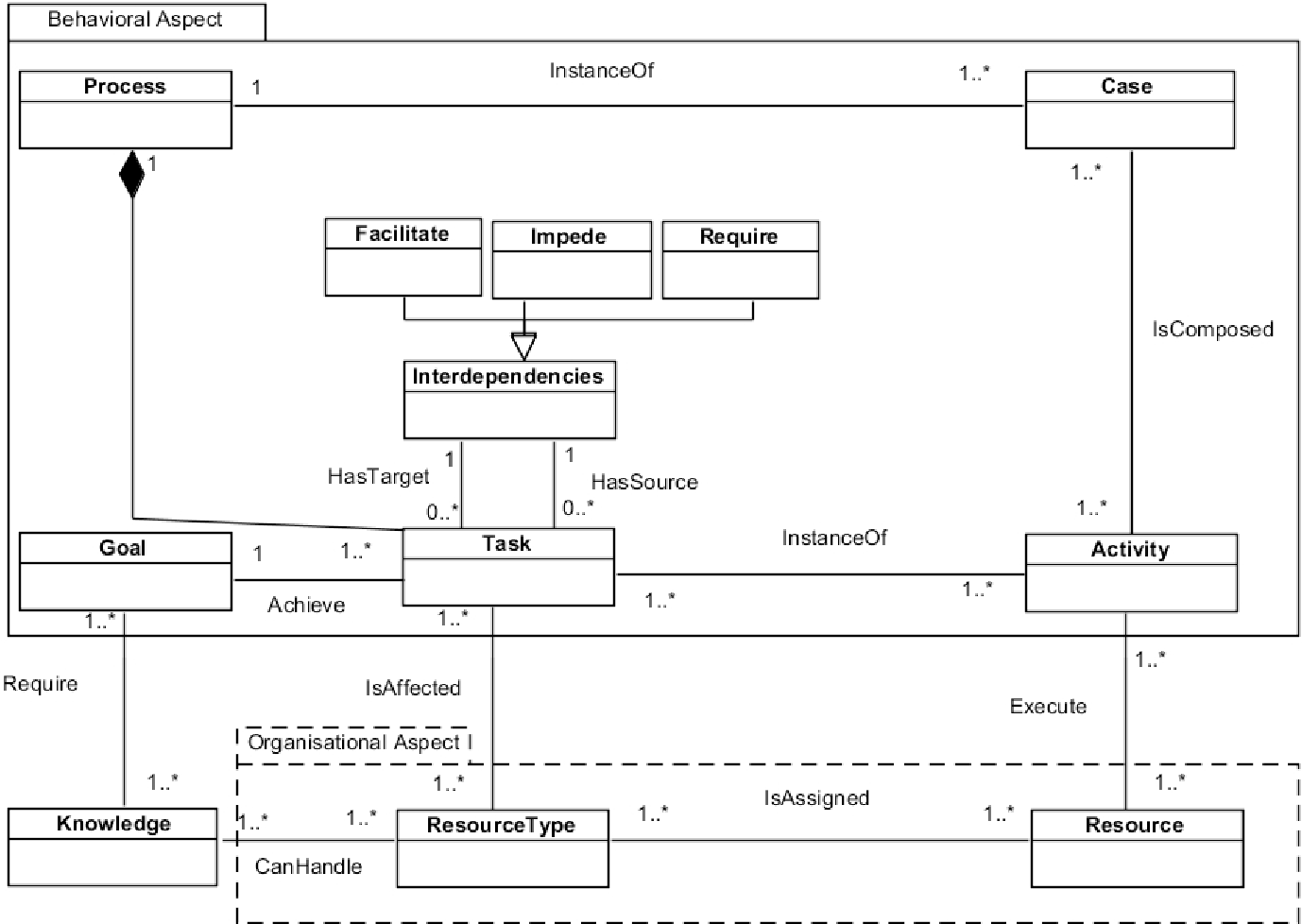 Figure: The behavioral interdependencies (facilitate, require, impede) that govern task execution.
Experiments & Results: Semantic Efficiency
The authors demonstrated that by querying the ontology with SPARQL, users can gain unprecedented visibility. Actors can ask:
- "Which tasks allow me to reach Goal X?"
- "Who coordinates with whom in the Samus division?"
The key results show that this semantic approach reduces the Model-Reality divide by allowing the process to morph at runtime based on the social relations currently active in the system.
Critical Analysis & Conclusion
Takeaway
This work shifts Social BPM from a technical definition (using social tools) to a conceptual one (modeling social logic). It proves that social relations are not "noise" in a process but are essential coordination mechanisms that define its efficiency.
Limitations & Future Work
While the conceptual framework is robust, the authors acknowledge that user-friendly interfaces are still needed. Typing SPARQL queries is not feasible for a fire chief on the ground. Future work involves wrapping this logic into Web Services and potentially extending BPMN (Business Process Model and Notation) to include these social perspectives natively.
Senior Editor's Note: This paper is a significant theoretical step. In the age of AI, the next evolution of this work will likely involve using LLMs to navigate these ontologies, allowing human-like reasoning to drive complex organizational workflows.