
Beyond Sequential Talk: Scaling the Naming Game via Parallel Simulation
Concurrent conversation modeling and parallel simulation of the naming game in social networks
This paper introduces a concurrent, asynchronous revision of the classical Naming Game, a model for linguistic consensus emergence in social networks. By transitioning from sequential evaluation to a Parallel Discrete Event Simulation (PDES) framework, the author enables the modeling of large-scale agent populations with hundreds of thousands of individuals and demonstrates significant reductions in simulation time.
TL;DR
The Naming Game—a fundamental model for how social groups agree on words and meanings—has long been shackled by sequential processing. This paper breaks those chains, introducing a Concurrent Discrete Event Model that allows for simultaneous, time-spanning conversations. By leveraging Parallel Discrete Event Simulation (PDES), the research achieves a 3.4x speedup on large networks while revealing that concurrency actually changes the path to consensus.
Context: Why the Classical Model Fails at Scale
In the classical Naming Game, two agents are picked, they talk, update their dictionaries, and only then can the next pair start. This "stop-and-go" approach is fundamentally at odds with modern social networks where millions talk at once. Furthermore, it assumes conversations are instantaneous "telepathy," ignoring the physical reality of transmission delays.
The author, Kalyan S. Perumalla, argues that for the Naming Game to be relevant for today’s digital social planes (like auto-tagging or robot communication), we must embrace asynchrony.
Methodology: Deconstructing the Conversation
The core innovation lies in breaking a single "update" into eight distinct operations. This allows the simulation to handle a speaker who is simultaneously being addressed as a hearer—a "conflict" that doesn't exist in sequential models but is common in reality.
The Event-Based Architecture
The paper maps each person to a virtual timeline. Interactions are no longer global state changes but discrete events: Speak, Hear, and Revise.
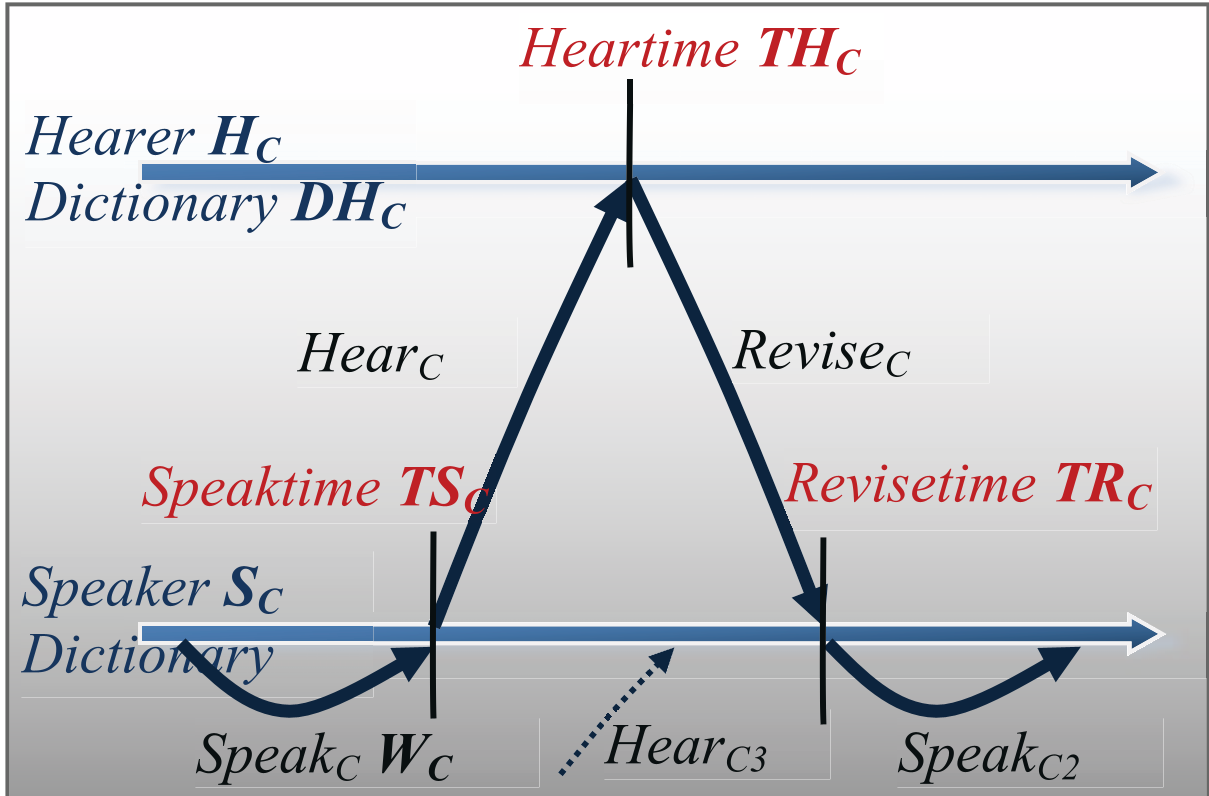 Figure 2: The concurrent asynchronous conversation flow across speaker and hearer timelines.
To handle this at scale, the system uses:
- Mattern-style synchronization: To maintain logical consistency across different processor cores.
- Adaptive Dictionary Data Structures: A clever mechanism that switches between bit-vectors (for dense word sets) and integer-vectors (for sparse sets) to minimize memory foot-print.
Experimental Insights: Consensual Dynamics
Does changing the rules change the outcome? Yes. The research shows that while the goal (consensus) is the same, the journey is different.
1. Dictionary Size Suppression
In the concurrent model, because many agents are "mixing" their vocabularies simultaneously, the maximum and average dictionary sizes remain lower than in the sequential version. The system is more "active" in pruning irrelevant words.
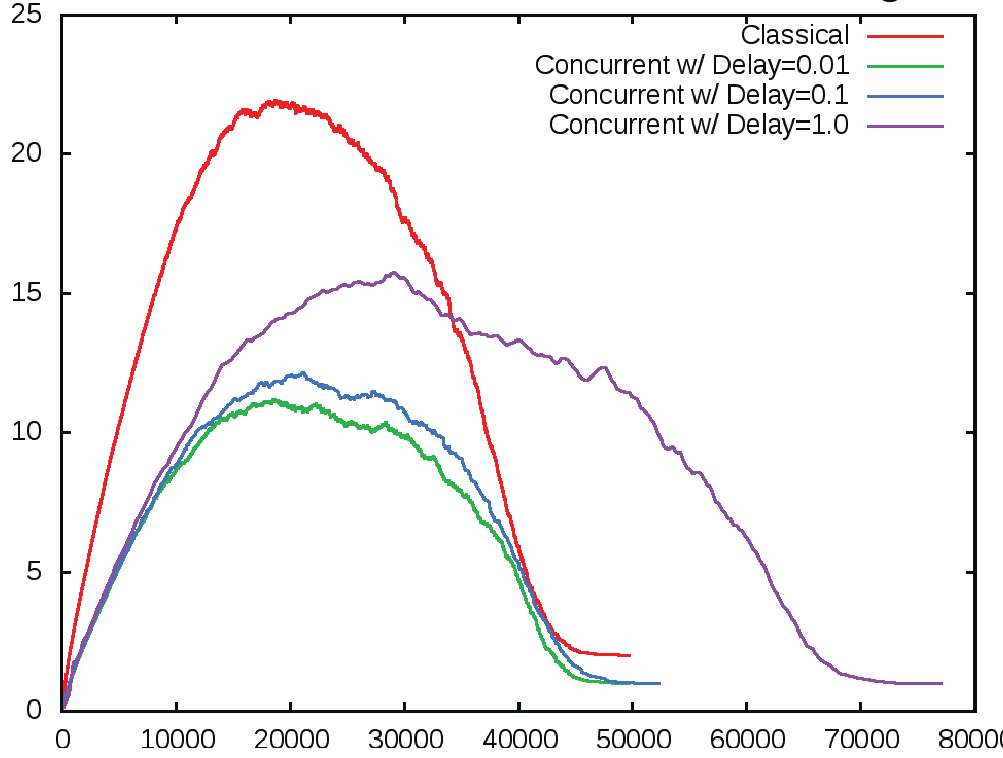 Figure 4: The concurrent model (with delays) reduces the peak average dictionary size compared to the classical model.
2. Parallel Performance
The simulation was tested with populations up to 262,144 agents. For small populations, the overhead of communication between cores makes parallelization slow. However, as the population scales, the workload becomes "coarse-grained" enough that adding cores provides significant benefits.
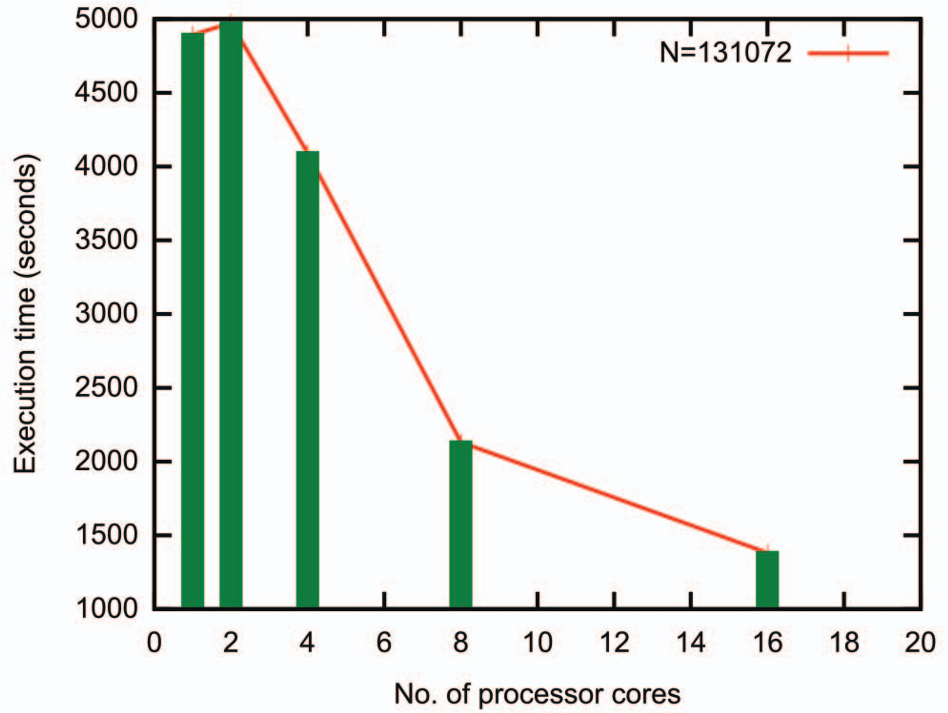 Figure 7: Scaling performance from 1 to 16 cores for large-scale agent populations.
Critical Analysis & Conclusion
This work provides a crucial bridge between social complexity and high-performance computing. By proving that we can relax the strict sequential order of agent-based models without losing the "emergent truth," it opens the door for simulating global-scale social phenomena.
Takeaway: The "time-stepped" or "strictly sequential" default in social modeling is a relic of limited computing power. Moving to an asynchronous, event-driven paradigm is not just a performance optimization—it is a more accurate representation of how the world actually talks.
Future Directions: The author points toward applying this to the Schelling Segregation model, suggesting that many "classic" social algorithms are ripe for a parallel, asynchronous makeover.