
NBFA: Optimizing Concurrent Team Formation via Collective Intelligence
Concurrent Team Formation for Multiple Tasks in Crowdsourcing Platform
This paper introduces the Best Fit Assignment (BFA) and NBFA algorithms for concurrent team formation in crowdsourcing platforms. It addresses the NP-hard problem of assigning mutually exclusive workers to multiple tasks with diverse skill requirements, achieving a provable (2 + α) approximation ratio while minimizing total cost.
TL;DR
In the rapidly growing gig economy, complex tasks (like web development) require diverse skill sets that a single freelancer rarely possesses. This paper tackles the Concurrent Team Formation problem—assigning a limited pool of workers to multiple tasks simultaneously. By introducing the Best Fit Assignment (BFA) and its multi-task extension NBFA, the authors provide a mathematically grounded approximation algorithm that strikes an optimal balance between worker cost and collective expertise.
The Motivation: Why Cost and Skill Greedy Approaches Fail
In crowdsourcing, two intuitive approaches usually dominate:
- Greedy by Cost (GBC): Hire the cheapest workers. This fails because hiring many low-skilled workers to meet a high threshold often results in a higher total bill than hiring one expert.
- Greedy by Skill (GBS): Hire the most elite workers. This fails because over-qualified workers charge premiums that exceed the marginal value of their "excess" skills for a specific task.
The authors identify a "sweet spot" using Collective Intelligence (CI)—selecting workers whose skills complement each other to fulfill a task's minimum requirements without overspending.
Methodology: From BFA to NBFA
The paper formalizes the problem as N:MRP (Minimum Reward Problem for N Tasks), proving it is NP-hard by reducing it to the Dual Bin Packing problem.
1. Best Fit Assignment (BFA) for Single Tasks
The BFA algorithm operates on the principle of Effective Skill (). If a task needs 10 units of Java skill and a worker has 15, their "effective skill" is only 10. BFA greedily picks workers who provide the highest ratio of:
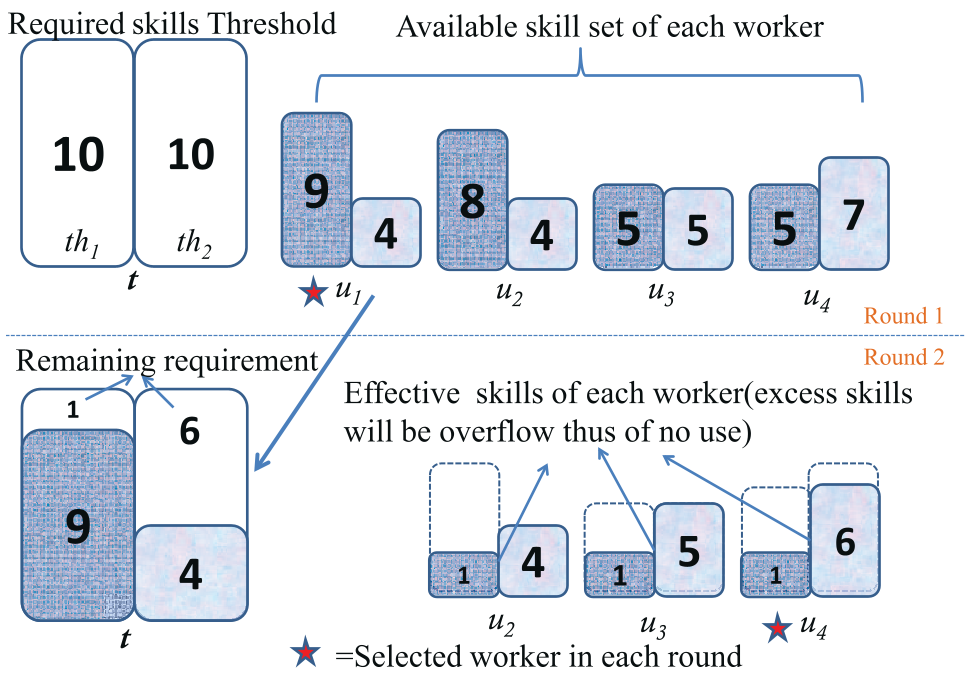 Figure 1: Sample demonstration of BFA selecting workers whose skills balance the remaining threshold.
2. Scaling to N-Tasks (NBFA)
To handle multiple tasks with a shared worker pool, the authors apply the Local Ratio Theorem. The algorithm decomposes the global cost matrix, increases the "virtual cost" of workers already tentatively assigned to other tasks, and uses a bottom-up refinement to ensure each worker is assigned to at most one task.
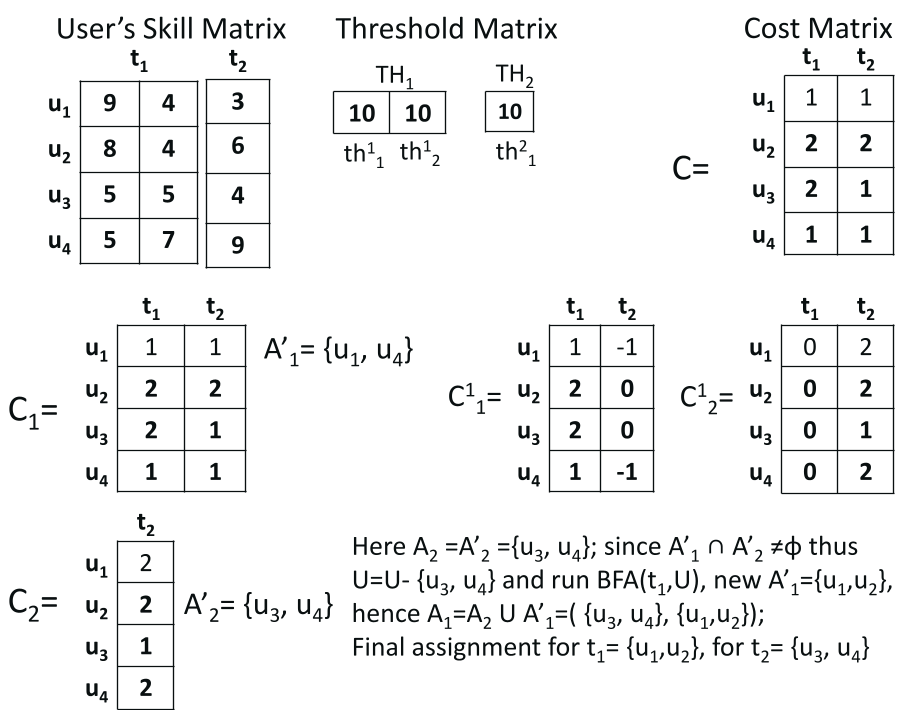 Figure 2: NBFA handling worker collisions across multiple tasks via cost decomposition.
Performance & Experimental Results
The researchers validated their approach using real-world data from Upwork, extracting skill rankings and hourly rates.
- Cost Efficiency: BFA outperformed Genetic Algorithms (GA) and Greedy schemes. Specifically, while GBS (Skill-Greedy) picked "all-stars," BFA picked "balanced teams," spending 14% less money while meeting the same requirements.
- Team Size: GBC (Cost-Greedy) ended up hiring 38% more workers than BFA to get the job done, leading to higher management overhead and total cost.
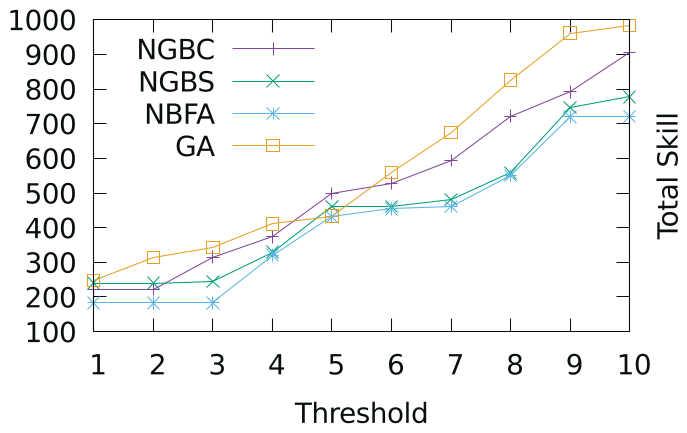 Figure 3: Threshold vs. Cost Comparison. Note how BFA (Red Line) consistently remains the lowest cost solution across increasing complexity.
Critical Analysis & Takeaways
The brilliance of this work lies in how it handles skill equity. By updating thresholds dynamically, BFA ensures that once a specific skill (e.g., PHP) is satisfied, the algorithm stops "valuing" that skill in subsequent worker selections, effectively pivoting to seek the remaining missing skills (e.g., Design).
Limitations: The current model assumes worker costs are static and skills are binary/scalar rankings. In the real world, "fatigue" (as mentioned in related work) and "synergy" (social connectivity) could further refine these assignments.
Final Word: For platforms like Upwork or Toptal, implementing NBFA-style logic could transition them from simple marketplaces to automated agency-builders, delivering high-quality teams at the lowest possible price point.