
Conformal Divergences: Transcending the Limits of Ordinary Bregman Clustering
On Conformal Divergences and Their Population Minimizers
The paper introduces Conformal Divergences, a unified family of dissimilarity measures generalizing both ordinary and Total Bregman Divergences within a (u, v)-geometric structure. It provides the first complete characterization of left and right population minimizers (centroids) for these divergences, proving they are exhaustive for their respective minimizer types.
TL;DR
In the world of clustering and information geometry, the "mean" isn't always the average. This paper introduces Conformal Divergences, a powerful superset of Bregman and Total Bregman Divergences. By operating within a generalized (u, v)-geometric structure, the authors characterize exactly how to find population minimizers (centroids) that are robust to outliers and invariant to rotations, effectively rewriting the rules for "best-fit" data summarization.
Background: Why the "Mean" is Often Wrong
For decades, the Bregman Divergence has been the workhorse of machine learning (powering k-means, EM, and exponential families). However, it has a major "hardcoded" limitation: its right population minimizer is always the arithmetic mean. No matter how you change the geometry (the generator function ), the center stays the same.
In fields like medical imaging (DTI) or computer vision, we need more flexibility. Total Bregman Divergences (TBD) were proposed to fix this, offering rotation invariance. But until now, TBDs were seen as a "tweak" rather than a part of a rigorous, broader family.
The Core Innovation: Conformal Divergences
The authors define a Conformal Divergence by introducing a "conformal factor" that regularizes the standard Bregman divergence.
By moving into the (u, v)-geometric structure, they separate the coordinate system of the gradient from the coordinate system of the space itself. This allows for a massive expansion of possible divergence measures while maintaining "dual flatness"—a property essential for efficient optimization.
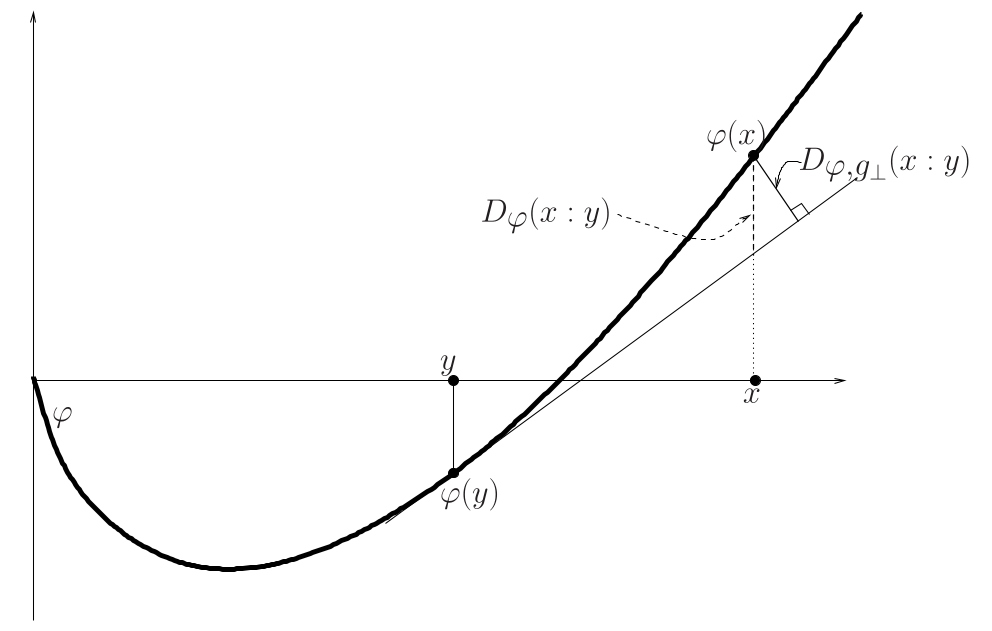 Visual comparison of Ordinary Bregman (left) vs. Conformal/Total Bregman (right). Note how the distance relates to the tangent space optimization.
Methodology: Where do the Minimizers Live?
The paper’s technical "heavylifting" lies in characterizing the Left and Right population minimizers:
- Left Minimizers (Weighted u-means): The left center of a conformal divergence is shown to be a weighted average in a transformed coordinate space. This explains why TBDs are so effective at "smoothing" signal processing data without losing sharp boundaries.
- Right Minimizers (Tangent Projections): For the Right minimizer of a Total Bregman Divergence, the authors prove a beautiful geometric result: the minimizer is the point whose orthogonal projection in a dimensional space (the "lifted" space) hits the center of the data.
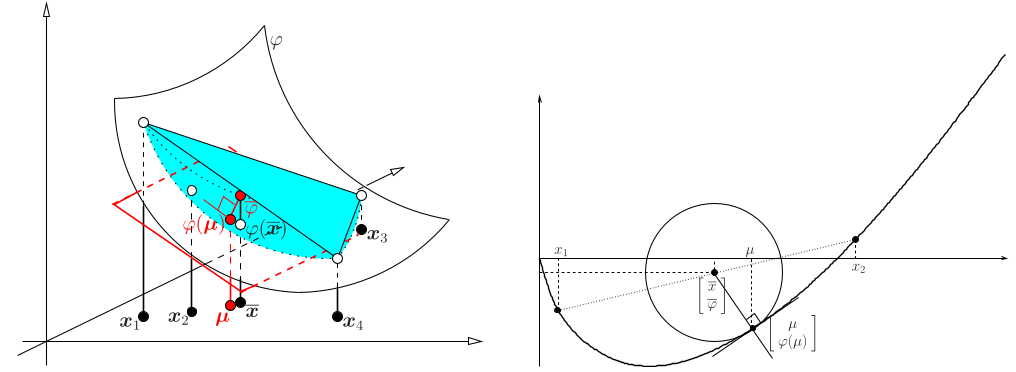 Geometrical construction of the population minimizer. The point μ is found where the vector to the data average is orthogonal to the tangent hyperplane.
Key Results & Robustness
The paper confirms why these new divergences outperform standard methods in noisy environments:
- Total Bregman Exhaustiveness: They prove that if a divergence is axis-rotation invariant and has a specific minimizer geometry, it must be a Total Bregman Divergence.
- Robustness to Outliers: Using the influence function, the authors demonstrate that while the arithmetic mean (Standard Bregman) can be pulled infinitely far by a single outlier, Conformal Divergences remain "stable" (B-robust).
| Divergence Type | Minimizer Type | Robust? | Invariant? |
|---|---|---|---|
| Ordinary Bregman | Arithmetic Mean | No | No |
| Total Bregman | Orthogonal Projection | Yes | Rotation |
| Conformal (New) | Weighted u-mean | Yes | Coordinate-Adaptive |
Critical Insight: The (u, v) Equivalence
Perhaps the most profound insight is the Tolerance Relation. The authors show that we can "tune" the coordinate mappings and independently. This means that for a specific clustering task, we can optimize the coordinate system to fit the distribution of the data without ever changing the fundamental loss function.
Conclusion
This paper elevates Total Bregman Divergences from a specialized tool to a member of the diverse Conformal family. For developers of clustering algorithms and computer vision pipelines, this provides a rigorous roadmap: if your data is noisy or needs rotation invariance, move beyond the arithmetic mean and embrace the geometry of conformal factors.
The "mean" is no longer a fixed point; it is a geometric choice.