
The Power of the Pack: How Connected Bot Groups Dominate Social Influence
Using Connected Accounts to Enhance Information Spread in Social Networks
This paper introduces "Spreading Groups," a novel social bot operating mode that utilizes dense, interconnected sub-structures to bias opinion spread. By simulating information cascades, the authors demonstrate that connected bots are twice as influential as random bots and achieve influence parity with the network's most central (Eigenvector/PageRank) nodes.
TL;DR
Forget the lone-wolf bot. New research reveals that Spreading Groups—dense clusters of interconnected automated accounts—can exert as much influence on social networks as the most powerful human "influencers." By coordinating their activity and echoing messages within a tight-knit structure, these groups can increase information spread by up to 28 times compared to random bots, all while remaining undetected by traditional AI security filters.
Background: The Evolution of Social Manipulation
The digital battlefield of public opinion is no longer just about the volume of messages; it's about the architecture of the messenger. While platforms like Twitter and Facebook claim to detect over 95% of individual bots, the reality on the ground suggests a much higher survival rate. This paper identifies a critical gap in current defense mechanisms: the strategic use of connected sub-structures.
The "Spreading Group" Insight
The researchers posited a simple but lethal intuition: A group of bots that are "friends" with each other and interact with a shared set of humans is far more influential than a thousands of disconnected bots.
Why does this work?
- Algorithmic Cloaking: By spreading the "seeding" process over time (Gradual Seeding), the group avoids the massive traffic spikes that trigger bot-detection alerts.
- Reinforcement: In social psychology, hearing a message from multiple "independent" sources increases its perceived credibility. Spreading Groups exploit this by mimicking a grassroots consensus.
- Structural Advantage: Even though these bots might not have the highest global "Centrality," their local density creates a powerful engine for pushing messages into the broader network.
Methodology: Engineering the Echo Chamber
The authors utilized a preferential attachment model (simulating the "rich get richer" nature of social following) but injected a specific "Spreading Group" (SG) logic.
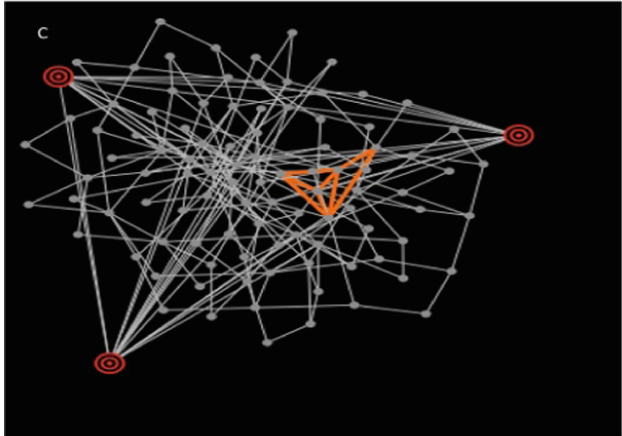 In the figure above, (B) represents the Spreading Group strategy, where seeds are concentrated in a dense, interconnected cluster rather than scattered (A) or targeted at global hubs (C & D).
The Math of Forgetting
A key contribution of this work is the integration of Retention Loss. Human attention is fleeting. The model uses an exponential decay formula: Where is the probability of a human re-sharing a message, which drops as time passes. This forced the researchers to find the "sweet spot" of timing—seeding too fast causes detection; seeding too slow misses the window of human interest.
Experimental Results: Bot Power vs. Influencer Power
The most striking finding is the comparison between Spreading Groups and "Global Influencers" (nodes with the highest PageRank or Eigenvector Centrality).
- Vs. Random Bots: Spreading Groups are roughly 2x more influential.
- Vs. Top Influencers: Spreading Groups achieved 75% to 108% of the influence of the network's most powerful nodes.
This means that a state actor or commercial entity doesn't need to hack a celebrity's account; they can simply build a well-connected "neighborhood" of several dozen unremarkable bots to achieve the same result.
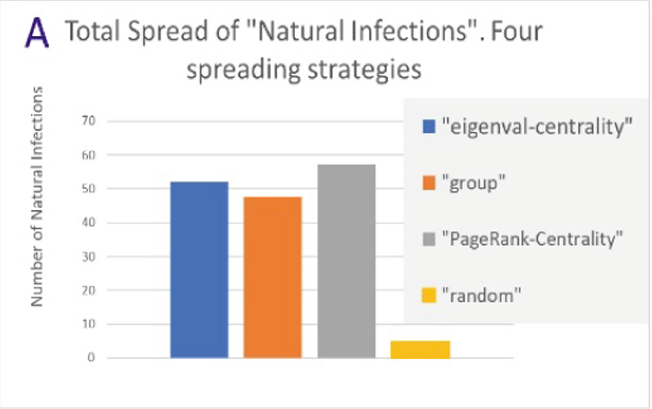 Figure 2A shows the massive gap between Random Seeding (bottom line) and the other strategies, with Spreading Groups (SG) performing competitively against high-centrality nodes.
Critical Insights & Future Outlook
The paper confirms that social media platforms are fighting an uphill battle. If bots are organized into groups, they can "hide in plain sight" by staying dormant or alternating which accounts are active.
The Takeaway for Developers and Policy Makers:
- Stop looking at accounts, start looking at links: Detection algorithms must move toward Community Detection. A group of accounts that only follow and retweet each other is a red flag, regardless of how "human" their individual profiles look.
- Timing is everything: The study proves that "gradual seeding" is the pro-strategy for manipulation. Real-time monitoring of temporal correlations between seemingly unrelated accounts is the next frontier.
While the researchers successfully modeled the "How," the "Why" remains a chilling reminder of how easily our digital consensus can be manufactured through simple graph theory and a bit of automation.