
Decoding COLLNET: Connectivity, Stratification, and the "Small-World" of Scientific Collaboration
Connection and stratification in research collaboration: An analysis of the COLLNET network
This paper utilizes Social Network Analysis (SNA) to map and analyze the COLLNET international collaboration network. The study confirms that the network exhibits "small-world" and "scale-free" properties, driven by a hierarchy of central hubs that facilitate global connectivity despite sparse overall collaboration.
TL;DR
Is the scientific community a democratic level playing field or a stratified hierarchy? This study analyzes COLLNET, a global interdisciplinary network, revealing it to be a scale-free, "small-world" system. While it facilitates rapid information flow through highly connected "hubs," it remains strikingly vulnerable: removing just three key individuals can shatter the network's cohesion.
The Hidden Physics of Collaboration
Scientific progress is rarely a solitary endeavor. As researchers collaborate, they form a complex social topology that dictates how knowledge diffuses. The authors of this paper argue that the macro-structure (the whole network) and micro-structure (individual roles) of these collaborations create a "physics of connection" that influences creativity and productivity.
The central problem is that while collaboration is increasing, the networks are often "inhomogeneously wired." This leads to a tension between efficiency (getting information quickly) and robustness (not falling apart if a leader departs).
Methodology: Mapping the Scientific Ego
The researchers analyzed 48 members of the COLLNET network using several sophisticated Social Network Analysis (SNA) metrics:
- Macro-Level Connectivity: Measuring the "average degrees of separation" (geodesic distance) and the "clustering coefficient" (how likely your friends are to be friends with each other).
- Scale-Free Distribution: Plotting the probability of an author having collaborators to see if the network follows a power law ().
- Centrality Measures: Calculating Degree (local influence), Closeness (global efficiency), and Betweenness (brokerage power).
- K-Core Analysis: Identifying the "inner circle" or the resilient core of the network.
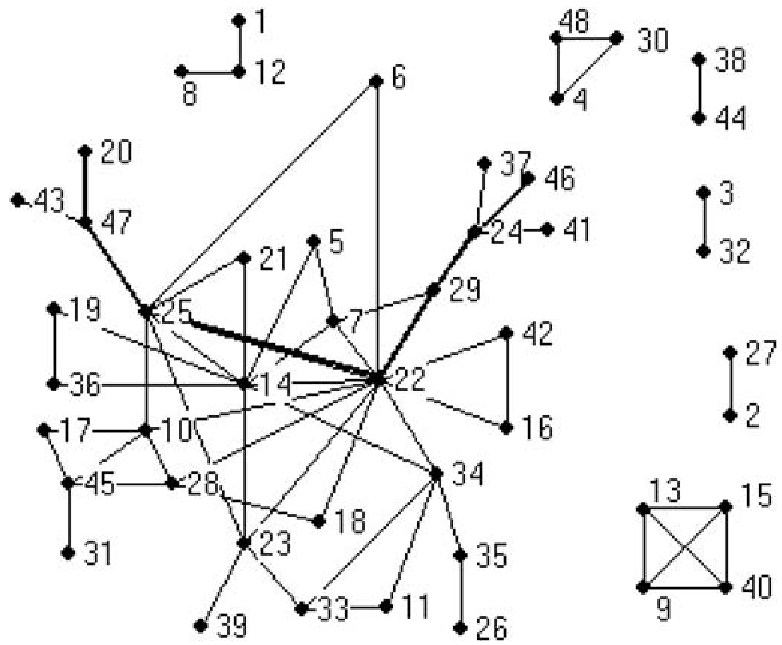 Figure 1: The initial topology of the COLLNET network showing 48 nodes and 63 links.
Key Findings: The Power of the Few
1. The Small-World Paradox
The study found a mean geodesic distance of 3.02, echoing the "six degrees of separation" theory but in a much tighter scientific context. Despite members being spread across 20 countries, most are only three steps away from one another. This is facilitated by a high clustering coefficient (0.643), significantly higher than counterparts in MEDLINE or physics archives.
2. Stratification and the "Star" Effect
The degree distribution followed a power law (), suggesting preferential attachment: prominent researchers attract more collaborators, further increasing their prominence. Node 22 (the network's chair) emerged as the "genuine dominator," ranking first in every centrality dimension.
3. Fragility of the Elite
The most striking experiment was the "attack" on the network's robustness. By removing the three most influential nodes (14, 22, and 25), the network collapsed into eight isolated fragments. Conversely, when nodes were removed randomly, the "main core" survived even after a 50% loss of participants.
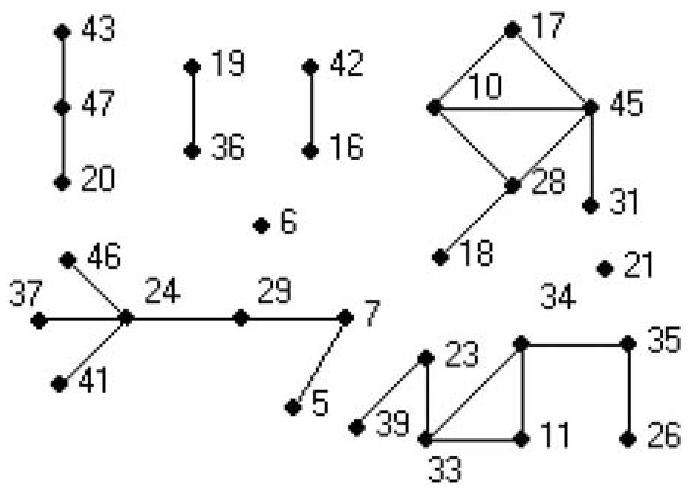 Figure 3: Fragmentation of the network after removing the top 3 central hubs.
Critical Insight: Elites as Integrators
The paper concludes with a nuanced take on inequality. While stratification is inevitable in small-world networks, it isn't necessarily detrimental. In COLLNET, the "elites" do not form a closed, exclusionary clique. Instead, they act as integrative hubs that connect diverse, peripheral researchers to the main core.
Limits and Future Work:
- The study is a "snapshot" in time (2003). Modern networks, fueled by digital platforms, likely show even lower geodesic distances.
- The network is "young" and "narrow," which might exaggerate the influence of its founders.
Conclusion
This research highlights that the health of a scientific community depends on its hubs. To foster a robust research field, institutional support should not only focus on individual productivity but also on fostering the "brokers" who ensure the network remains connected and resilient against the loss of key figures.