
SOLVER: Bridging Virtual and Physical Social Networks for Reliable Vehicular Communication
Connectivity Management in an Integrated Heterogeneous Social Networks Framework in Vehicular Environments
The paper proposes SOLVER, a heterogeneous network framework that integrates Online Social Networks (OSNs) with Vehicular Social Networks (VSNs). It introduces a connectivity management technique that enables dynamic switching between P2P vehicular links and Client-Server OSN links to ensure seamless data exchange in high-mobility environments.
TL;DR
Vehicular Social Networks (VSNs) often fail due to physical distance, while Online Social Networks (OSNs) are limited by centralized server bottlenecks. The SOLVER framework integrates these two domains, allowing vehicles to perform "vertical handovers" between P2P and Client-Server modes. This hybrid approach ensures that if a car can't find a local peer to pass a message to, it hops onto an OSN bridge, maintaining a Packet Delivery Ratio (PDR) of over 90%.
The Connectivity Gap in VSNs
In the world of autonomous and connected vehicles, real-time data exchange (traffic updates, hazard warnings) is critical. However, current VSNs rely on opportunistic networking. If there isn't a car within transmission range, the "store-carry-and-forward" mechanism takes over, leading to delays that are unacceptable for safety-critical tasks.
The authors identify a missed opportunity: most drivers are already part of Online Social Networks (OSNs). While VSNs are volatile but fast (direct P2P), OSNs are stable but centralized. The core motivation is to use OSN infrastructure as a "safety net" for the fragmented physical vehicular network.
Methodology: The Hybrid Switch
The paper defines three types of nodes:
- Pure VSN: Standard P2P (IEEE 802.11p).
- Pure OSN: Standard LTE/CS mode.
- Hybrid OSN-VSN: The "Smart Connector" that can navigate both.
The technical heart of the paper is the Connectivity Index (), calculated as: where is the VSN node degree (popularity in the physical world) and is the OSN connectivity (stability in the virtual world).
The SOLVER Algorithm
When a source vehicle wants to send a packet, it first tries a direct V2V link. If that fails, it looks for a Cluster Head (CH). If the CH determines there is no physical forwarder but specifies the destination is an OSN member, it triggers an Handover to OSN.
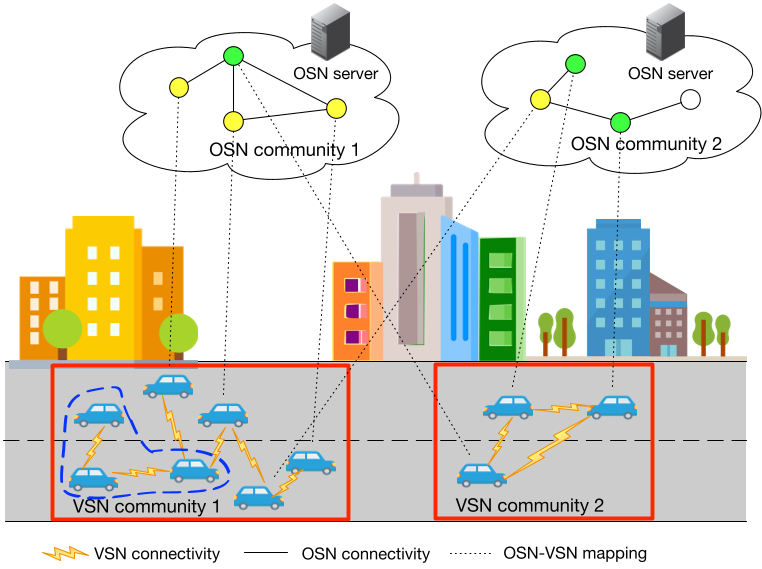 Figure 1: The architecture showing overlapping VSN communities (clusters of cars) and OSN communities connected via virtual servers.
Experimental Proof: Best of Both Worlds
The authors tested SOLVER in NS3 against pure P2P and pure Client-Server (CS) architectures.
1. Delay Optimization
In low-density scenarios, SOLVER benefits from P2P routes to keep latency low. As node density increases, P2P delay explodes due to queuing at Cluster Heads. SOLVER avoids this by offloading excess traffic to OSN servers, maintaining a much flatter delay curve than P2P.
2. Reliability (PDR)
The most striking result is in Packet Delivery Ratio. In a 30-node network:
- P2P mode collapses to 20% PDR because the network graph is too fragmented.
- SOLVER maintains >90% PDR, almost matching the centralized CS mode but with lower average latency.
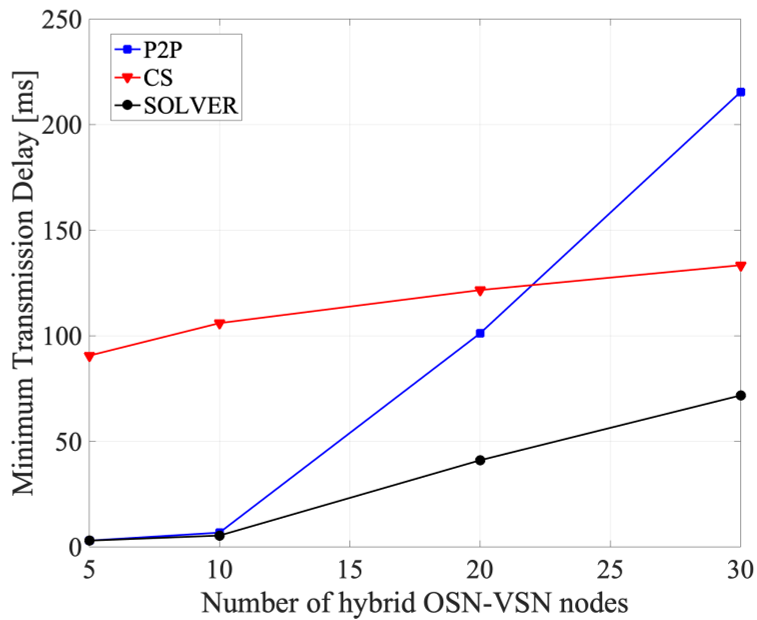 Figure 2: Performance comparison showing SOLVER's superior balance between delay (a) and delivery ratio (b).
Critical Insight & Future Outlook
While SOLVER solves the "disconnection" problem, it introduces a new challenge: Server Outage. The paper notes that if too many vehicles switch to OSN mode simultaneously, the server surpasses its upload rate threshold ().
The ultimate takeaway is that the future of ITS (Intelligent Transportation Systems) isn't just about better hardware (DSRC vs CV2X), but about Social-Aware Intelligence. By treating social ties as routing metadata, we can create a more resilient internet of vehicles.
Limitations: The current model assumes nodes have near-perfect knowledge of their neighbors' social status, which might encounter privacy hurdles or beacon overhead in real-world deployments.