
Consensus vs. Crowdsourcing: Navigating ICT Choices for Cultural Institutions
Consensus versus Crowdsourcing in Collaborative Decision-Making Applied in Cultural Institutions
The paper explores collaborative decision-making frameworks within cultural institutions, specifically comparing Consensus Building and Crowdsourcing for selecting optimal ICT platforms for virtual exhibitions. It introduces a multi-criteria analysis model and evaluates 10 major crowdsourcing platforms against specialized institutional needs.
TL;DR
In the digital transformation of museums and libraries, choosing the right software is a high-stakes decision. This paper analyzes two primary paths for collaborative choice: Consensus Building (focused on expert alignment) and Crowdsourcing (leveraging the "wisdom of the crowd"). By evaluating 10 global platforms and proposing a structured multi-criteria loop, the authors provide a roadmap for cultural institutions to adopt ICT solutions effectively.
The Digital Dilemma in Cultural Heritage
Modern cultural institutions are no longer just physical archives; they are digital hubs requiring 3D representations and virtual exhibitions. However, the bottleneck is often the selection of the platform itself. Should a museum use MOVIO (open source), Omeka (publishing-focused), or Prezi (storytelling)?
The difficulty lies in the "multi-dimensional" nature of the problem:
- Technical requirements: Scalability, security, and robustness.
- Content adequacy: Accuracy and response time.
- Logistical constraints: Price and dependency on technical support.
Methodology: Two Paths to a Single Choice
The authors break down the collaborative process into two distinct technical paradigms:
1. Consensus Building (The Expert Path)
This is an iterative process where a limited group of decision-makers moves through "Levels of Agreement." The goal is to reach a jointly feasible decision rather than a simple majority vote.
 Figure 1: The progression from Blocking to Full Agreement in consensus-oriented GDM.
2. Crowdsourcing (The Mass Wisdom Path)
In contrast, crowdsourcing involves an unlimited number of people. While it drives innovation (citing the 1714 "Long-Term Problem" of the British government), it requires a more rigid structure:
- Problem Formulation: Casting the ICT choice into "rules of the game."
- Solution Aggregation: Integrating complementary small-scale resolutions.
Evaluating the Marketplace
One of the most valuable aspects of the paper is the comparative analysis of existing crowdsourcing platforms. The authors note that while platforms like Amazon Mechanical Turk or Innocentive are powerful, they often alienate the "older adult" demographic due to complex UI/UX—a critical flaw for cultural projects that rely on intergenerational participation.
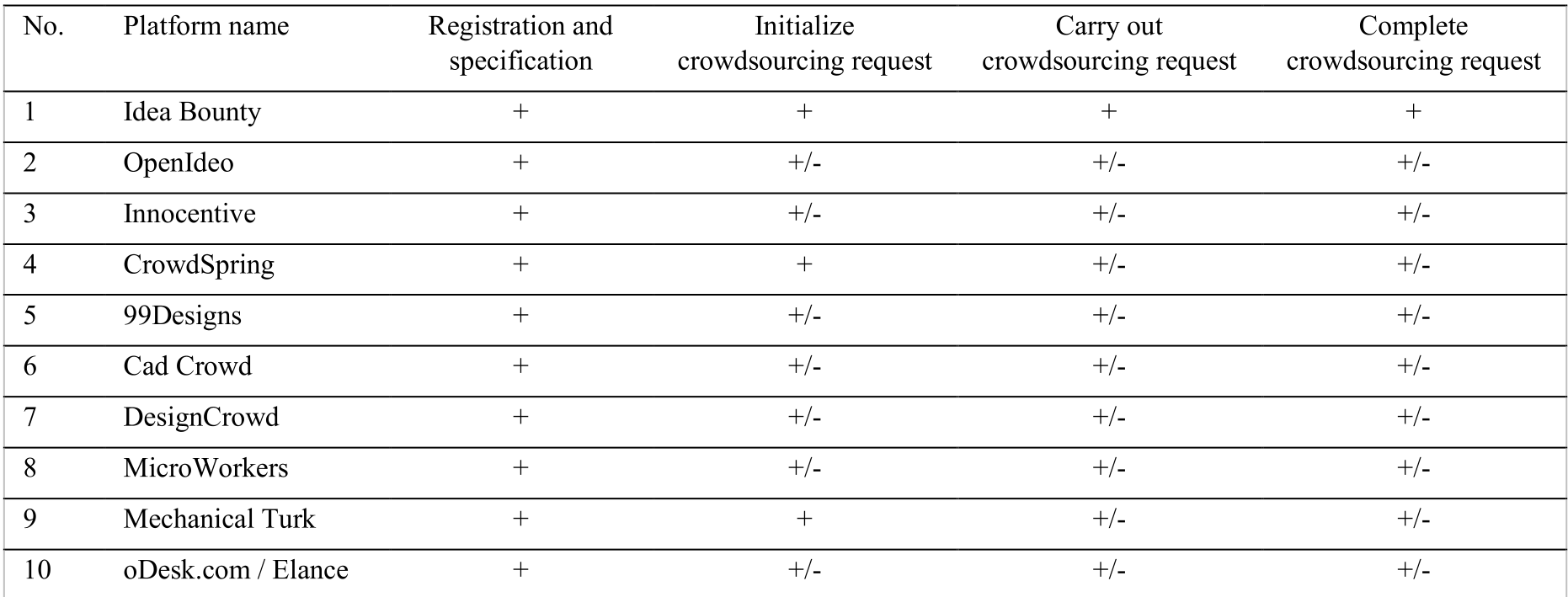 Table 1: Comparison of top 10 crowdsourcing platforms based on request initialization and completion features.
Deep Insights: The "Decision Taker" vs. "Decision Maker"
A sharp distinction is made between Decision Takers (those accountable for consequences) and Decision Makers (those who prepare the data). The paper suggests that effective collaboration involves:
- Avoiding Polarization: Using "Polarization Indices" to identify when experts stand out with extreme scores.
- Closing the Loop: Decisions should not be final until "Back to Step 1" occurs, ensuring that user feedback on the virtual exhibition informs the next cycle of ICT upgrades.
Critical Analysis & Conclusion
The paper successfully bridges the gap between pure decision theory (AHP, ELECTRE) and practical implementation in the cultural sector. However, the limitations are clear: the paper notes that "emotions of the crowd" can disrupt rational MCDM, and malicious activity on platforms remains a threat.
Takeaway: For a cultural institution, the "Goldilocks" zone lies in using Crowdsourcing for data tagging and transcription while maintaining Expert Consensus for high-level infrastructure selection. Future research will likely focus on "Affective Analytics"—measuring the emotional state of the crowd to predict the reliability of their decisions.
This research was a joint effort between the Romanian and Polish Academies of Sciences, emphasizing the global nature of collaborative decision-making.