
Consensus, Polarization, and the Strategy of Social Influence: A Deep Dive into Opinion Dynamics
Consensus, polarization and clustering of opinions in social networks
This paper introduces a generalized Deffuant-Weisbuch model to analyze opinion dynamics in social networks using a multi-dimensional "hard-interaction" trust function and a "strategic interaction" framework. It identifies the phase transition conditions from polarization to consensus and validates these findings using the Social Evolution dataset.
TL;DR
Why do some social groups reach a unified consensus while others fracture into hostile echo chambers? This paper generalizes the Deffuant-Weisbuch (DW) model to show that opinion formation is a byproduct of both "hard-interaction" thresholds (open-mindedness) and "strategic" utility (the cost of dialogue). By analyzing multi-dimensional probability vectors rather than simple scalars, the authors provide a rigorous mathematical framework for the phase transitions that lead to social clustering.
Problem & Motivation: Beyond Simple Averages
In classical models like DeGroot, agents simply average their opinions with neighbors. However, real life is more complex:
- Bounded Confidence: We don't listen to people whose views are too radical compared to ours.
- Strategic Effort: We choose who to talk to. Dialogue takes time and energy; if the "distance" is too great, we stop trying.
The authors argue that prior works (like the original DW or HK models) are too limited because they treat interaction rates as fixed and opinions as one-dimensional. To solve this, they treat opinions as points in a simplex (probability distributions) and model the "trust" as a dynamic function of distance.
Methodology: The Core of the Model
1. The Hard-Interaction Model
The authors define a trust function which operates on the squared distance between opinions . Unlike the original DW model where is a constant, here can vary, representing how much "weight" you give to someone else's view. Importantly, if the distance exceeds a threshold , the trust drops to zero—this is the Hard Interaction.
2. The Strategic Interaction Model
This is the most innovative part of the paper. Instead of random encounters, agents maximize a Utility Function:
- : The reward (reaching consensus).
- : The cost (the energy required to communicate with someone different).
- : The probability/rate of interaction.
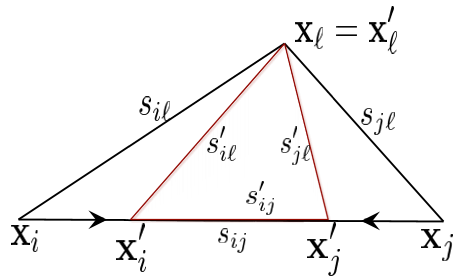 Figure 1: Illustration of how opinions move closer in the simplex space during an interaction.
Experiments & Results: The Phase Transition
The authors used ODE approximations to predict when a society will reach consensus. They found a "Phase Transition" boundary. If the threshold of open-mindedness is higher than the average initial disparity , the group converges. If not, they polarize.
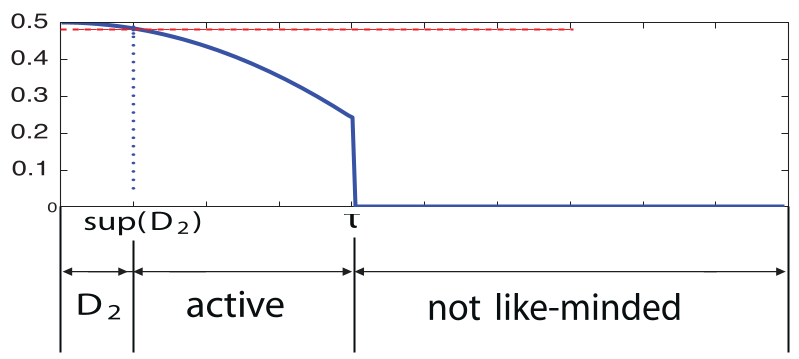 Figure 2: The sharp transition from polarization (low algebraic connectivity) to consensus as the threshold increases.
Real-World Validation: Social Evolution Dataset
The researchers didn't just stay in the realm of math. They used the Social Evolution Dataset, tracking the proximity of students in a dormitory via mobile phone data.
- Finding: Student location habits (where they hang out) showed clear Clustering behavior over time, perfectly matching the model’s predictions for strategic interaction.
- The Anomaly: Health habits (eating/exercise) did not cluster. Why? The authors suggest these habits have a much smaller , meaning people are more closed-minded about their lifestyle choices than their hangout spots.
Deep Insight: Why Clustering Happens
The model reveals that Clustering is the equilibrium when the cost of interaction grows faster than the reward of consensus. In "Case Study (ii)" of the strategic model, they demonstrate that groups form clusters where internal distances are small enough to be "cost-effective" to maintain, while distances between groups are too large to bridge, given the social energy required.
Critical Analysis & Conclusion
This paper provides a powerful bridge between Statistical Physics and Social Science. It moves the field forward by:
- Proving that fixed communication rates don't change the necessity of the consensus condition, but strategic rates change the pattern of the clusters.
- Identifying that interaction "incentives" are the primary drivers of echo chambers.
Limitations: The model assumes agents are somewhat rational in maximizing utility. In current hyper-polarized digital environments, "negative reward" (malicious interactions) might exist, which this model doesn't explicitly cover.
Future Prospect: Integrating this model with algorithmic filtering (Recommendation Engines) could explain how AI accelerates or mitigates the social phase transitions described here.