
Knowledge-Driven Anatomy: A New Frontier in Medical Image Ontology Construction
Constructing Medical Image Domain Ontology with Anatomical Knowledge
This paper introduces an anatomical knowledge-driven method for automatically constructing medical image domain ontologies from unstructured reports. By combining prior knowledge of human anatomy with dependency parsing, it transforms free-text reports into structured XML semantic trees and merges them into a cohesive domain ontology, achieving SOTA-level F1 scores (~90%) across various modalities.
TL;DR
Converting unstructured medical imaging reports into machine-readable knowledge is a persistent challenge in healthcare AI. This paper presents a framework that uses anatomical prior knowledge to guide a dependency parsing-based extraction system. By transforming reports into XML semantic trees and merging them, the researchers achieved F1-scores near 90% across multiple imaging modalities (CT, MRI, Ultrasound), outperforming traditional LSTM models while requiring significantly less manual annotation.
The "Anatomy" of the Problem
Doctors produce millions of imaging reports daily, yet most remain trapped in narrative text format. While systems like UMLS and SNOMED CT provide broad terminologies, they often lack the fine-grained "Attribute-Value" relationships found in specific diagnostic reports (e.g., "thyroid left lobe" -> "size" -> "normal").
Prior works generally fall into two traps:
- Rule-based systems: Highly accurate but brittle and labor-intensive.
- Deep Learning (LSTM/CNN): Requires massive annotated datasets and often produces "hallucinated" or logically inconsistent relationships because the model doesn't "understand" the human body's structure.
Methodology: The Knowledge-Driven Engine
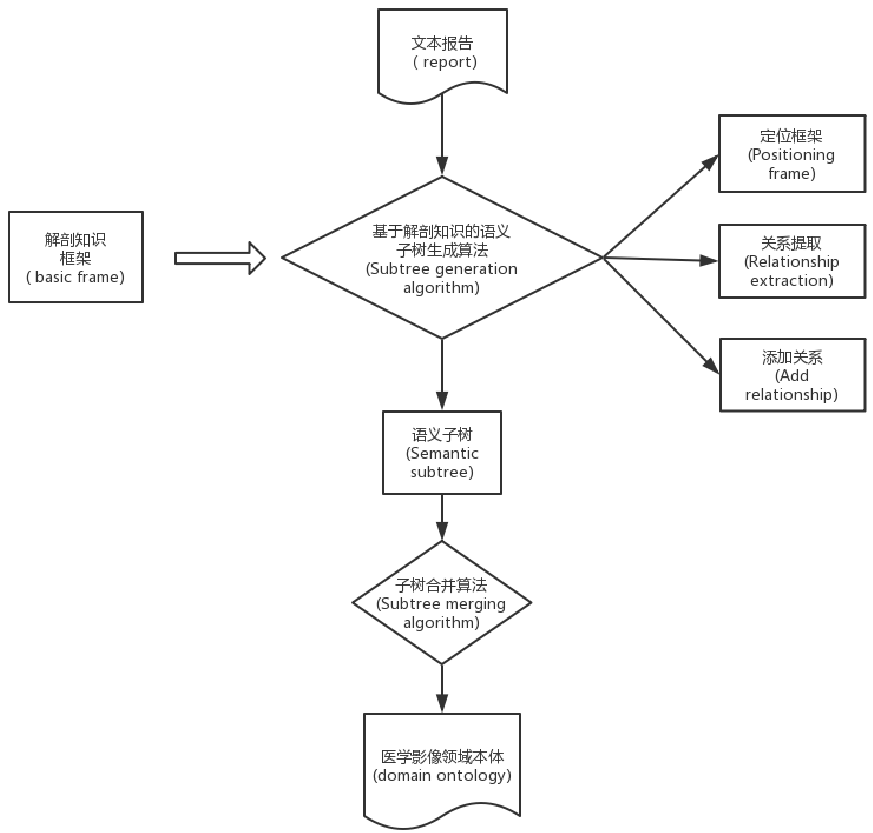
The core innovation lies in the Anatomical Knowledge Frame. Instead of treating the text as a flat sequence of words, the system uses a pre-defined hierarchical structure of organs and parts (e.g., Thyroid Left Leaf Isthmus).
1. Positioning Strategy
The system first "locates" where a sentence belongs in the anatomical hierarchy. If a sentence mentions "clear boundary" but lacks a subject, the algorithm intelligently assigns it to the previously mentioned organ part. This significantly reduces the complexity of the text.
2. Semantic Subtree Generation
Using the Pyltp dependency parsing tool, the system identifies the "Skeleton" of a sentence. It applies four specific rules to extract three types of relationships:
- Attribute-of: "The size of the left lobe."
- Value-of: "Size is normal."
- Exist: "Hypoechoic nodule was seen."
3. Merging for the Domain Ontology
Once individual reports are turned into XML subtrees, the "Ontology Construction Algorithm" merges them. It handles three logical scenarios:
- Leaf Merge: Combining different attribute values for the same organ.
- Intermediate Merge: Adding new anatomical branches.
- Extra Node Insertion: Handling modifiers like "residual" after surgery.
Experimental Results: Precision over Bulk
The researchers tested the method on 1,000 real-world records from a top-tier hospital.
Key Finding 1: Structural Simplification The positioning strategy reduced the average height of the dependency tree from 3.02 to 1.16. By "flattening" the syntactic complexity through anatomical grouping, the system made relationship extraction far easier and less error-prone.
Key Finding 2: Outperforming Deep Learning As shown in the table below, the proposed method consistently beat LSTM-based models by 2-5% across various modalities.
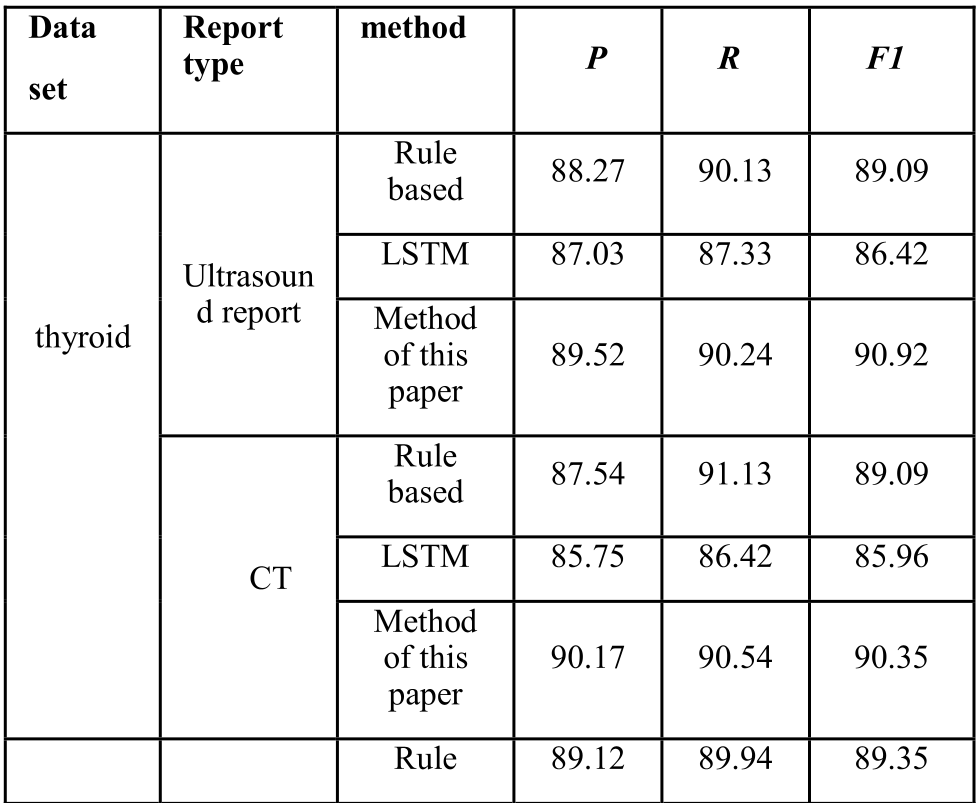
Unlike the rule-based approach (which had similar accuracy), this method demonstrated high portability—it could be applied to Ultrasound, CT, and MRI with minimal adjustment, whereas rule-based systems would require a total rewrite of the logic.
Critical Insight & Conclusion
This paper proves that Inductive Bias—in the form of anatomical knowledge—is a powerful tool in medical NLP. In an era where many lean exclusively on "black box" LLMs, this work highlights the value of structured, knowledge-driven frameworks.
Limitations: While the system performs well on standard reports, its reliance on dependency parsing means it might struggle with highly ungrammatical or extremely complex "shorthand" often used in emergency settings. Furthermore, its current scope is limited to organ-specific ontologies (Thyroid/Breast); a universal human anatomy ontology would be the logical (and much more difficult) next step.
Future Outlook: Integrating this knowledge-driven extraction with Large Language Models could provide the "best of both worlds"—the reasoning power of LLMs with the logical constraints and accuracy of anatomical ontologies.