
Abductive Machine Learning: Streamlining Educational Tests Without Losing Precision
Construction and analysis of educational tests using abductive machine learning
This paper introduces an abductive machine learning approach for the automated construction and analysis of educational tests. Using self-organizing abductive networks, the method identifies the most informative subset of test items to classify examinees' abilities, achieving 91% accuracy with only 12 items out of an original 45-item bank.
TL;DR
Researchers have developed a novel way to build shorter, more efficient educational tests using Abductive Machine Learning. By automatically selecting only the most "informative" questions, the system reduced a 45-item test to just 12 items while maintaining over 90% classification accuracy. This method bypasses the complex manual tuning required by traditional neural networks and the computational heavy lifting of standard Item Response Theory (IRT).
The Scalability Wall in Test Construction
Designing a high-stakes exam is a balancing act. To measure a student's "true ability" () accurately, you typically need many questions. However, more questions mean higher costs and "examinee fatigue."
Traditional methods like Item Response Theory (IRT) use Fisher’s information function to pick items. While mathematically sound, these methods struggle when the item bank is massive, and they require a rigorous prior estimation of item parameters (difficulty, discrimination, and guessing). The authors argue that current AI approaches, like standard Neural Networks, are often "black boxes" that require tedious architecture searching (choosing layers, neurons, and activation functions).
The Solution: Abductive Networks (AIM)
The core innovation is the use of the Abductory Inductive Mechanism (AIM). Unlike a standard neural network where the human designer picks the structure, AIM is self-organizing. It builds a model out of "functional elements"—essentially polynomial equations—and only keeps the ones that actually help predict the outcome.
How it Works:
- Iterative Regression: It starts with simple relationships and evolves into complex, high-degree polynomials.
- Constraint via PSE: It uses the Predicted Squared Error (PSE) criterion. This formula penalizes models that are too complex, preventing the "overfitting" problem where a model memorizes the training data but fails in the real world.
- Automatic Item Selection: Because the network only keeps useful inputs, it naturally identifies which test items are the "heavy hitters" for determining if a student passes or fails.
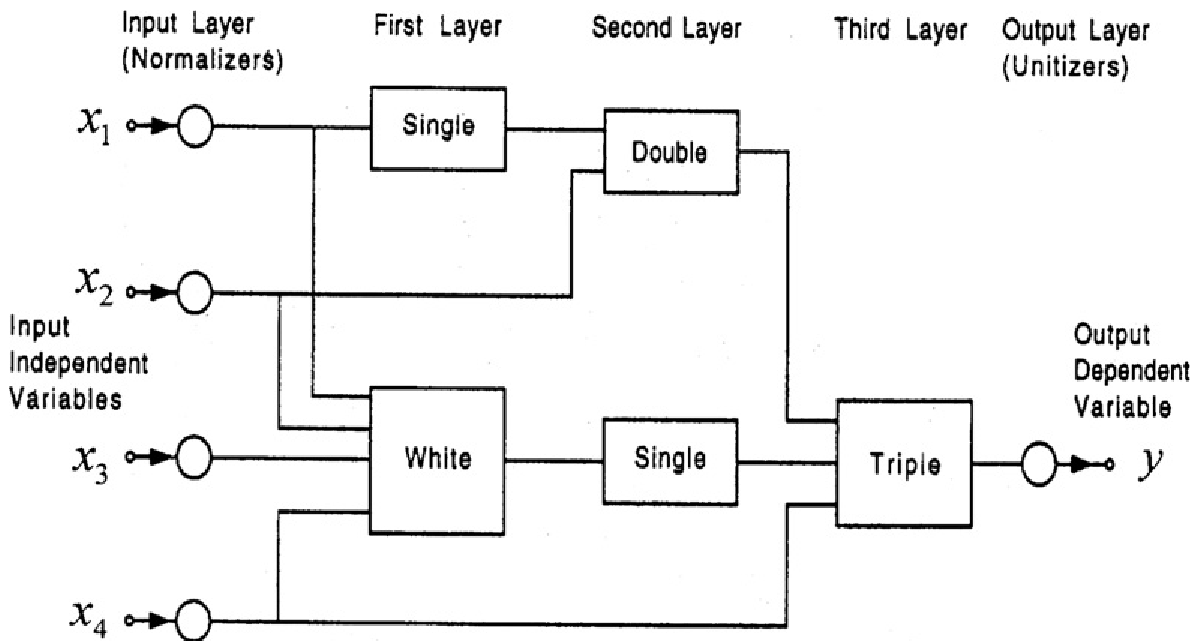 Figure 1: Typical structure of a layered abductive network with normalizers and unitizers.
Experiments: Performance at 1/4 the Length
The researchers tested this on a dataset of 2,000 examinees and 45 items.
- Pass/Fail Accuracy: The optimal abductive model (at ) selected only 12 items.
- Success Rate: It achieved a 90.6% classification accuracy on unseen data.
- Efficiency: It achieved a 73.3% reduction in test length with a negligible increase in error compared to using the full 45-item set.
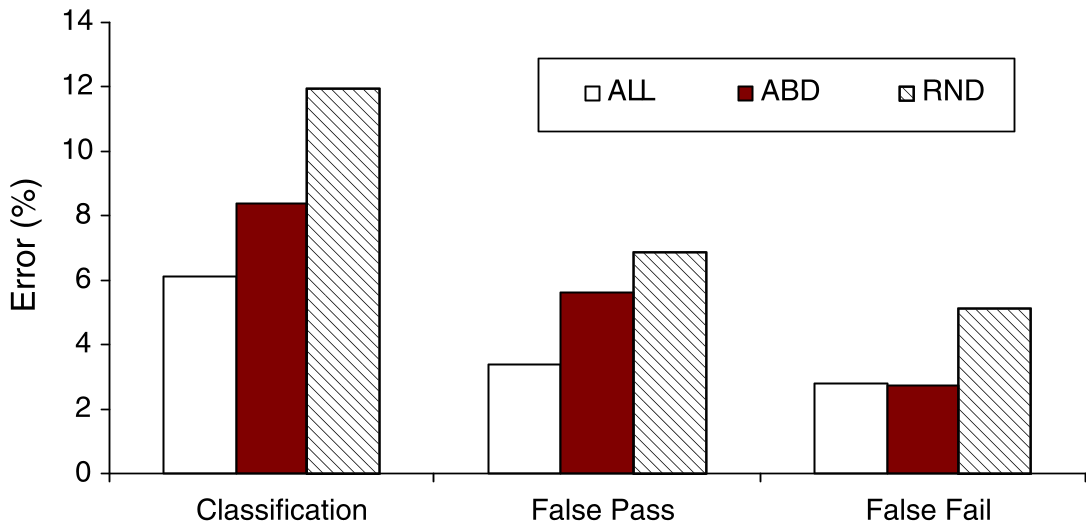 Figure 2: The Abductive selection (dashed line) produces a sharper peak at the pass/fail cutoff () than random selection, providing higher precision where it matters most.
Deep Insight: The "Math" has "Logic"
The most fascinating finding was which items the AI chose. When mapped back to IRT parameters, the abductive network ignored the items that were too easy or too hard. Instead, it concentrated on items with a "difficulty" ( parameter) near the pass/fail threshold. This confirms that the machine learning model discovered the same "Information Function" logic used by human psychometricians, but it did so automatically and directly from the raw data.
Critical Analysis & Future Outlook
Strengths:
- Transparency: Unlike deep learning, the resulting polynomial equations can be inspected to see how inputs are weighted.
- Automation: No need to "guess" the number of hidden layers or learning rates.
Limitations:
- The study focuses on binary (0/1) scoring. Modern exams often use "polytomous" scoring (partial credit), which would require more complex modeling.
- Accuracy (90-91%) is excellent for classroom settings but might need further refinement for high-stakes certification (e.g., medical licensing) where the current IRT error (6%) is the gold standard.
The Takeaway: As we move toward globalized, computerized testing, abductive machine learning offers a powerful "shortcut" to creating shorter, smarter, and statistically sound assessments.