
CCP: Reclaiming Privacy in Social Networks via Seamless Client-Side Encryption
Consumer-centric protection for online social networks
The paper introduces Consumer-Centric Protection (CCP), a framework designed to return data sovereignty to users in Online Social Networks (OSNs). It presents a browser-based middleware, the Consumer-Oriented Protection (COP) layer, which secures user content via client-side encryption (AES and ECC) before it is uploaded to platforms like Facebook.
TL;DR
Social media users currently trade their privacy for connectivity, leaving personal data at the mercy of OSN operators. This paper proposes Consumer-Centric Protection (CCP), a browser-based encryption layer that automatically secures posts and photos before they hit the server. It bypasses the need for trusting the service provider entirely, offering a "lock" to which only friends hold the "key."
The Core Conflict: Human-Centric vs. Operator-Centric
Online Social Networks (OSNs) like Facebook and Twitter are marketed as tools for human connection. However, their underlying architecture is Operator-Centric. The provider acts as the data controller, possessing the technical capability to scan, sell, or lose your data.
The authors argue that the current "Privacy Settings" are a facade; they rely on the provider enforcing rules against itself. To solve this, they propose a shift to Consumer-Centric Protection, where the user exerts control through the laws of mathematics (cryptography) rather than the policies of a corporation.
Methodology: The Consumer-Oriented Protection (COP) Layer
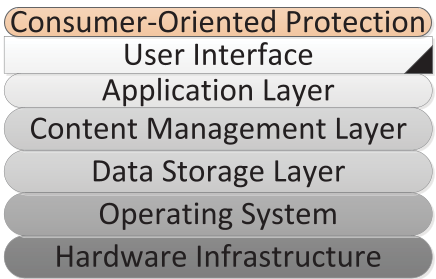
The genius of the COP framework lies in its positioning. Instead of trying to build a new, unpopulated social network, it hijacks the existing ones by inserting a thin security layer into the web browser.
1. Architecture Overview
The COP layer sits on top of the OSN User Interface. From the user's perspective, the experience is unchanged. However, under the hood, the add-on monitors specific DOM events.
2. The Cryptographic Pipeline
- Interception: When a user clicks "Post" or "Upload Image," the COP add-on halts the outgoing request.
- Encryption: Text is encrypted using AES (Advanced Encryption Standard) in CFB or GCM modes. Images are encrypted at the binary level.
- Key Exchange: Using ECC (Elliptic Curve Cryptography), the AES key is encrypted for specific recipients and embedded within the metadata of the post/image.
- Seamless Decryption: For authorized friends using the same add-on, the ciphertext is automatically decrypted and rendered as plaintext in the feed.
Experimental Proof: Practical Facebook Integration
The authors developed a Firefox add-on to test the theory on Facebook. The results show that privacy doesn't have to be cumbersome.
- Status Updates: A user types a sensitive status. The add-on converts "Testing Status" into an unreadable string before it reaches Facebook’s servers.
- Visual Evidence: In the UI, the user briefly sees the ciphertext, which then resolves into plaintext once the local decryption trigger completes.
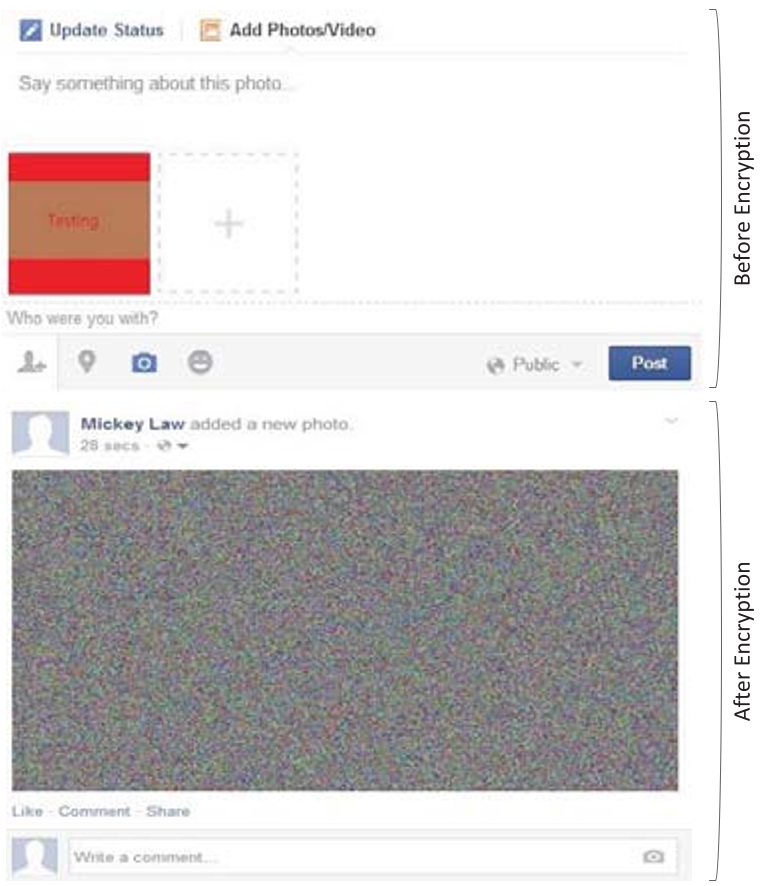 Figure: The transformation from readable text to ciphertext ensures Facebook only stores "noise."
- Image Protection: The framework successfully intercepts photo uploads, ensuring that even if a server-side breach occurs, the images remain protected by the owner's keys.
Critical Insight: The Challenge of One-to-Many
While the current implementation excels at peer-to-peer (1:1) communication, the authors acknowledge a major hurdle: scalable group privacy. Sharing a post with 500 friends requires a sophisticated Key Distribution Center (KDC) or a decentralized group key management protocol.
Furthermore, this method creates a "Cat and Mouse" game. If OSN providers view this as a threat to their data-driven business models, they may update their site code to intentionally break add-on interception.
Conclusion & Future Impact
This research highlights a vital move toward Zero-Trust OSNs. By treating the service provider as a "less than trustworthy" entity, CCP ensures that personal data remains a private asset. As privacy regulations like GDPR tighten, tools that empower users to encrypt their own "digital shadows" will move from academic concepts to essential daily utilities.
Takeaway: In the future of social media, the platform should be the pipe, not the vault.