
Predicting Market Viralization: A Blend of Social Psychology and Complex Networks
Consumer Phase Shift Simulation Based on Social Psychology and Complex Networks
This paper introduces a multi-agent simulation framework to estimate new product acceptance by combining social psychology with complex network theory. The authors propose a "Consumer Phase Shift" model that classifies agents into four psychological types and six adoption phases, utilizing a novel overlapping community network structure.
TL;DR
How does a new service like "mixi" or "Threads" go viral? This paper provides a rigorous simulation framework that goes beyond simple "Information Cascades." By categorizing consumers based on their psychological traits (e.g., Market Mavens) and placing them in a social network characterized by overlapping communities, the authors successfully simulated the real-world adoption trajectory of a major Japanese social service with high accuracy.
The Motivation: Why Traditional Marketing Models Are Breaking
The era of "top-down" advertising is fading. In contemporary society, a consumer's decision is heavily influenced by their peers. However, quantifying the "Word-of-Mouth" (WOM) effect is notoriously difficult. Previous models often treated social networks as homogeneous or overly simplified graphs (like the Barabási-Albert model). The authors argue that these ignore a fundamental human reality: we live in communities (family, work, hobby groups) that overlap, and these clusters are the true engines of phase shifts in consumer behavior.
Methodology: The Consumer Phase Shift Model
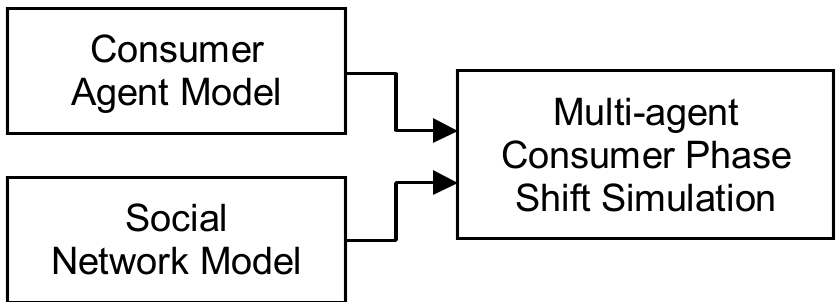
The researchers developed a dual-layered approach:
1. The Agent Model (The "Who")
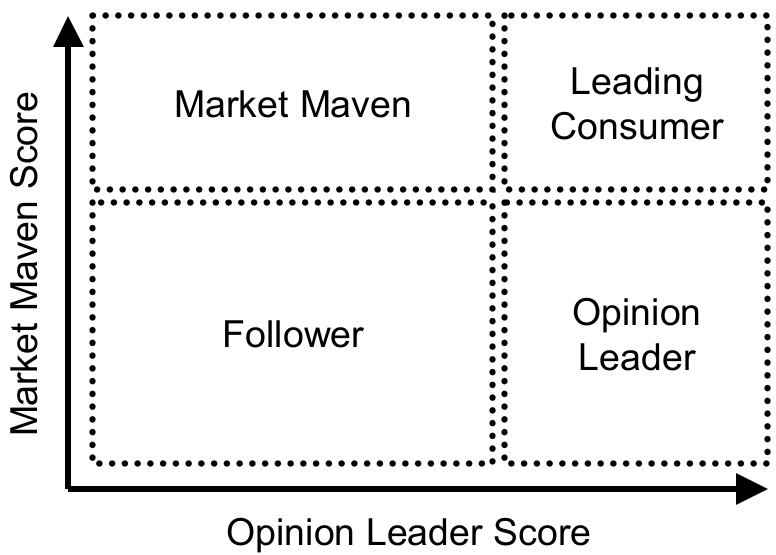
Consumers aren't all the same. Using psychological scores (Opinion Leader vs. Market Maven), they identified four distinct personas:
- Leading Consumers: High in both scores—the ultimate "hubs."
- Opinion Leaders: High influence but within a narrow, persuasive range.
- Market Mavens: Information collectors who spread knowledge widely across different domains.
- Followers: Cautious adopters who represent the majority.
2. The Network Model (The "Where")
Instead of a simple scale-free graph, the authors built a procedure to generate overlapping community structures. They assumed each community is a "complete graph" (where everyone knows everyone), and individuals can belong to multiple communities. This creates a "Small World" effect where information travels fast but stays dense within local groups.
Verification: The "mixi" Case Study
The authors used Snowball Sampling—a technique where respondents recruit their acquaintances—to collect real behavioral data in Japan. This allowed them to measure how many "positive" vs. "negative" nudges a person needs before they transition from "Recognition" to "Possession" (buying/using).
Key Results
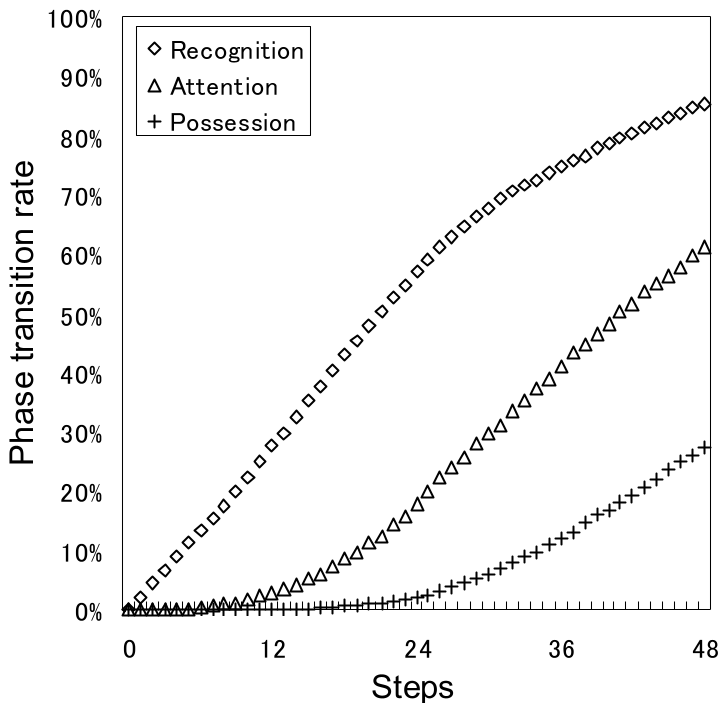
The simulation, built on the Repast toolkit, demonstrated that:
- Accuracy: The predicted adoption rates (27% possession) almost perfectly mirrored the actual market survey results for the service mixi.
- Community Effect: When they swapped their "Community Network" for a standard Barabási model (which lacks clustering), the adoption rate dropped to 20%. This proves that community density is a catalyst for adoption.
Critical Insight: The "Bridge" Role of Market Mavens
The most fascinating takeaway is the role of the Market Maven. While Opinion Leaders are persuasive, they are often confined to niche circles. Market Mavens, powered by the Internet, act as the "connective tissue" between overlapping communities. By identifying and targeting these agents, companies can trigger a "Phase Shift" more efficiently than through mass media alone.
Conclusion and Future Outlook
This work bridges the gap between abstract graph theory and practical marketing. While the current model omits "Abandonment" (churn) and uses a simplified "complete graph" for communities, its success in matching real-world data is a powerful proof of concept. For future researchers, the next step is applying this to multi-modal social data (integrating sentiment analysis from text) to dynamically adjust transition probabilities in real-time.
Key Values for Practitioners:
- Targeting hubs is not enough; targeting those who bridge different communities is the key to virality.
- Simulations must account for the "Negative Possession" phase, as negative WOM often spreads faster than positive.