
From Social Buzz to Product Design: Decoding Consumer Preferences with Fuzzy Evidential Reasoning
Investigating consumer preferences on product designs by analyzing opinions from social networks using evidential reasoning
2019-11-14
Summary
Problem
Method
Results
Takeaways
Abstract
This paper proposes an integrative Multi-Criterion Decision-Making (MCDM) framework that combines phrase-level sentiment analysis, Fuzzy Set theory, and Evidential Reasoning (ER) to analyze User-Generated Content (UGC). The approach effectively ranks consumer product designs (e.g., smartphones) by extracting preferences from social network opinions, transforming qualitative reviews into structured quantitative assessments.
## TL;DR
In the hyper-competitive era of e-commerce, user-generated content (UGC) is a goldmine for product designers. However, turning thousands of "Amazing" or "Horrible" comments into a concrete design roadmap is notoriously difficult. This paper presents a sophisticated hybrid model that combines **Sentiment Analysis**, **Fuzzy Logic**, and **Evidential Reasoning (ER)** to transform messy social media opinions into a mathematically rigorous ranking of product preferences.
## The Core Challenge: The Subjectivity Gap
Prior sentiment analysis tools typically focus on *what* users feel (Positive vs. Negative) but struggle with *how much* they care and the *uncertainty* of their language. One user's "good" might be another user's "average."
The authors identify a critical bottleneck:
1. **Subjectivity**: Traditional MCDM relies on expert reviews, which often mismatch with actual consumer sentiment.
2. **Information Overload**: Manually reviewing 2,000+ comments for a single smartphone launch is unsustainable.
3. **Inconsistency**: Sentiment words like "Perfect" or "Nice" have varying "opinion strengths" that simple counters ignore.
## Methodology: The Hybrid Intelligence Pipeline
The proposed framework moves away from simple word-counting toward an optimization-based approach.
### 1. The Pre-processing & Criteria Corpus
Instead of generic sentiment analysis, the model categorizes comments into specific product attributes (e.g., Performance, Camera, Battery) using a "criteria corpus." This ensures that the final "score" is actionable for engineers and designers.
### 2. Fuzzy Approximation: Modeling the "Probably"
Language is fuzzy. To handle this, the authors map sentiment intensities from SentiWords (ranging from -1 to 1) onto **Triangular Fuzzy Numbers (TFNs)**. This allows the model to treat a "63.91% positive" sentiment not as a single point, but as a distribution of possibilities.
### 3. Evidential Reasoning (ER): The Decision Engine
The "magic" happens when these fuzzy numbers are fed into the ER algorithm. Unlike standard weighted averages, ER can handle **incomplete, uncertain, and qualitative information** by using a "belief structure."
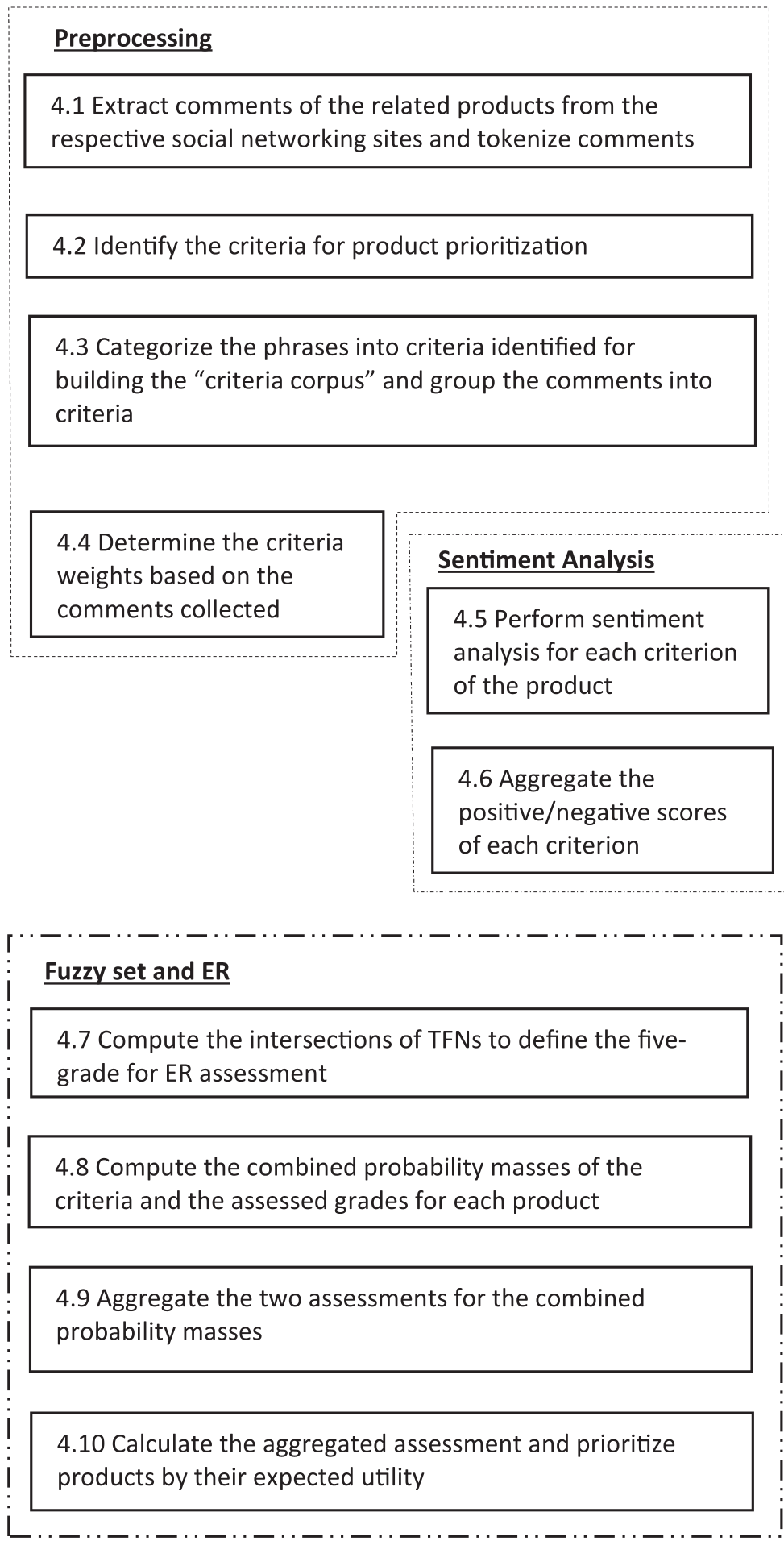
*The three-stage approach: Pre-processing, Sentiment Analysis, and MCDM Evaluation.*
## Experiments: The Smartphone Case Study
The authors applied this method to three flagship smartphones (D1, D2, D3) using 2,412 Facebook comments.
### Key Findings:
* **Weighting Matters**: While "Performance" is vital, "Aesthetic" (appearance and materials) actually held the highest weight (0.3756) in driving consumer conversation on social media.
* **Rank Reconciliation**: Design D3 was the "Performance" leader, but Design D2 won the overall "Average Expected Utility" (0.7561) because it balanced aesthetic and battery life more effectively according to the belief structures.
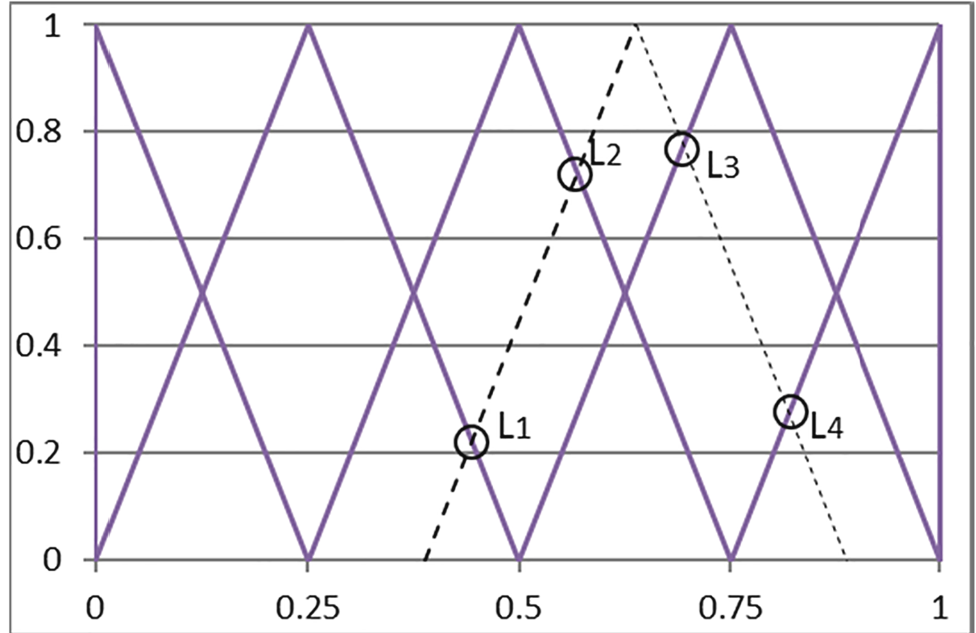
*Visualizing how a fuzzy sentiment value is sliced into distinct 'Grades of Belief' (Very Weak to Very Strong).*
## Academic Insight: Why Is This Method Effective?
The brilliance of this work lies in its **objectivity**. By using the relative frequency of comments to determine weights and SentiWords to determine intensity, the model removes the "subjective expert" from the loop. It creates a "consumer-driven" decision matrix where the data, processed through the lens of Evidential Reasoning, speaks for itself.
## Critical Analysis & Conclusion
### Takeaway
The integration of Evidential Reasoning with UGC mining is a major step forward for **Agile Product Development**. It allows firms to pivot design strategies in weeks rather than months.
### Limitations
The paper still relies on a "criteria corpus" that requires initial manual categorization by experts. Transitioning this to a fully unsupervised Zero-shot Learning model (like GPT-4 or specialized LLMs) would be the logical next step.
### Future Outlook
As social media becomes the primary feedback loop, models that can quantify "the gut feeling of the crowd" will become essential. This fuzzy-ER approach provides the mathematical scaffolding for a new generation of automated market research tools.