
Game Theory in the Pocket: Fair Broadcasting for WiFi Direct MSNs
Contact-duration aware broadcast in WiFi direct enabled mobile social networks
This paper proposes a contact-duration aware scheduling scheme for broadcast in WiFi Direct Mobile Social Networks (MSNs). It utilizes a Nash Bargaining Solution (NBS) combined with a water-filling algorithm and a window-based round-robin scheduler to achieve proportional fairness and Pareto efficiency under limited contact time.
TL;DR
In Mobile Social Networks (MSNs), your window of opportunity to share data is often just a few seconds as you walk past someone. This paper tackles a critical question: In a group of WiFi Direct devices, how do we fairly divide this tiny "contact duration" so everyone gets a chance to broadcast? Utilizing Nash Bargaining Theory, the authors propose a scheduling system that ensures no node is ignored while maximizing the total data exchanged.
Context & Motivation: The Half-Duplex Dilemma
WiFi Direct allows devices to form groups without a central router, making it perfect for offloading cellular traffic or sharing content on the move. However, it operates on a half-duplex basis—only one person can talk at a time.
Current scheduling logic usually falls into two traps:
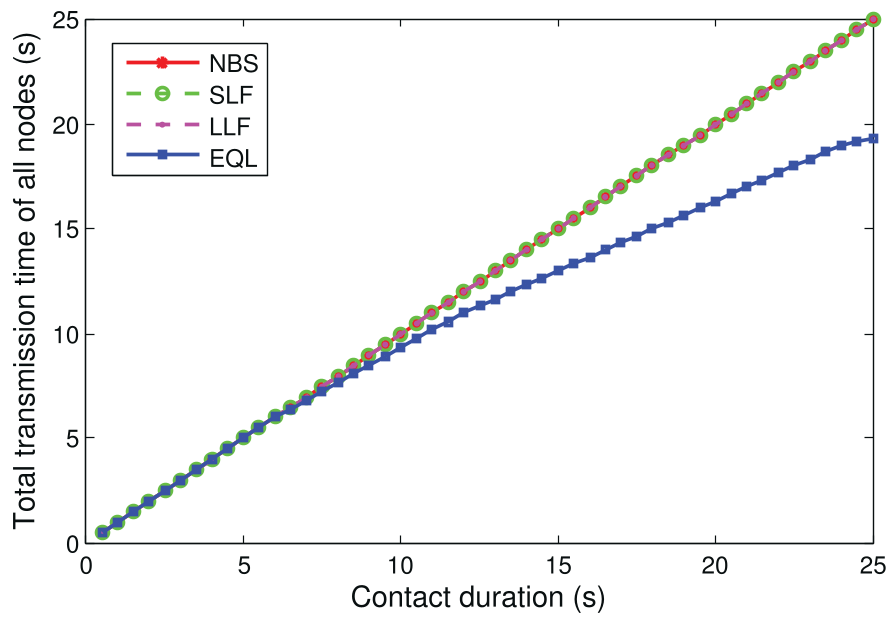
- Strict Priority (SLF/LLF): If we let the person with the least data go first, the person with the most data might get cut off entirely when the connection breaks.
- Equal Time (EQL): If we give everyone exactly 1 second, but someone only has 0.2 seconds of data to send, we waste 0.8 seconds of a precious, fleeting connection.
The authors argue that we need a "socially just" allocation that respects both the load of each node and the total available time.
Methodology: The Nash Bargaining Solution (NBS)
The paper treats the nodes as "players" in a cooperative game. Each node has a utility—the amount of time it gets to broadcast. The goal is to maximize the Nash Product, which naturally balances total efficiency with individual fairness.
1. The Water-Filling Intuition
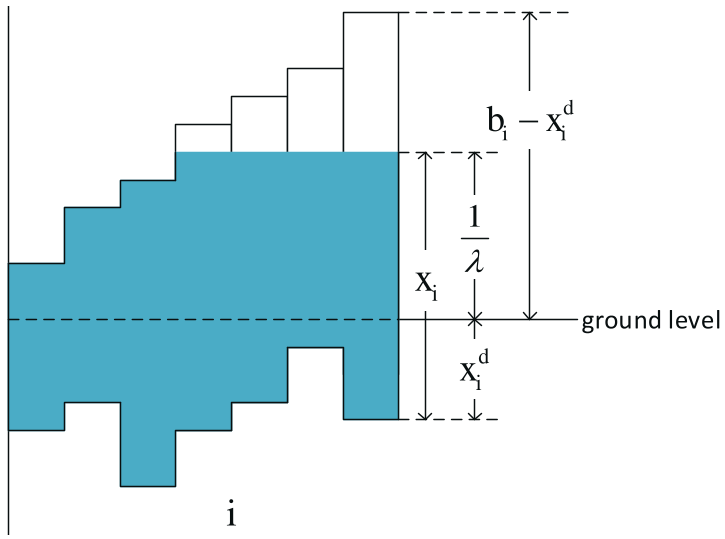
To solve the math, the authors use a Water-Filling Algorithm. Imagine each node is a container. Some containers are taller (nodes with more data). We pour "water" (available contact time) into all containers simultaneously. If a container is full (node finished its data), we stop pouring into that one and distribute the remaining water among the others.
2. Window-Based Scheduling
Theoretical allocation is one thing; physical reality is another. Because we can't perfectly predict when a node will move out of range, the authors break the allocated time into small windows. Nodes rotate in a Round-Robin fashion. If the contact ends early, everyone has at least sent some of their proportional share.
Performance: Efficiency meets Fairness
The simulation compared NBS against traditional heuristics. As seen in the results below, NBS (the blue bars) manages to provide a balanced allocation that utilizes the full 7.7s contact duration without starving the nodes with larger data loads (like ).
The Switching Trade-off
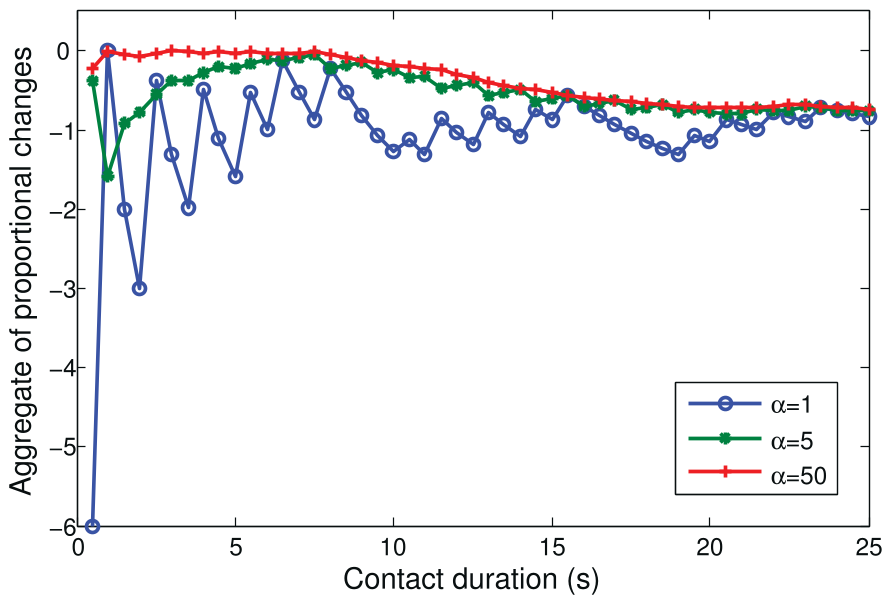
A key insight from the paper is the impact of the switching frequency ().
- High : Better fairness (everyone gets small chunks frequently), but high overhead (switching takes time).
- Low : Maximum efficiency (less time wasted on switching), but poor fairness if the connection drops unexpectedly.
Critical Insight & Conclusion
This work highlights that in autonomous mobile networks, fairness isn't just a "nice-to-have"—it's an incentive. If a system is consistently unfair, users have no reason to participate or share their own data. By applying the Nash Bargaining Solution, the authors provide a mathematically sound way to ensure that even in the chaotic environment of moving pedestrians, data sharing remains equitable and efficient.
Future Directions: While this model assumes a static data rate, real-world WiFi signals fluctuate wildly (fading/interference). Integrating channel-aware dynamic bargaining would be the next logical step for this research.