
The Viral Nature of Deceit: Decoding the Social Contagion of Cheating in MMORPGs
Contagion of Cheating Behaviors in Online Social Networks
This paper investigates the social contagion of cheating behaviors (specifically "game bots") in MMORPGs, leveraging a large-scale user interaction log from the game Aion. The authors propose a statistical framework and a gamma-distribution-based probability model to demonstrate that cheating is socially contagious and can be distinguished from homophily.
TL;DR
Is cheating in online games a "solo crime" or a "social disease"? This research analyzes over 15 months of log data from the MMORPG Aion to prove that cheating—specifically the use of automated game bots—spreads through social networks like a virus. By distinguishing between peer influence and simple similarity (homophily), the authors reveal that your risk of becoming a cheater peaks when one-third of your friends already are.
Problem & Motivation: Beyond the Individual
Most game security systems treat cheating as an isolated behavioral anomaly. They look for "inhuman" click rates or repetitive movement patterns. However, this paper argues that cheating is a socially learned behavior.
The core challenge in social network research is the "Homophily vs. Contagion" trap: Do you cheat because your friends cheat (Contagion), or did you become friends because you both like cheating (Homophily)? Distinguishing these is vital for game developers because if it's contagion, banning one "super-spreader" might save dozens of others.
Methodology: The Mechanics of Reinforcement
The researchers tracked nearly 100,000 characters and defined several factors to quantify "social reinforcement." These weren't just simple counts of cheater friends, but nuanced metrics like:
- I/K (The Ratio): The number of cheater friends divided by the total number of friends.
- M (Extreme Score): The intensity of cheating by one's most active cheater friend.
- Y (Anti-Score): The number of friends who were actually banned for cheating.
The Unified Model
The authors modeled the probability of adoption using a mathematical function inspired by the Gamma distribution. This captures a unique tension:
- Peer Influence: A polynomial increase () as you see friends succeeding with bots.
- Risk Aversion: An exponential decay () as the cheating becomes so prevalent that you fear an imminent "ban wave."
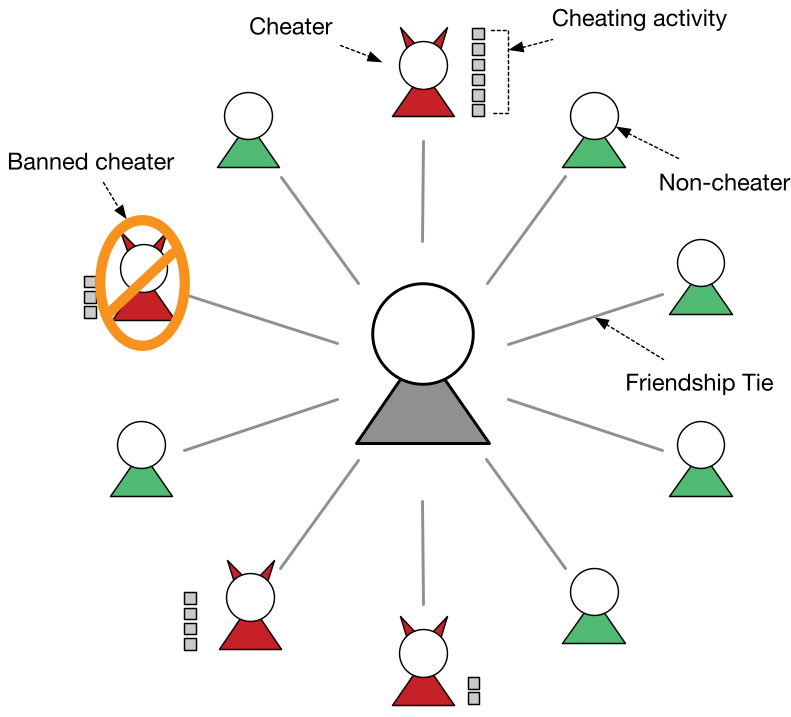 Figure 1: Conceptual overview of how social factors influence a central user's decision to cheat.
Experiments & The "Shuffle Test"
To prove that the timing of these adoptions wasn't coincidental (Homophily), the authors performed a Shuffle Test. They randomized the time-stamps of when users started cheating while keeping the network structure the same. They found that in the real data, the "contagion parameters" ( and ) were significantly different from the randomized versions, confirming that social influence is a real driver of behavior.
Key Findings:
- The 33% Threshold: The likelihood of adoption increases steadily until the cheater ratio (I/K) reaches about 1/3. After this point, the "fear of being caught" starts to outweigh the "benefit of cheating," and adoption rates decline.
- The Hazard Ratio: The I/K factor has a hazard ratio of 3.222, meaning users with high cheater-friend ratios are over 3 times more likely to start cheating themselves compared to baseline users.
- Banning Ineffectiveness: Surprisingly, seeing friends get banned had minimal impact on stopping those who had already started cheating. Banning acts as a deterrent for "innocent" players, but doesn't serve as a "cure" for "infected" ones.
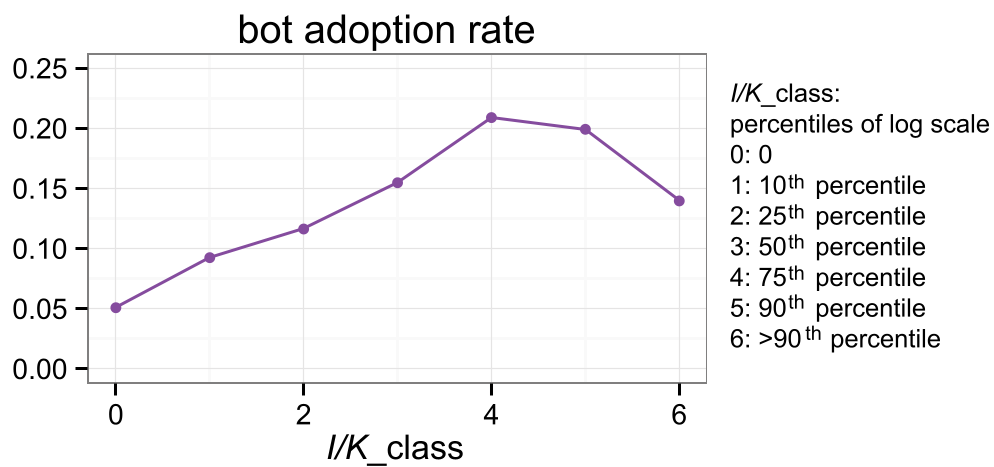 Figure 2: The non-linear relationship between cheater friend ratio and adoption probability.
Critical Analysis & Conclusion
Takeaway
This study shifts the paradigm of game security from "behavioral monitoring" to "network epidemiology." If a developer identifies a cluster where the cheater ratio is approaching the 33% tipping point, proactive intervention (like warnings or social nudges) could be more effective than retrospective banning.
Limitations
The study relies on "delayed banning" data, which might not reflect the dynamics of games with "instant-ban" anti-cheat systems (like Vanguard or Ricochet). Furthermore, the social networks in MMORPGs are often "flatter" and have lower clustering than real-world social networks (like Facebook), which may affect the speed of the "complex contagion."
Ultimately, this research suggests that in the fight against online malice, the company you keep is just as important as the code you run.