
Beyond Mimicry: The Deep Cognitive Architecture of Habit Contagion
Contagion of Habitual Behaviour in Social Networks: An Agent-Based Model
The paper introduces a multi-level Agent-Based Model (ABM) for the contagion of habitual behavior in social networks. By integrating individual cognitive mechanisms (attitudes, goals, intentions) with Hebbian learning and social impact theory, it demonstrates how healthy or unhealthy lifestyles propagate through small-world and scale-free networks.
TL;DR
Why is it so hard to start taking the stairs even when your friends do? This paper argues that habit change isn't just about "copying" others. The authors present a sophisticated Agent-Based Model where social influence must first "hack" your internal attitudes and goals, which then use Hebbian Learning to wire a new habit to environmental cues. Using small-world network simulations, they prove that influential "hubs" and environmental triggers are the twin keys to shifting population behavior.
The Problem: Why "Monkey See, Monkey Do" Fails for Habits
Most epidemic-style models treat social influence like a cold—if you're exposed to a behavior, you catch it. However, human habits like diet, exercise, or smoking are anchored by deep-seated internal states:
- Attitudes: Your evaluation of the behavior.
- Goals: Long-term aspirations (e.g., getting fit).
- Cues: Environmental triggers (e.g., seeing the elevator).
Prior work often failed because it ignored the fact that internal states usually override external observations. If you want to change a population's habit, you can't just show them a new behavior; you must change the underlying cognitive machinery.
Methodology: The "Indirect" Contagion Engine
The core innovation of this model is that agents don't mimic behavior; they catch internal states.
1. The Multi-Layer Architecture
The model defines an agent through a cascade: Attitude Long-Term Goal Short-Term Goal Intention Behavior.
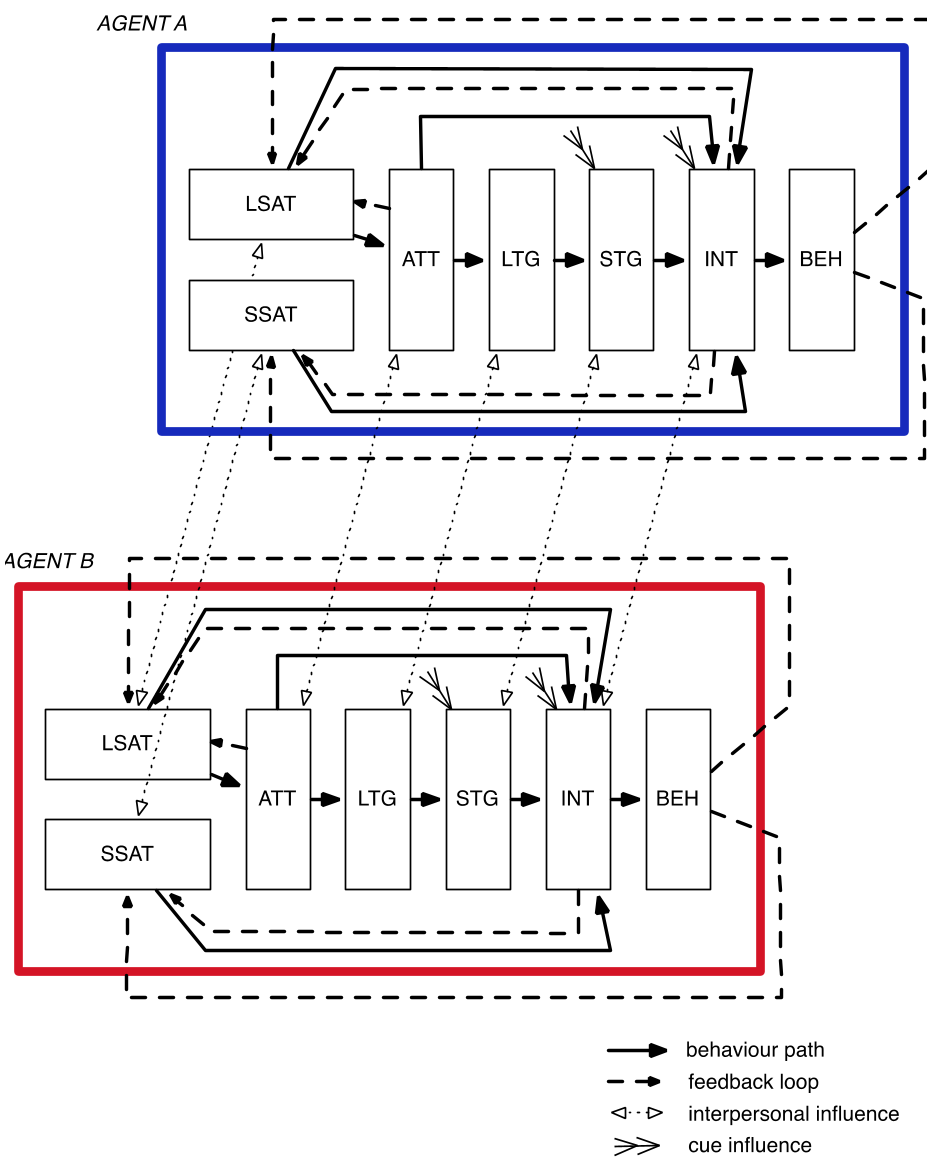
2. The Hebbian Learning Link
The model employs a Hebbian rule to represent habituation. If an agent has an intention and encounters a Cue simultaneously, the connection strength between that cue and the intention increases. Over time, the cue alone can trigger the behavior, even if the original goal has faded.
3. Social Impact Equations
Social influence is moderated by Openness () and Channel Strength. The update rule for any internal state balances an agent's internal logic with the weighted "social pressure" from their neighbors.
Experimental Insights: What Actually Changes a Habit?
Cues are the "Catalyst"
In "Two-Partner" simulations (e.g., Bob and Alice), the authors found that even if Alice has a positive attitude, Bob won't change his habit unless a physical cue (like a banner on the stairs) is present. Social influence provides the motivation, but environment provides the opportunity for Hebbian learning to take root.
The Power of Positive Hubs
When scaled to 100 agents in a small-world network (resembling real-world social structures), the distribution of attitudes mattered immensely.
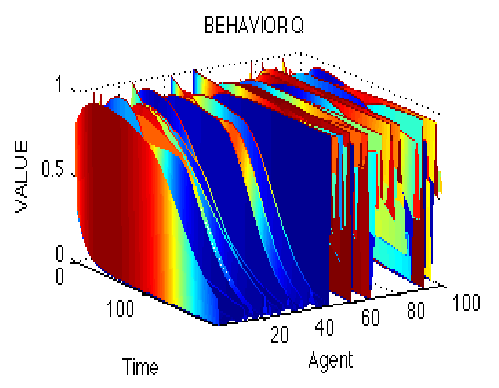
When "Hubs" (highly connected agents) were assigned positive attitudes, the entire network's average healthy behavior remained significantly higher. This provides a mathematical basis for influencer-led health campaigns.
Critical Analysis & Conclusion
This paper succeeds in moving social simulation from "reactive" to "adaptive." By integrating Hebbian learning, it explains a known psychological phenomenon: why we often "relapse" into old habits when social support or cues disappear.
Takeaways for the Industry:
- Product Design: Apps targeting habit change (like Duolingo or Strava) should focus on reinforcing the link between a specific cue and the user's intention, while leveraging "social hubs" to shift user attitudes.
- Limitations: The model assumes agents are relatively homogeneous in their cognitive architecture. Future work should explore "Resistance to Persuasion" where agents with extremely strong contrary attitudes act as "immune cells" against contagion.
Future Outlook: Integrating this model with real-time social media data could allow policymakers to simulate the impact of public health messages before they are launched.