
Beyond PageRank: Automating Truth Discovery in Online Healthcare
Content-based assessment of the credibility of online healthcare information
This paper presents a framework for automatically assessing the credibility of online healthcare information using two distinct content-based methods: Hidden Markov Models (HMM) and Topic Modeling (using TAGME). By analyzing semantic similarity to known trustworthy sources rather than relying on link popularity, the system achieves approximately 90% accuracy in identifying reliable medical content.
TL;DR
In the digital age, a professional-looking website does not guarantee medical accuracy. This paper tackles the "misinformation" crisis by moving away from link popularity (PageRank) toward Content-based Assessment. By combining Hidden Markov Models (HMM) to catch "salesy" linguistic patterns and Wikipedia-based Topic Modeling to verify semantic relevance, the authors developed a system that achieves 90% accuracy in separating scientific facts from suspicious claims.
The "Popularity vs. Truth" Conflict
Current search engines are built on the assumption that "more links equals better quality." However, in healthcare, this is a dangerous fallacy. A "miracle cure" blog might have thousands of social media backlinks, while a dry, technical NIH report has fewer.
The authors highlight a disturbing reality: users often prefer accessible, less clinical content (like Wikipedia) but may fall prey to "credible-looking" sites that lack scientific citations. The motivation here is clear: we need a machine that reads the meaning of the text, not just the network around it.
Methodology: Two Lenses of Analysis
1. HMM: The Linguistic "Detector"
The authors hypothesized that trustworthy and suspicious information have distinct "rhythms."
- Trustworthy HMM: Modeled on passive voice, proper nouns, and objective verb forms.
- Suspicious HMM: Focused on personal pronouns ("I," "You"), modal verbs ("must," "should"), superlatives ("best," "guaranteed"), and commercial keywords.
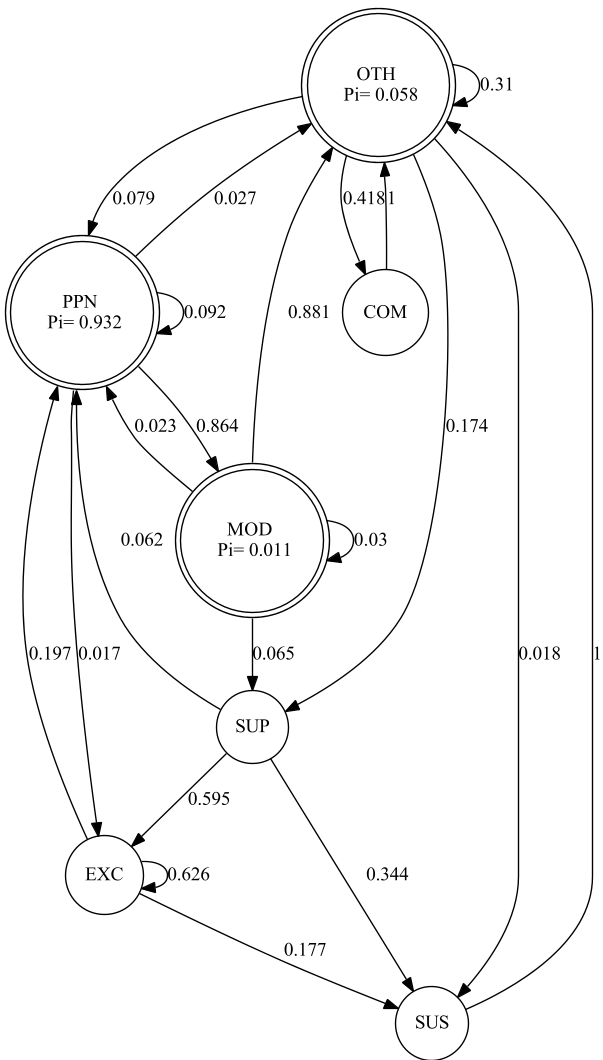 Figure 1: State transitions in a trained HMM for trustworthy sentences, focusing on noun-verb-noun structures.
2. TAGME: The Semantic Anchor
To avoid the limitations of "Bag-of-Words" (which ignores context), the authors used TAGME. This tool maps text fragments to Wikipedia entities. By measuring the "Relatedness" of topics in a new article to those in established government databases (like CDC.gov), the system calculates a ContentSim score. If a site's topics align more with the CDC than with a "scam" reference set, it is flagged as trustworthy.
Experimental Results
The researchers tested their approach on a massive dataset of 316,000 pages.
- The HMM Struggle: While HMM was excellent at catching "suspicious" patterns (80% site accuracy), it often failed to recognize "trustworthy" content (40% accuracy) because credible medical writing is highly diverse and difficult to capture through simple POS tagging.
- Topic Analysis Success: This method was the clear winner. By using Wikipedia as an external "anchor" of truth, the system correctly identified almost all test cases.
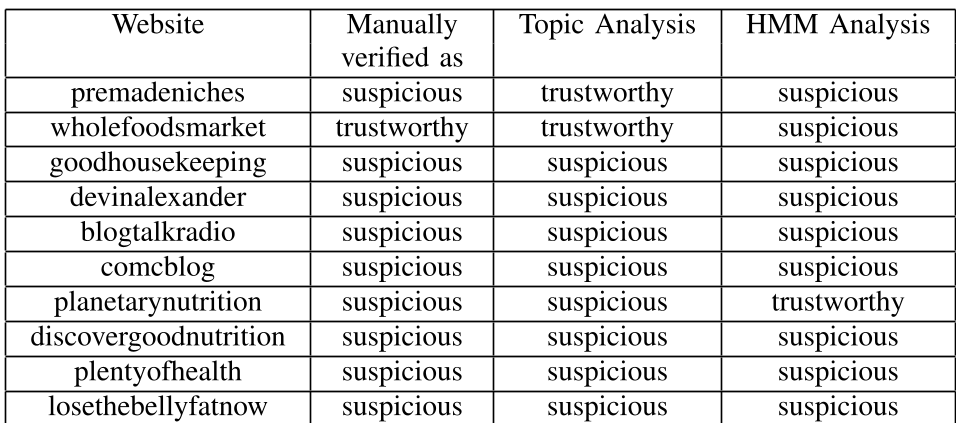 Figure 2: Performance comparison showing Topic Analysis correctly classifying 90% of real-world sites.
Critical Insight: Scaling Truth
One of the most impressive aspects of this work is its Linear Complexity—O(N). In the era of Big Data, an algorithm must be fast to be useful. Because this method classifies pages independently and matches them to a small reference set, it can theoretically monitor the health-web in real-time.
Case Study Reflection: The system correctly flagged discovergoodnutrition.com as suspicious. To a human, the site looks "professional." To the algorithm, the lack of semantic overlap with scientific citations and the presence of "salesy" patterns revealed the truth: it was a product-promotion site disguised as a health blog.
Conclusion & Future Outlook
This paper proves that semantic context is king. While linguistic patterns (HMM) provide a clue, grounding medical information in a known knowledge base (Wikipedia/TAGME) is the most effective way to fight digital misinformation.
Future work should look toward integrating these features into browser extensions or search engine re-ranking layers, ensuring that when a patient asks "is this bacteria good for me?", they get an answer based on science, not just SEO.