
Silent Crowds or Changing Minds? The Hidden Dynamics of the 2013 Egyptian Polarization
Content and Network Dynamics Behind Egyptian Political Polarization on Twitter
The paper explores political polarization in Egypt during the 2013 military intervention by analyzing 5.9 million Arabic tweets through both content-based classification (Pro/Anti-Military) and network-based community detection (Islamist/Secularist). It utilizes a combination of supervised learning and label propagation on retweet networks to track opinion dynamics and social group shifts over time.
TL;DR
By analyzing nearly 6 million Arabic tweets during the turbulent summer of 2013 in Egypt, researchers from QCRI found that the perceived shift in political dominance was not caused by people "changing their minds." Instead, it was a battle of volume: one side went silent while the other grew louder. The study also breaks the myth of a perfect Secular-Military alliance, proving that political identity in the MENA region is far more fragmented than Western media suggests.
Problem & Motivation: The Myth of the "Switch"
In the aftermath of the military intervention that ousted President Morsi in July 2013, the international community observed a shift in Egyptian public sentiment. However, a fundamental question remained: Were supporters of the revolution actually switching sides to the opposition as violence increased, or were we just hearing different voices?
Existing research often treats what people say (content) and who they talk to (network) as separate silos. This paper bridges that gap to test sociological models of "opinion switching" versus "withdrawal" in conflictive environments.
Methodology: A Dual-Axis Approach
The authors tracked 120,000 active users using two distinct lenses:
- Semantic Lens (Pro-MI vs. Anti-MI): Using a supervised SVM classifier trained on 150 polarized hashtags (e.g.,
#Sisi_the_herovs.#Against_coup), they categorized individual tweets. - Structural Lens (Secularist vs. Islamist): By applying a Label Propagation algorithm to the retweet network, they identified users' latent political leanings based on their interaction with known seed accounts.

Key Insights: Loudness vs. Persistence
1. The Rarity of "Switching"
The most striking finding is that "ideological turnover" is almost non-existent. Over the 3-month period, less than 5% of users moved from one camp to another. The dramatic shift in the narrative on Twitter was primarily a "volume game."
- Pre-July 3: Secularist/Pro-Military users were dominant and extremely vocal.
- Post-July 3: Following the crackdown at Rabia Square, the Islamist/Anti-Military camp became significantly louder, while the Secularists became increasingly "muted."
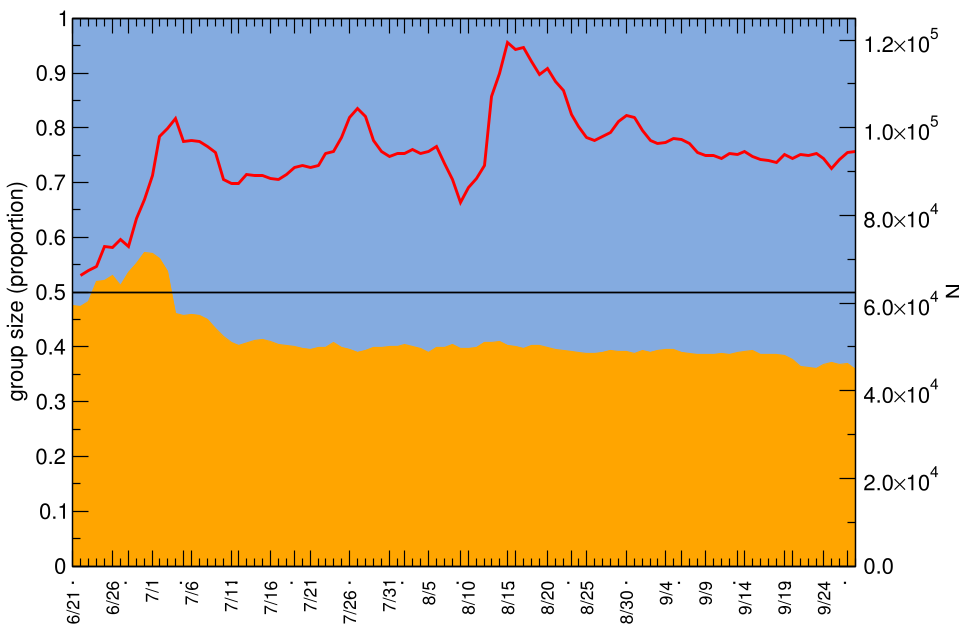 Figure: The crossover point in community volume occurs exactly around the July 3 military intervention.
2. Debunking the Binary Narrative
Traditional media often mapped Secularists directly to Military supporters. The data tells a different story. While Islamists were almost 100% aligned against the military intervention, the Secularist camp was highly heterogeneous. Many Secularists who participated in the June 30 protests grew disillusioned and "withdrew" when the military phase began.
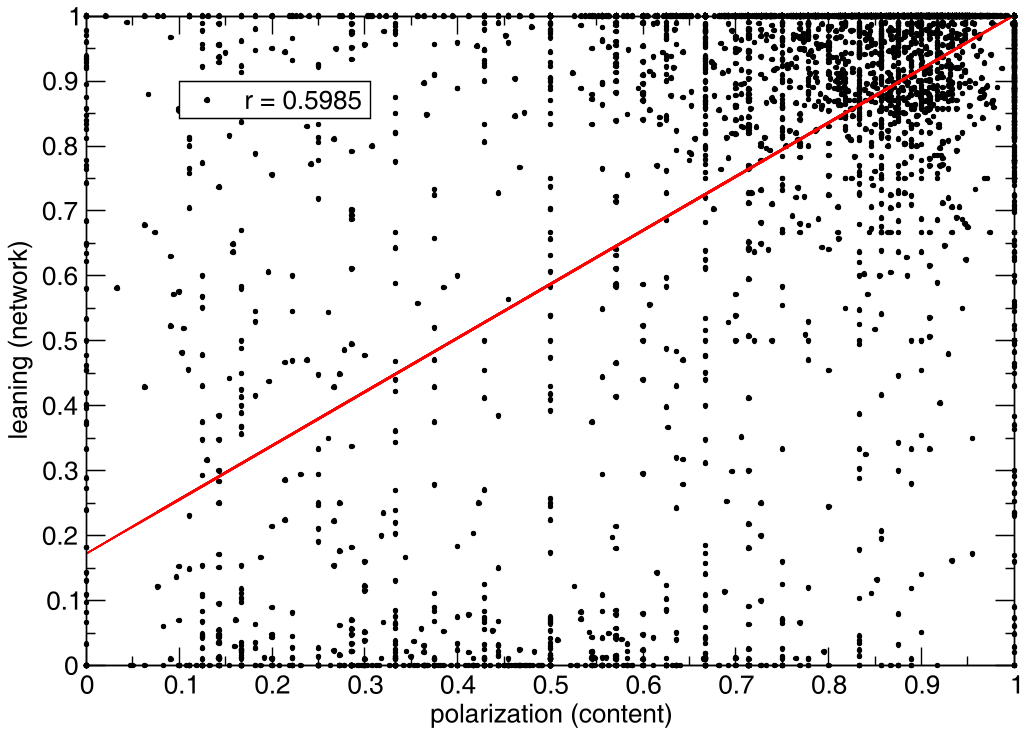 Figure: The correlation (r~0.6) shows significant dispersion on the Secularist side (left of x-axis), indicating varied stances on the military intervention.
Critical Analysis & Takeaways
This paper provides a rare, longitudinal look at "Social Media in the Aftermath." Most studies focus only on the peak of a protest; this one captures the messy, violent decline that follows.
- Social Cost of Switching: The authors argue that switching sides in a polarized environment carries a high social cost (the "Volunteer's Dilemma"). It is safer for an individual to simply stop tweeting (withdraw) than to publicly adopt the opponent's view.
- Methodological Strength: By using the first derivative of the signal (relative changes) rather than absolute volumes, the study mitigates the inherent demographic bias of Twitter in Egypt.
Final Takeaway: In highly polarized conflicts, don't assume a change in the "public voice" means a change in "public mind." Polarization is often resolved not by persuasion, but by the strategic silencing of the opposition.