
Leveraging Social Metadata: A New Frontier for Content-Centric Networking
Content Propagation for Content-Centric Networking Systems From Location-Based Social Networks
This paper proposes an analytical framework for efficient content propagation in Content-Centric Networking (CCN) by leveraging Location-Based Social Networks (LBSNs). It introduces a Simulated Annealing (SA)-based algorithm to optimize the selection of content relayers, achieving a balance between maximum propagation effect and minimum latency.
TL;DR
In the face of exploding mobile data traffic, this paper asks: What if we could offload cellular traffic by predicting who is most likely to share content based on their social check-ins? The authors propose a framework that uses Foursquare data to identify optimal "content holders" (relays). Using a Simulated Annealing algorithm, they achieved up to a 65.6% improvement in propagation effect and a 57.8% reduction in delay.
Background: Why Content-Centric?
The current Internet is host-oriented (IP-based), but users care about the what, not the where. Content-Centric Networking (CCN) focuses on the data itself, which is ideal for "Edge Content Server" systems. However, picking the right users to act as temporary servers in an opportunistic environment is an NP-hard optimization nightmare.
The Core Insight: Social-Spatial Synergy
The authors realized that physical distance alone doesn't dictate a successful "contact." By analyzing LBSN (Location-Based Social Network) data, they extracted three critical factors:
- Content Preference: Based on where you check-in (e.g., a gym), what are you interested in?
- Meeting Probability: Modeled via a Power Law distribution, suggesting that contact rate decays as a function of the distance between users' home locations.
- Temporal Overlap: Users aren't just in the same place; they must be there at the same time.
Methodology: From Raw Data to SA-Optimization
The framework follows a sophisticated pipeline:
- Recursive Grid Search: Pinpointing a user's "home" by analyzing dense clusters of check-ins.
- Quantitative Engine: Formulating the "Propagation Effect" (expected number of successful transfers) and "Propagation Latency" (using Exponential and Pareto distributions).
- Simulated Annealing (SA): Instead of a simple greedy search, SA allows the system to occasionally accept "worse" solutions early on to escape local optima, eventually converging on a global near-optimum.
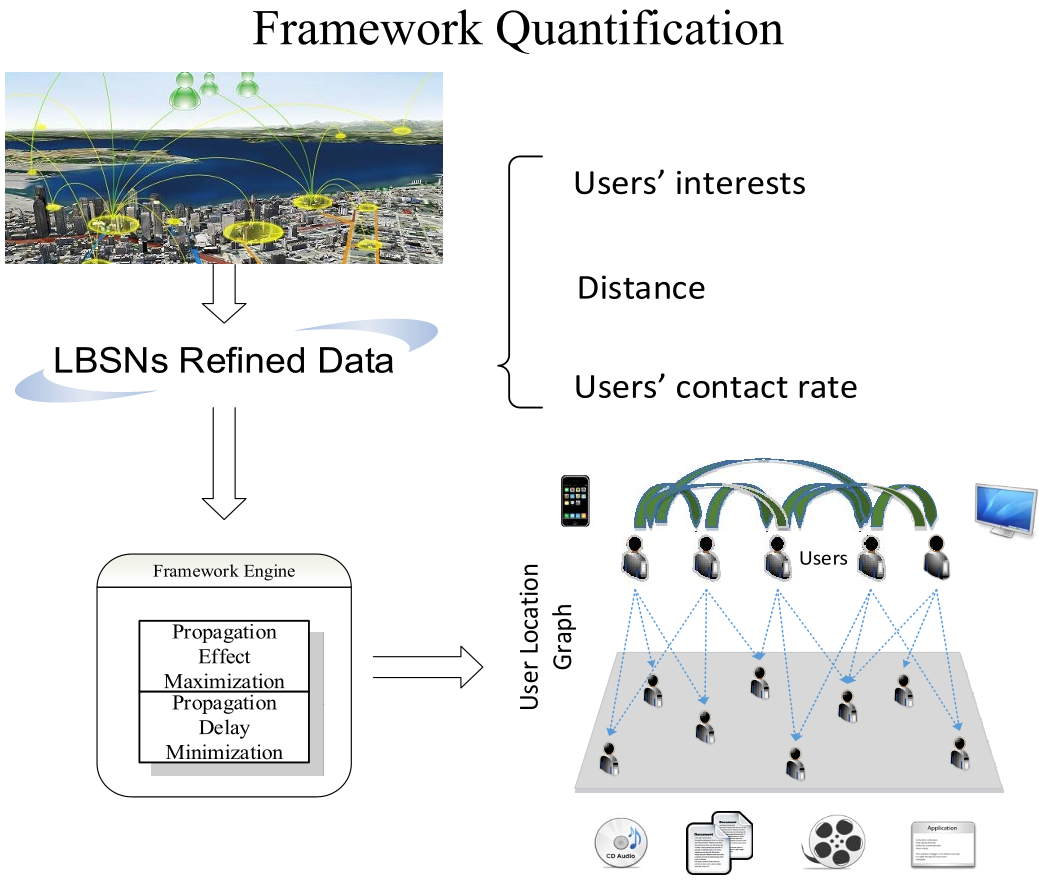 Figure: The proposed analytical framework integrating LBSN datasets with the SA optimization engine.
Experimental Showdown: SA vs. Random Selection
Using the New York City dataset (1,083 users, 227k check-ins), the performance jump was staggering.
1. Effectiveness and Speed
The SA-based selection consistently outperformed random selection across all content categories. For a popular tag like "Gym/Fitness Center," the propagation effect scales linearly with the number of holders, but the SA approach stays significantly more efficient.
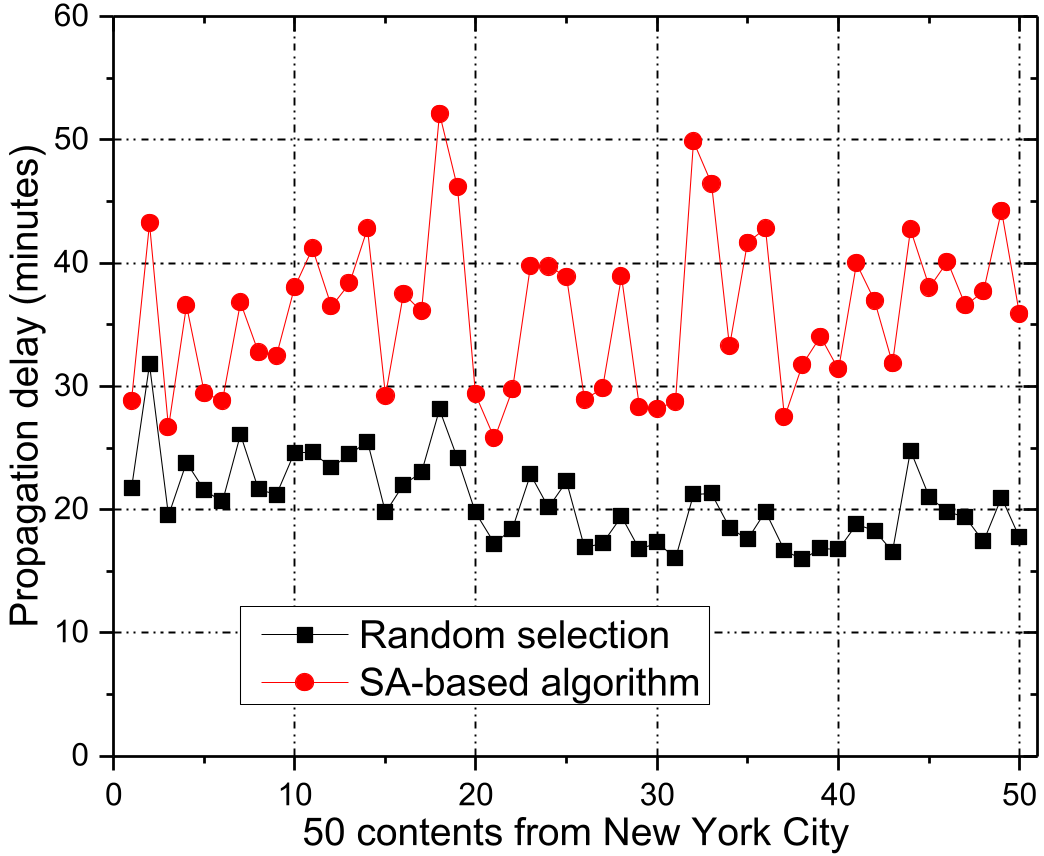 Figure: Propagation delay comparison. The SA algorithm maintains a stable, low latency even as content popularity shifts.
2. The Relationship Between Effect and Delay
A fascinating finding in the paper is that optimizing for minimum delay also yields about 85% of the maximum possible effect. This suggests that distance-sensitive optimization (speed) naturally captures the social clusters needed for broad propagation.
Critical Insight & Future Outlook
While the paper demonstrates a clear win for social-aware propagation, it acknowledges a few hurdles:
- Dynamic Privacy: As the authors note, the system relies on users being willing to share check-in data.
- Security: Malicious nodes could drop packets. Future research must integrate trust models into the SA objective function.
Takeaway: The transition from 4G to 5G/6G isn't just about faster radios; it's about smarter content placement. By understanding the "social trajectory" of a user, networks can offload data to the edge before the user even knows they want it.
Conclusion
This work translates the messy, stochastic nature of human movement into a rigorous mathematical framework. It proves that metaheuristics like Simulated Annealing, when fed with high-quality social metadata, can solve resource allocation problems that traditional routing protocols cannot touch.