
ResNel: High-Precision Content Sharing Prediction via Probabilistic Tensor Learning
Content Sharing Prediction for Device-to-Device (D2D)-based Offline Mobile Social Networks by Network Representation Learning
The paper introduces ResNel, a probability-scored tensor factorization model designed for Content Sharing Prediction (CSP) in offline Device-to-Device (D2D) Mobile Social Networks. By leveraging multi-dimensional relations and geographic data (GPS), it maps users and interactions into a low-dimensional embedding space.
TL;DR
With the massive explosion of cellular data, offline Device-to-Device (D2D) communication has become a vital strategy to alleviate backbone traffic. This paper proposes ResNel, a network representation learning model that treats multi-dimensional social interactions (like shared App types and geographic proximity) as probabilities within a 3D tensor. By moving beyond simple binary "connected or not" logic, ResNel achieves up to 7x improvement in prediction accuracy on real-world large-scale datasets.
Problem & Motivation: The "Blind Spot" of Binary Links
In the context of offline Mobile Social Networks (MSNs), sharing a file isn't just a random act—it is driven by interest (what you share) and friendship/proximity (who is near you).
Traditional Network Representation Learning (NRL) methods like DeepWalk or node2vec face two significant hurdles in this scenario:
- Semantic Loss: They treat an edge between two users as a 1 or 0, ignoring what was shared (e.g., a communication app vs. a game) and where it happened.
- Scenario Mismatch: Most models are benchmarked on online services (Twitter, YouTube), where distance doesn't matter. In D2D, physical proximity is the ultimate filter.
The authors' insight is simple yet powerful: if we can represent users and their multifaceted interactions (App types + Location) in a unified, probabilistic latent space, we can predict future sharing behavior with far greater precision.
Methodology: Probability-Scored Tensor Factorization
ResNel's core innovation lies in its structured representation of social data.
1. The 3D Relational Tensor
Instead of a flat adjacency matrix, the authors construct a third-order (3D) tensor where the dimensions represent (Sender, Receiver, Relation). Relations include 48 categories of Apps and a 49th critical slice: GPS Similarity.
2. From Binary to Probability
Standard RESCAL factorization uses binary values. ResNel introduces a logistic sigmoid scoring function: This transforms the interaction into a valid probability , allowing the model to distinguish between highly likely "true" links and "malicious" or "accidental" noise.
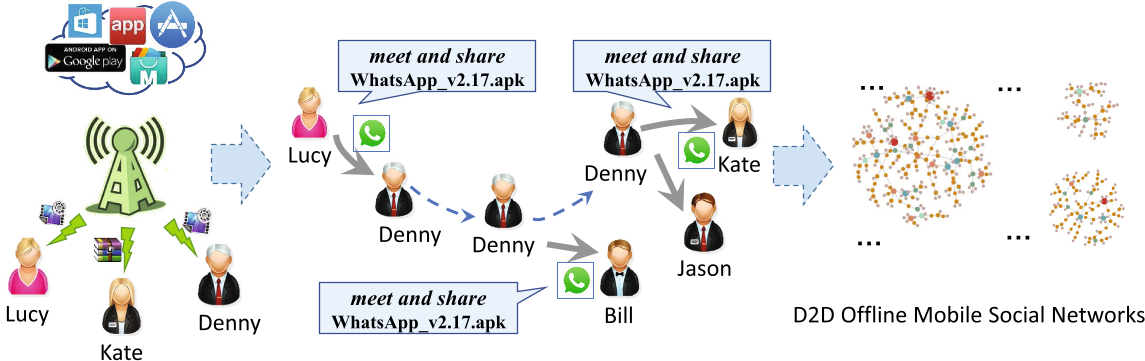 Figure 1: The framework of multi-relational sharing in D2D networks, showcasing how entities interact via different content types and geographic slices.
3. Incorporating GPS via DBSCAN
To handle the "spatial homogeneity" of offline links, the authors used DBSCAN to cluster raw GPS coordinates into 5,590 functional zones. They then calculated geographic cosine similarity, effectively making "being in the same place" a learnable feature for the model.
Experiments & Results
The model was tested against state-of-the-art baselines like RESCAL, TransNet, and DeepWalk using the Xender dataset (64,028 transmissions).
Key Performance Indicators:
- MRR (Mean Reciprocal Rank): ResNel outperformed all baselines by a factor of 3 to 7. While baselines struggled to exceed 0.2 MRR, ResNel peaked at 0.704.
- Hits@k: The model showed incredible stability. While other models saw a sharp rise between Hits@1 and Hits@10 (suggesting their top guess is often wrong), ResNel held a high, steady accuracy, indicating that the correct prediction is almost always at the very top of the list.
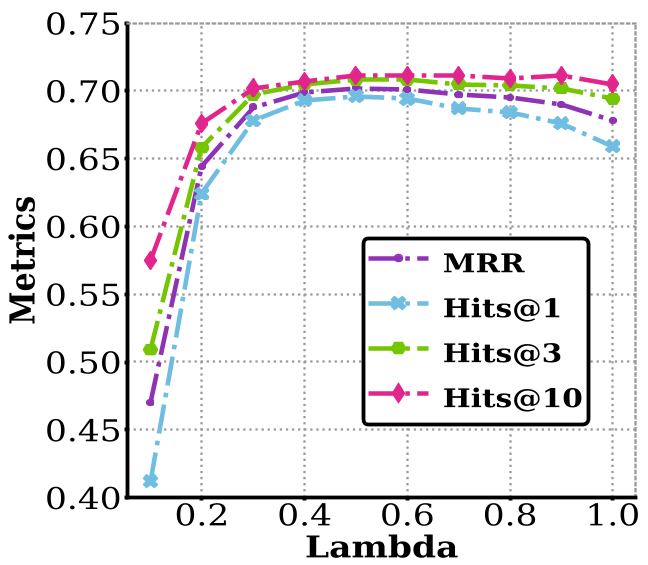 Figure 2: Performance comparison across MRR and Hits@k metrics, highlighting ResNel's dominance over traditional NRL and Translation-based models.
Sensitivity Analysis
The authors found that the model stabilizes once the embedding size reaches 40-50 and the regularization parameter . This suggests a "sweet spot" where the model is complex enough to capture social nuances without overfitting the sparse D2D data.
Critical Insight & Conclusion
ResNel proves that geometry and semantics are inseparable in offline networks. By mathematically bridging the gap between social relationships and physical location via tensor factorization, the paper provides a roadmap for more efficient edge computing and proactive content caching.
Limitations: The model currently relies on semi-static geographic clusters (DBSCAN). Future iterations would benefit from dynamic, time-aware mobility embeddings to capture the "mobile" in Mobile Social Networks.
Future Work: This framework could potentially be extended to Federated Learning environments, where tensor slices are updated locally on user devices to preserve privacy while maintaining high prediction accuracy.