
Beyond Mere Contact: Leveraging Social Context for High-Efficiency Information Influence
Context-aware communities and their impact on information influence in mobile social networks
2012-03-01
Summary
Problem
Method
Results
Takeaways
Abstract
The paper introduces a "Context-Aware Community" framework for Mobile Social Networks (MSNs) that integrates spatial-temporal data (Points of Interest) with physical contact history. It proposes a directed weighted influence graph and a community-based participation strategy to optimize information diffusion, achieving higher influence efficiency than traditional barter-based or "always influence" models.
## Executive Summary
**TL;DR**: This paper argues that who we talk to is only half the story in mobile networks—*where* and *when* we met them determines the value of the information shared. By introducing **Context-Aware Communities**, the authors move beyond simple contact-based clustering to create a distribution model that achieves high information reach with significantly lower redundancy than baseline "Always Influence" strategies.
In the ecosystem of Mobile Social Networks (MSNs), this work serves as a vital bridge between pure mobility modeling and practical information dissemination, demonstrating that social context is the key to managing the "selfishness" and resource constraints of mobile devices.
## Problem & Motivation: The Context Gap
In a typical campus or urban environment, we encounter dozens of people daily. Traditional MSN research groups these people into communities based on **Contact Frequency**: if User A and User B are often in Bluetooth range, they belong together.
However, the authors point out a fatal flaw in this logic: **Information is situational.** A student leaving a basketball game at a stadium has information relevant to others heading there, but that same student might have nothing of interest to someone they meet in a quiet library five hours later.
Existing methods fail because:
1. They treat all contacts as equal opportunities for sharing.
2. They ignore the "Source" (Point of Interest) and "Freshness" (Time) of the information.
3. They lead to massive communication overhead by sharing redundant data with uninterested peers.
## Methodology: The Influence Graph
The core innovation is the construction of a **Directed Weighted Influence Graph**. Unlike a simple contact graph, this structure records the potential for one user to "influence" another based on their PoI visit history.
### 1. Influence Graph Construction
If User $i$ visits a PoI, they are "infected" with that context. When they later meet User $j$ within a specific "Influence Lifetime" ($T_l$), a directed edge is drawn from $i$ to $j$. The weight of this edge is specific to that PoI, quantifying how many potential sharing opportunities exist.
### 2. Context-Aware Community Detection
The authors use the **Directed Clique Percolation Method (CPMd)**. By applying thresholds to the influence graph, they identify overlapping communities. This allows a single user to belong to a "Gym Community," a "Library Community," and a "Cafeteria Community" simultaneously, reflecting real-world social fluidness.
### 3. Participation Strategy
The model employs an $(\alpha, \beta)$ strategy:
* **$\alpha$ (Intra-community):** High probability of sharing (trusted/relevant).
* **$\beta$ (Inter-community):** Low probability of sharing (selfishness/less relevance).
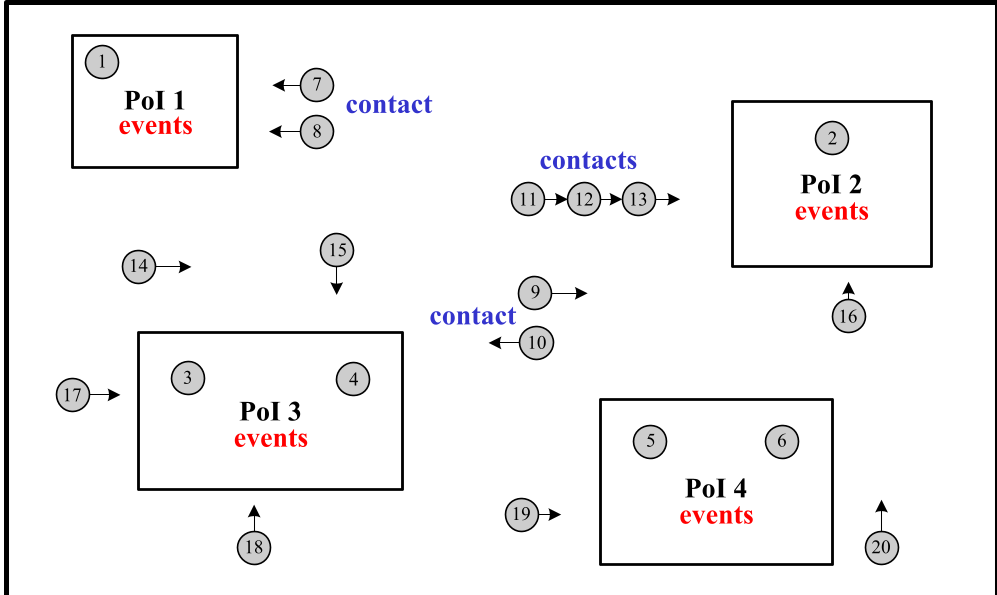
*Fig 1: The interaction between Points of Interest (PoIs) and mobile users forming the context for sharing.*
## Experiments & Results: Efficiency is Queen
Using the **UIM Dataset** (WiFi and Bluetooth traces from UIUC campus), the researchers compared their strategy against **Barter-based** (tit-for-tat) and **Always Influence** (flood) models.
### Key Findings:
* **Internal Pairwise Similarity (IPS):** The context-aware communities showed much stronger internal ties ($0.04-0.055$) compared to random groups ($\approx 0.009$), proving the communities are meaningful.
* **Influence Efficiency:** This is where the method shines. As shown in the results, context-aware sharing achieves a much higher ratio of "Unique Updates Received" to "Total Forwarded Messages."
* **Scalability:** When the user influence lifetime ($T_l$) increases, the gap between this method and Always Influence narrows in terms of reach, but the efficiency remains superior.
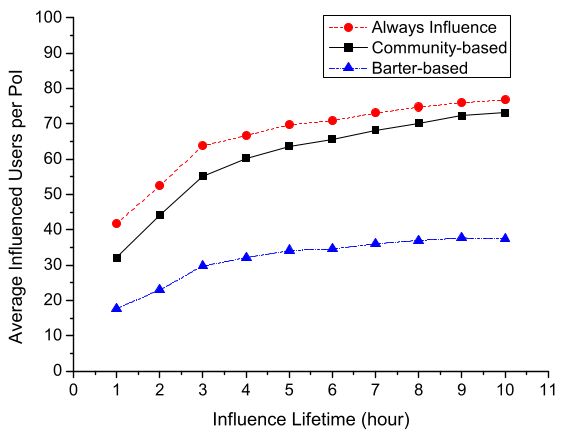
*Fig 2: Influence Efficiency (Ratio of unique updates vs total forwards). The community-based approach significantly reduces overhead.*
## Critical Analysis & Conclusion
**Takeaway**: The "Context-Aware Community" provides a surgical approach to information diffusion. Instead of a "spray and pray" contact model, it identifies the "latent corridors" of information flow created by human mobility patterns.
**Limitations**:
1. **Centralization**: The current community construction requires a central server to aggregate profiles, which may raise privacy concerns.
2. **Homogeneity**: The model assumes all users share the same influence lifetime ($T_l$), which might vary based on individual device battery levels or storage.
**Future Outlook**:
The next frontier for this research lies in **Decentralized Community Detection**, where users can identify their context-aware groups locally without 3rd-party servers, potentially using Zero-Knowledge Proofs to verify context without revealing exact location history.