
RWCFR: Reimaging Friend Recommendation in LBSNs through Context-Aware Random Walks
Context Aware Friend Recommendation for Location Based Social Networks using Random Walk
The paper proposes RWCFR, a Random Walk based Context-aware Friend Recommendation algorithm for Location-Based Social Networks (LBSNs). It utilizes a specialized Random Walk with Restart (RWR) on a dynamically constructed local subgraph to rank potential friends, achieving state-of-the-art performance on Brightkite, Gowalla, and Foursquare datasets.
TL;DR
In the era of Location-Based Social Networks (LBSNs), finding the right "friend" isn't just about who you know, but where you are. The paper introduces RWCFR, a framework that treats friend discovery as a local graph traversal problem. By combining a user's current location, their check-in history, and the opinions of "local experts," RWCFR outperforms traditional popularity and social-link-only models by a wide margin.
Problem & Motivation: The Context Gap
Traditional recommendation systems often view the social graph as a static entity. However, in LBSNs like Foursquare or Gowalla, the relevance of a potential friend changes based on the user's current environment.
The authors identify three major flaws in prior work:
- Lack of Context-Awareness: Many models don't account for the user's current "vicinity," suggesting friends that are geographically irrelevant.
- Data Sparsity: GPS trajectories are dense and hard to process; check-in data is richer but requires sophisticated modeling to find "place friends."
- Structural Rigidity: Collaborative Filtering (CF) and tensor-based methods are computationally expensive to update whenever a new check-in or friend is added.
Methodology: Fusing Social and Spatial Signals
The core innovation of RWCFR lies in its Subgraph Construction phase. Instead of running a Random Walk across the entire, massive LBSN graph, RWCFR builds a "neighborhood" graph specifically for the user's request.
The Subgraph Ingredients
RWCFR populates its subgraph with:
- Personal Spatial Context: Locations the user has visited in the current region.
- Social Context: Friends and "friends of friends."
- Place Friends: Strangers who have visited the same locations as the current user.
- Local Experts: High-knowledge users identified via a HITS-based (Hyperlink-Induced Topic Search) algorithm, where locations are "authorities" and users are "hubs."

Ranking via Random Walk with Restart (RWR)
Once the subgraph is built, the algorithm initiates a Random Walk starting from the current user node.
- The Restart Mechanism: In each step, there is a probability to jump back to the starting user. This ensures the random walk stays "anchored" to the user's specific context and doesn't wander into irrelevant parts of the graph.
- Efficiency: Because the subgraph is small, the algorithm reaches a steady state (convergence) rapidly.
Experiments & Results
The authors tested RWCFR against three baselines (Popularity-based, Friend-based, and Expert-based) using datasets from Brightkite, Gowalla, and Foursquare.
Performance Gains
The results were conclusive: RWCFR consistently achieved higher Precision and Recall.
- Expert-based (EBFR) was the strongest baseline, confirming that "Local Experts" are a powerful signal for discovery.
- Friend-based (FBFR) performed poorly whenusers had few friends, highlighting the "cold start" social problem that RWCFR solves by using location history.
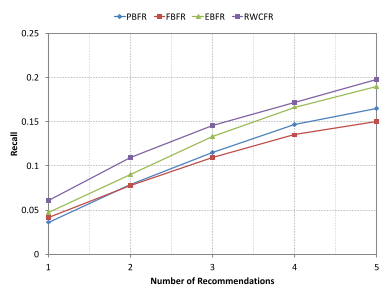
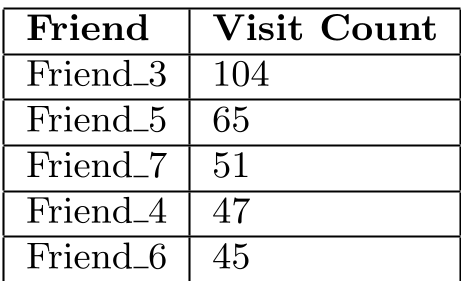
Table 1 from the paper shows a typical ranking output where Friend_3, having the highest visit count, becomes the top recommendation.
Critical Insight & Conclusion
The genius of RWCFR is its Hybrid Inductive Bias. It acknowledges that friendship in the physical world is a blend of "triadic closure" (friends of friends) and "homophily" (sharing similar interests/places). By dynamically constructing subgraphs, the authors maintain a system that is both highly accurate and horizontally scalable.
Limitations: While context-aware, the model relies on a "circular vicinity" (fixed radius). In real-world urban environments, "distance" is often better measured by transit time or neighborhood boundaries rather than raw meters—a potential avenue for future Graph Neural Network (GNN) integrations.