
Social-Aware D2D: Redefining Emergency Alerting in 5G Networks
Context-Aware Information Diffusion for Alerting Messages in 5G Mobile Social Networks
This paper proposes a context-aware information diffusion framework for 5G mobile social networks, specifically designed for emergency alerting. It leverages Device-to-Device (D2D) communications and a novel "social intercontact time" metric to optimize the dissemination of composite data collected from IoT environments to end-users.
TL;DR
In emergency scenarios, every second counts. This paper introduces a framework that optimizes Information Diffusion by combining the physical proximity of 5G D2D links with the social patterns of human users. By moving away from rigid "one-size-fits-all" multicasting and towards a flexible, social-aware hierarchy, the authors achieve a 50% faster dissemination rate for critical alerting messages.
Problem & Motivation: The "Slowest Passenger" Bottleneck
In standard cellular multicasting (CMS), the Base Station (eNodeB) must transmit at a rate that the user with the weakest signal can handle. This is the "slowest passenger" problem—even if 90% of users have perfect signal, they are forced to wait for the 10% at the cell edge.
Furthermore, technical models often assume that data is "forwarded" the instant it is received. In reality, human behavior introduces a delay: the Social Intercontact Time. People do not check their social apps constantly; there is a stochastic gap between receiving a message and interacting with it to spread the word.
Methodology: Bridging the Gap with Social Clusters
The core innovation lies in the Socially-Enhanced Hierarchical Structure. Instead of the eNodeB trying to reach everyone simultaneously, it selects Primary Bridge Nodes (PBNs)—users with excellent cellular links—to act as local data hubs.
The Secret Sauce: Social Intercontact Time ()
The researchers modeled the serving time for a user as: Where is the physical transmission time and is the human-induced social delay. By accounting for this, the eNodeB can more accurately predict which users will be the most effective "bridges" for others.
1. The Architecture
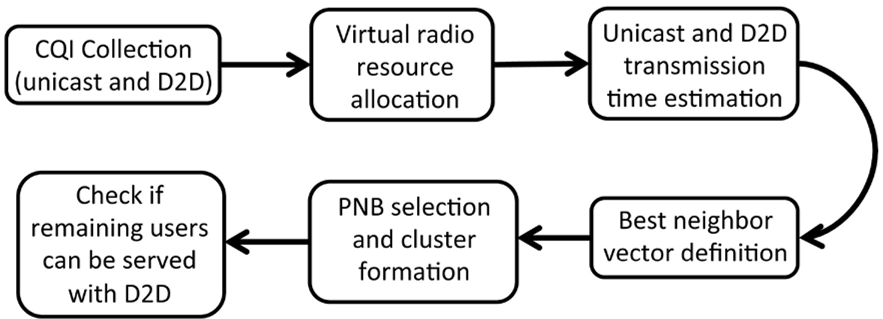
The system follows a 5-step workflow:
- Estimation: The eNodeB calculates potential D2D speeds and social delays for all users.
- Clustering: Users choose their "Best Neighbor" (either the eNodeB or a high-speed peer).
- MSC Formation: Users with many followers become PBNs, forming Multicast Social Clusters.
- Resource Pooling: PBNs take the "virtual" radio resources that would have been assigned to their followers, using that massive bandwidth to download the message instantly from the eNodeB.
- D2D Diffusion: PBNs relay the message via short-range D2D to their neighbors.
Experiments & Results: Slashing Latency
The framework was tested in a 500m radius LTE-A femtocell environment. The benchmarks were clear:
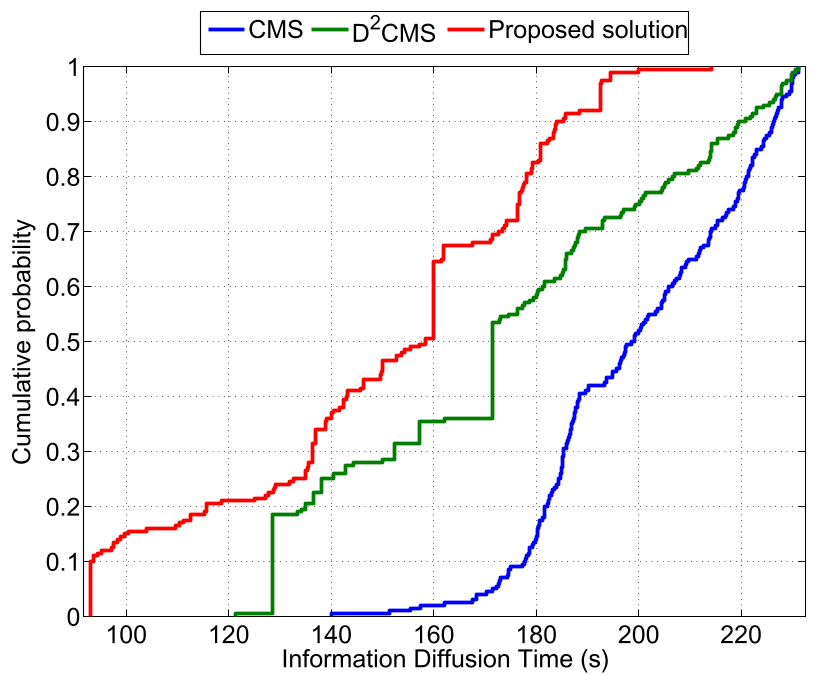
- Latency: The total diffusion time was halved (50% gain) compared to standard multicast.
- Fairness: Using the Jain’s Fairness Index, the proposed method ensured that most users received information within a similar timeframe, reducing the "social isolation" of cell-edge users.
- Energy Efficiency: Short-range D2D links require significantly less power than long-range cellular links, resulting in a more sustainable network during disasters.
Critical Insight: The Human-in-the-Loop Network
What makes this work stand out is its Inductive Bias toward human behavior. In 5G and early 6G research, we often obsess over dBm and bits/Hz. This paper reminds us that in a Mobile Social Network, the human is part of the infrastructure.
Limitations & Future Work
- Trust & Incentive: In a real disaster, would a user allow their phone's battery to be used as a "Bridge Node" for strangers? The paper assumes cooperation, but future iterations would need a Game Theoretic Incentive Mechanism.
- Mobility: The study uses static/semi-static snapshots. High-speed mobility (e.g., users running during an emergency) remains a challenging frontier for D2D cluster stability.
Conclusion
By integrating context-awareness and social metrics, the authors have provided a blueprint for more resilient public safety networks. This "Social-D2D" paradigm shift ensures that 5G is not just about faster Netflix streaming, but about building a "connected reality" that can save lives when the stakes are highest.