
Intelligent VSNs: Bridging Social Context and Mobile Crowdsensing
Torwards Context-aware Mobile Crowdsensing in Vehicular Social Networks
This paper introduces a framework for context-aware mobile crowdsensing in Vehicular Social Networks (VSNs), featuring the Application-oriented Service Collaboration Model (ASCM) for task allocation and the Context-aware Semantic Service (CSS) for dynamic service matching. The work achieves substantial improvements in task execution efficiency and matching accuracy for vehicular environments.
TL;DR
With the global average driving time rising to 84 minutes daily, vehicles have become a primary hub for social and sensing activities. This paper presents a dual-layered approach to Vehicular Social Networks (VSNs): ASCM for intelligently matching participants to sensing tasks, and CSS for ensuring these services remain relevant as driver contexts change. The result is a system that is 6x faster than previous benchmarks while maintaining high adaptability.
Problem & Motivation: The Dynamic Chaos of the Road
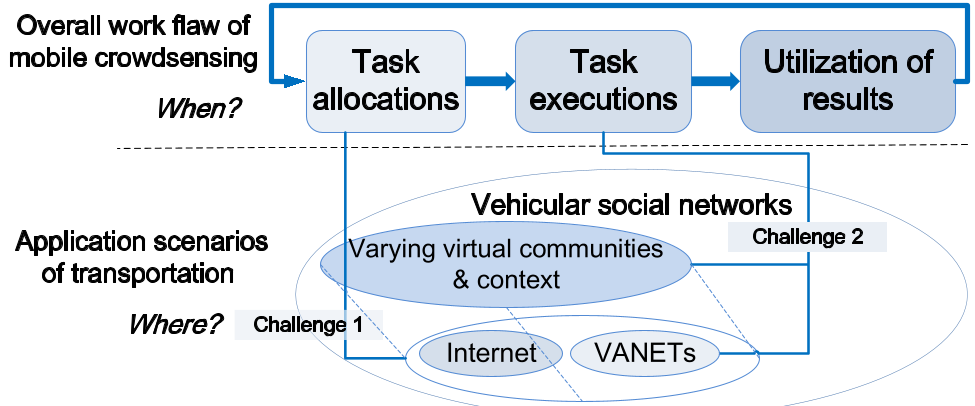
Mobile crowdsensing in a vehicular environment isn't just about collecting data; it's about doing so amidst high-speed mobility and shifting social ties. Existing solutions face two "dead ends":
- Inefficient Allocation: Most systems randomly assign tasks or use simplistic social grouping that ignores the specific skills or real-time positions of drivers.
- Semantic Rigidity: Traditional "keyword-based" matching breaks down when a user's destination or status is described differently across platforms.
The authors' insight is that we must quantify social relationships and use lightweight semantic reasoning to bridge the gap between human social behavior and machine task execution.
Methodology: ASCM and CSS
1. ASCM: Intelligent Task Allocation
The Application-oriented Service Collaboration Model (ASCM) moves away from random matching. It uses a Social Vector to model:
- User context (device capacity, history).
- Task context (requirements, urgency).
- Social distance between participants.
2. CSS: Semantic Context Awareness
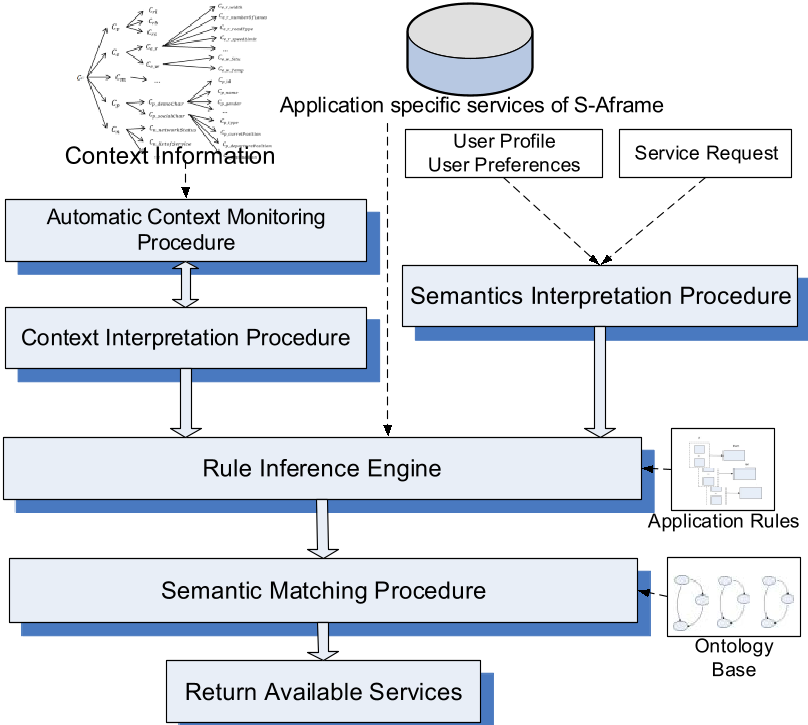
To handle the "virtual community" changes in VSNs, the Context-aware Semantic Service (CSS) employs labeled links and ontologies. Unlike heavy desktop-based semantic systems, CSS is designed to be lightweight, allowing mobile devices to perform rule inference locally. This enables the system to "understand" that a driver looking for a "ride-share" and another offering a "carpool" are searching for the same thing, even if the keywords differ.
Experiments: Speed and Accuracy
The authors validated their work using the Vita platform and prototype apps like Social Drive and SafeDJ.
Quantitative Performance
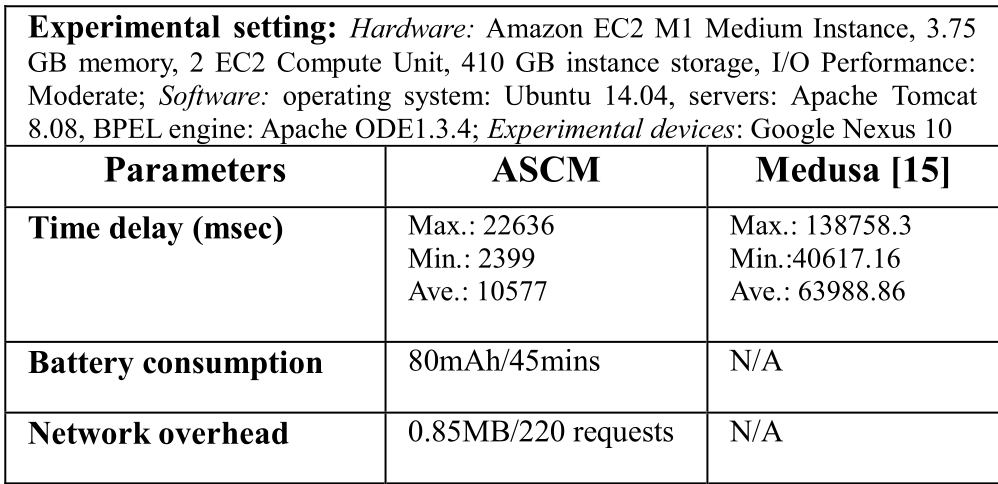
In comparisons with Medusa, the gold-standard benchmark at the time, ASCM showed a massive reduction in latency. By utilizing a RESTful architecture and intelligent allocation rather than SMS-based triggers, the average delay dropped from ~64 seconds to ~10 seconds.
Qualitative Utility
In the Smart Ride case study, the CSS model returned significantly more relevant results than keyword matching. By adjusting the semantic threshold (0.5 to 0.75), the system proved it could provide flexible options to users in sparse data environments—a critical feature for real-world deployments where a "no results found" screen is a failure.
Critical Analysis & Conclusion
This paper provides a robust foundation for Context-aware VSNs. The transition from keyword-based systems to semantic-aware agents is a necessary evolution for the Internet of Vehicles (IoV).
Strengths:
- Superior latency reduction through architecture optimization.
- Creation of a generic evaluation platform (Vita).
Limitations:
- While the semantic links are "lightweight," the paper does not extensively discuss the energy trade-offs of continuous ontology reasoning on older mobile hardware.
- Future work must address the privacy implications of sharing "Social Vectors" (e.g., location history and device capacity) in a public crowdsensing environment.
Final Takeaway: For VSNs to be viable, they must be as social as they are technical. This work successfully treats drivers not just as moving sensors, but as context-rich social entities.